Is Bigamy ground for Annulment? - Lawyers in the Philippines


Is bigamy a reason to get an annulment in the Philippines?
Not quite—but it’s a common mix-up and totally understandable.
Bigamy happens when someone gets married even though they’re already legally married to someone else. In Philippine law, that second marriage is considered void from the start—it’s like it never legally existed.
So instead of filing for annulment, which applies to marriages that were valid but flawed, you file a petition to declare the marriage null and void.
Both annulment and nullity involve going to court to end a marriage, and the process can look very similar. That’s why many people mix them up. But legally, they’re different.
If your spouse was already married when he married you, then your marriage is bigamous and void. You can go to court, show proof of the earlier marriage, and ask the judge to officially declare your marriage invalid.
In the sections below, I’ll explain what a bigamous marriage is, how to end it legally, and answer common questions people ask about this situation.
For the sake of this article, let’s just use “annulment” to refer to both annulment and declaration of nullity, so it’s easier to follow.

Send us an email with the details for
personalized recommendations or schedule a consulation if needed.

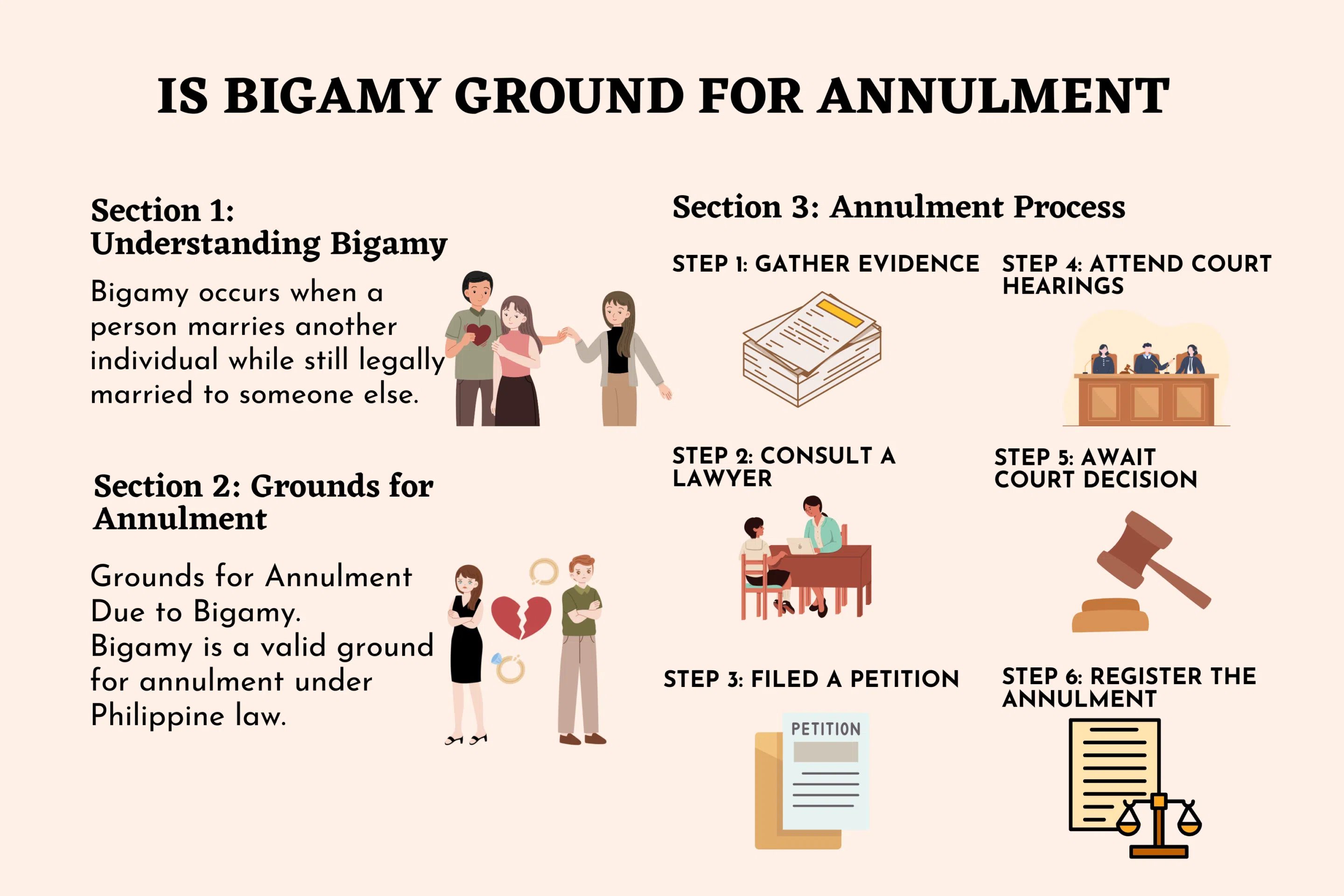
Bigamy occurs when an individual enters into a marriage with one person while still being legally married to another individual.
Bigamy can be used to file a criminal complaint as per the Revised Penal Code.
But is bigamy ground for annulment or nullity of marriage?
The answer is Yes. Bigamy can also be used in an annulment/nullity of marriage case as a ground to end a marriage.
Bigamous marriages are marriages when one spouse is still legally married and these are void from the outset. This is further emphasized by the Supreme Court case Niñal vs. Bayadog [4] which said that that our civil laws, past or present, absolutely prohibited the concurrence of multiple marriages by the same person during the same period. Any marriage subsequently contracted during the lifetime of the first spouse shall be illegal and void.
However, while a bigamous marriage is not legally valid, you must still file formal annulment through judicial action to dissolve it officially.
In this article, I focus on how to end such a marriage. I do not discuss criminal cases for bigamy here as this is a separate and involved topic.
There are several real life implications of bigamy.
Consider a situation in which Maria finds out that her husband, Juan, was already married to someone else at the time of their wedding.
Maria’s marriage is actually void.
Maria’s children are actually illegitimate.
Furthermore, Maria and her children have less rights to the property of Juan.
This situation can be very difficult for all concerned parties, and Maria may choose to file for annulment on the grounds of bigamy.
If she does file, the the court will request documentation, including Juan’s Certificate of No Marriage (CENOMAR), to validate her allegations.
This legal process not only terminates her marriage but also addresses critical issues such as property distribution and the status of children that I’ve itemized above.
When these are not addressed, confusion and difficulty can arise due to competing claims to conjugal property.

Get your partner’s CENOMAR to check his marital status.
If you want to confirm whether or not you are in a bigamous marriage, you should obtain your spouse’s Certificate of No Marriage (CENOMAR) from the Philippine Statistics Authority (PSA).
The CENOMAR is a certification stating that a person has not contracted any marriage. It is also called a certificate of No Record of Marriage or Certificate of Singleness.[5]
The CENOMAR lists all the marriages under the name of a person.
From there, you can now countercheck whether or not he was already married at the time of your marriage.
You can order a CENOMAR in person or online and have it delivered to you.

Online requesting of PSA documents is recommended, as this is easy to do.
Personal application
- Go to the nearest PSA office.
- Bring two (2) ID’s and money for the fees.
- Fill up the form and include the information of the person you are checking.
- Wait a day or two and pick up the form.
- Note that only the court, spouse, children, parents or guardian can obtain the CENOMAR. This widens to the nearest kin if deceased.[6]
Online Application
- Go to the PSA website.
- Fill up the online application.
- Note that you will only be able to receive the delivery if you are the spouse, child, parent or guardian of the person involved. An SPA can also grant you authority to obtain the document.
- This takes about a week and currently costs Php 330.00

The innocent spouse can file anullment based on bigamy
If your spouse’s CENOMAR shows he was already married at the time of your marriage, then your marriage is void.
You may file for annulment based on bigamy if you are either the husband or the wife. You can file anytime during your lifetime.
You may also file if you are an heir and the parties are deceased.

Filing an annulment case will cost you some resources so make sure you have everything right before the big day.
You must file an annulment case in the Family Court of the province or city where you or your spouse have resided at least six months prior to the date of filing. [7]
If your spouse is not a resident of the Philippines, the case can be filed in the Philippine city or municipality your spouse may be found.
It is best to comply with the laws on where to file your case.
If you file in a city you do not reside in, the court may require you to refile your case. This costs you additional time and money.

Filing an annulment case is a serious business.
First, you’ll need to work with your lawyer to create your petition.
He will need some general information and a narration as to why the marriage failed. He will need proof and documentation. In addition, he may want to attach your psychological assessment and facts from your witnesses. All this will go into the petition, which is why it often takes time to prepare.
After the petition is complete your lawyer will file it in court.
Then, he will comply with the other legal requirements so that the case can proceed to trial.
Trial includes your testimony, the psychologist’s testimony and those of your witnesses.
The court then deliberates on the case and releases a decision.
There are a few effects to filing a case based on annulment:
- Legal end of marriage
- Property division
- Children’s custody and status
Let’s discuss this one by one.
Legal End of Marriage

Annulment makes a person regain his/her single status as if he/she has not been married.
A successful annulment means that your marriage has legally ended.
The practical effects to this are:
- You may use your maiden name on all documents, including your passport.
- Your civil status is single, which may be needed for fiance visa purposes and remarriage.
- Your husband will no longer have any spousal rights with regards to you.
Many people believe if the marriage was bigamous there is an automatic end to the marriage.
They say they no longer need to go to court.
This is incorrect.
Only the court can legally end the marriage.
Without court, you will remain married.
Property Division

Only the court can decide how the property will be disposed
Annulment means that your spouse no longer has a right to your property.
Furthermore, if your annulment was due to bigamy, there is a distinction between innocent and guilty parties.
If the court declares one party guilty, his share will be given to his children.
If there are no children of that marriage, his share will be given to his children of the previous marriage.
If there are no children of the previous marriage, his share will be given to the innocent spouse of the previous marriage. [ Art 143, Family Code]
Otherwise, your conjugal property will be divided between you.

The conjugal property has to be divided no matter what the reasons are.
Property rights are a major reason many go through Annulment.
A successful annulment means that your spouse has no share in any property you have. It also means that he cannot inherit from you. More practically, he no longer needs to co-sign for any mortgages or bank loans for property and his name no longer appears on the title.
Some people say that their spouse should no longer have any say in their property since they have already been separated for many years, because the marriage was void, because they didn’t contribute any money to buying the propert, or some other reason or another.
No reasons are valid.
If you are legally married, your spouse has a share in your property.
Children’s Custody and Status

The court decides on the best interest of the children
When a marriage is ended based on bigamy, it has the following effects on children:
- Children become illegitimate [GR 105619, Dec 1995]
- Children’s custody and support are ironed out by the court.
Many don’t understand the legal impact of a child being legitimate or illegitimate.
Among the most important are inheritance rights. A legitimate child will receive a larger inheritance than an illegitimate child in most situations.
Another issue that annulment tackles is the custody and support of the children.
The court decides who the children live with in case you and your spouse cannot come to an agreement.
The court decides in the best interest of the child, taking into account all considerations. [G.R. 115640, Mar 1995] It also define visitation rights for the parent without custody. [Art 43, Family Code of the Philippines]

Registration of the court decree in the Civil Registry System and Local Civil Registry is also a bureaucratic requirement.
What you do after the court decision depends on what the court decision is.
- File the Court Order with the PSA if the Courts grants the annulment.
- Refile if the case was dismissed. However, not that you cannot refile if the case was denied on its merits.
Let me explain a little bit.
Say that your annulment has been granted.
The information must be reported to the PSA for them to make the necessary changes.
For the PSA to do this, the court decision must be registered with the PSA. Otherwise, it will not take effect and a subsequent marriage would still be void. [Art 52 & Art 53, Family Code of the Philippines]
Registering with the PSA is a detailed and confusing process. However, it can be done on your own with sufficient time and effort.
Now – what do you do when your case is denied?
In some situations, the case can be refiled or appealed.
However, it cannot be refiled when a case is denied on its merits.
When a case is denied on its merits, the court has decided that the grounds are insufficient and the petition has no value.
In such a situation, the annulment is not granted and you remain married.

Around 6% of annulments are denied because the case fails to prove the claims of the petition.
It could be that the proof presented is weak.
It could also be that the case was incompletely laid out. Perhaps the petition missed a crucial argument [G.R. No. 141528, Oct 31, 2006] or that it contradicted a later allegation. It could mean insufficient proof was given.
In some situations, there are factors beyond anyone’s control. This may be as extremely high standards of evidence by the court.
Remember –
If your case was denied on its merits, then it cannot be refiled again.

Pick a trusted lawyer that can help you through your annulment case.
If you married someone already married, you must still go to court to end the marriage and marry again.
It may take 2-3 years for an annulment based on the grounds of bigamy if it is uncontested and proof is sufficient.
An annulment based on bigamy means that:
- Your children will be illegitimate
- The Court will help determine custody and support of the children
- The Court will separate your properties so that your spouse no longer has any claim to your property.
- You can remarry and use your maiden name in all documents, including your passport.
Be careful when you go through the annulment process.
Stay away from fixers promising “quickie” annulments.
An annulment can be invalidated, dismissed or denied when shortcuts are taken.
Much of the work will be done by your lawyer so it is important to pick someone dependable.
Atty. Francesco C. Britanico
[1] Merriam-Webster website. Retrieved from https://www.merriam-webster.com/dictionary/bigamy.
[2] Article 349.
[3] Article 35.
[4] G.R. No. 133778, 14 March 2000.
[5] Philippine Statistics Authority Website. Retrieved from https://psa.gov.ph/civilregistration/requesting-civil-registry-document/cenomar.
[6] PSA Office Memorandum No. 2017-050.
[7] A.M. No. 02-11-10-SC, Sec. 4
1 What documents are required for filing annulment due to bigamy?
To file for annulment based on bigamy, you will need your marriage certificate, your spouse’s CENOMAR, and any other pertinent documents that prove the existence of the previous marriage.
2 How long does the annulment process typically take?
Generally, an uncontested annulment can take anywhere from 2 to 3 years, with the timeline largely depending on court availability and the complexity of the case.
3 Can children from a bigamous marriage be legitimized?
Under Philippine law, children born from a bigamous marriage are regarded as illegitimate, which can impact their rights to inheritance.
4 What is the punishment for bigamy?
If a criminal case is filed, bigamy can result in imprisonment from 6 years and 1 day to 12 years.
Criminal prosecution is not an automatic effect of filing for annulment based on bigamy, as a criminal case must still be instigated.
5 How much is bail for bigamy in the Philippines?
Yes, bigamy is a bailable offense, and bail is usually set at maximum years for the Bigamy Penalty Philippines, multiplied by 6,000. For further information, please see this link.