Setting Up Your Business in the Philippines: Key Steps and Considerations - Lawyers in the Philippines
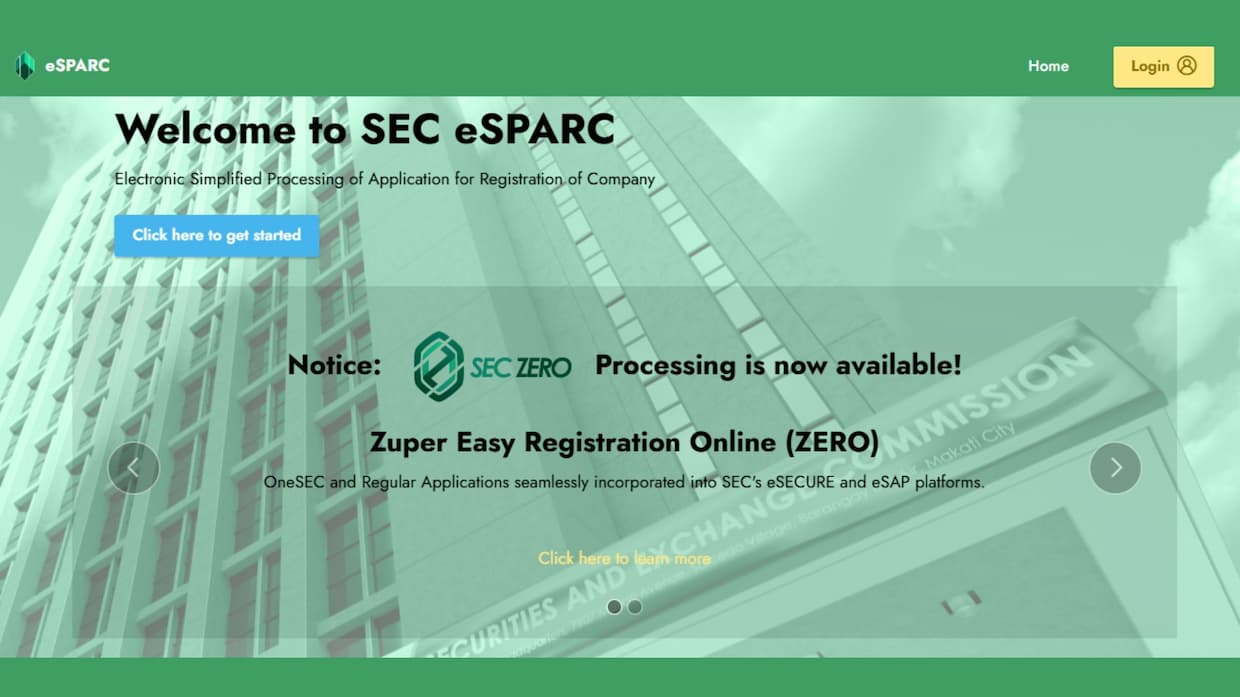

Thinking of starting a business in the Philippines?
Proper registration is the first and most crucial step to ensuring legal operation and avoiding penalties.
In this article, we will discuss the step-by-step of the registration process, key requirements, and important legal considerations for businesses in the Philippines

Send us an email with the details for
personalized recommendations or schedule a consulation if needed.
The first step in the Philippines business registration process is determining the type of business entity you want to set up.
Your business entity will determine what the business can and cannot do.
Each business type is governed by separate legal requirements and has different registration needs.
In the Philippines, businesses can operate under various structures depending on their ownership, objectives, and whether they are domestic or foreign entities.
There are many ways to categorize companies, but I’ve separated them into domestic and foreign business structures for ease of understanding.
Business Registration Philippines: Domestic Business Structures
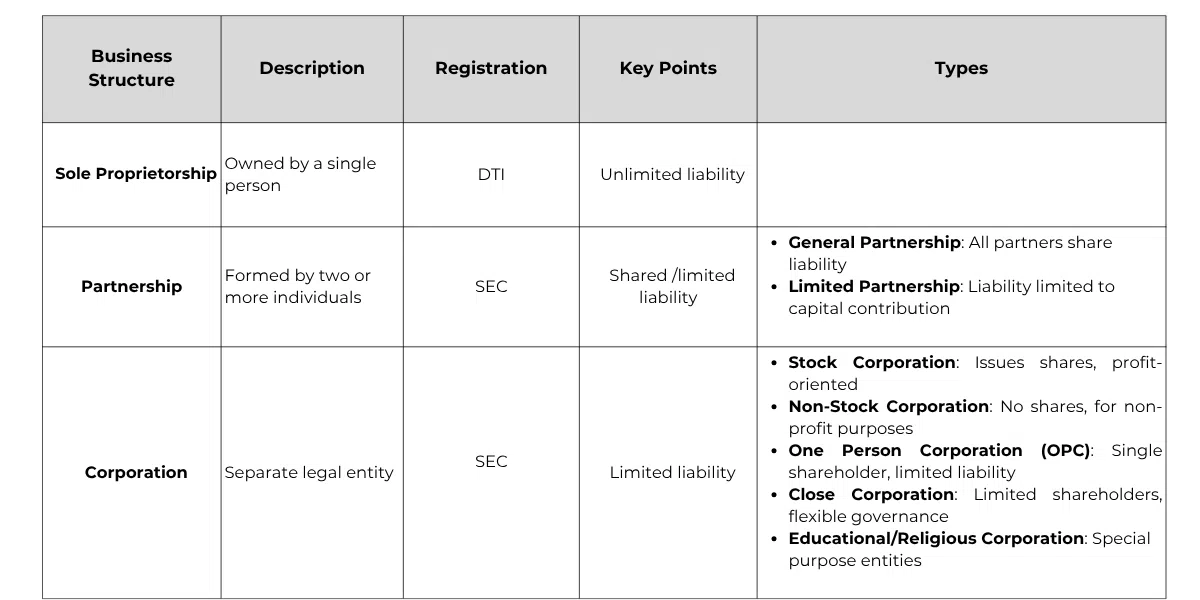
Choosing the right business structure in the Philippines is very crucial as it affects your taxes, liability, ownership rules, and long-term growth opportunities.
Domestic business structures are incorporated under Philippine law.
There are several different options, with differing levels of liability.
They also have different governance mechanisms, from very simple sole proprietorship operations to the more complex corporations with a full board.
The type of business you are setting up, how much you value limited liability, and your goals and situation will dictate which entity is appropriate for you and a thorough analysis of your situation is important so that the correct entity is incorporated.
While domestic corporations are incorporated under Philippine law, foreign businesses who set up shop in the Philippines can choose to operate in the Philippines under a license to do business in the Philippines.
Below is a list of foreign business licenses available.
Business Registration Philippines: Foreign Business Structures
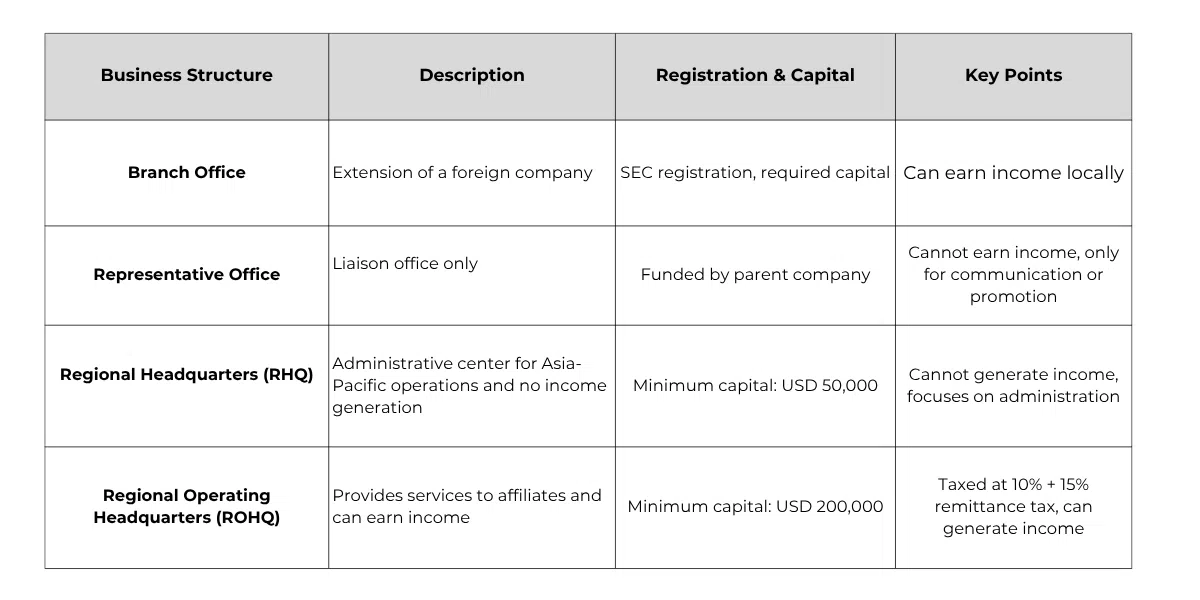
Foreign companies use special structures to legally run their business in the Philippines and access local customers.
Foreign business structures are licenses to do business in the Philippines formed by entities incorporated under foreign law.
These structures are essentially extensions of the foreign parent.
As such, they have some unique traits – for instance, they are fully foreign owned and controlled and liability extends to the foreign parent.
These types of licenses are also popular options as they offer international companies an easy way to operate in the country while still maintaining full control.
Aside from domestic and foreign structures, there are other ways to classify corporations which may deal with the type of work that they do, such as educational and religious corporations or their ownership, such as public corporations.

A lawyer explaining to his businessman client the process of business registration in the Philippines
Step 1: Secure Business Name Registration
- Once you have determined what type of entity is best for your business, you will need to choose a name for it.
- This may seem trivial, but your business name is an important branding tool, and you will undoubtedly want to choose something that will attract customers and be marketable.
- Your business name will also need to conform to Philippine regulations.
- This law requires all entities, whether domestic or foreign, to have a business name that is not already in use and registered with the governed agencies (DTI, NTC, or SEC).
- For Sole Proprietorship register with Department of Trade and Industry (DTI)
- Corporations and Partnerships register with Security Exchange commission (SEC)
- It is important to remember that an entity shall NOT be allowed to register a name that is already in use by a different entity.
- The Philippines business registration process can be somewhat detailed as there are many documents and it is not fully online, so it might be wise to engage an incorporation expert at the start.
Step 2: Register with the Bureau of Internal Revenue (BIR)
- Secure a Tax Identification Number (TIN).
- Register books of accounts and obtain official receipts.
Step 3: Obtain Barangay Clearance
- Visit the local Barangay Hall for a Barangay Clearance Certificate.
Step 4: Register with the Local Government (Mayor’s Permit)
- Submit documents to the City or Municipal Hall to get a Business Permit.
- These permits will also require you to have official receipts and invoices and to pay the corresponding percentage taxes.
- A business permit must be renewed annually, and failure to do so will result in penalties and surcharges.
Step 5: Register with SSS, PhilHealth, and Pag-IBIG (If Hiring Employees)
- Mandatory for businesses with hired workers.
- Here, you will need to make various reports and registrations, and there may be some regulatory requirements involving employees.
Step 6: Apply for Special Licenses (If needed)
- Certain businesses may need FDA, BSP, or SEC special permits.

Permits and licenses must be posted on business premises that can be easily seen, like bulletin boards
To ensure compliance with local laws and regulations, all entrepreneurs should complete the business registration Philippines process before starting operations.
Permits and licenses are required in order to start a business in the Philippines.
It can range from barangay clearance to permits from the local government, such as the mayor’s permit, to national government permits and licenses, such as but not limited to SEC registration, DTI registration, BIR registration, SSS, PhilHealth, and HDMF registration.
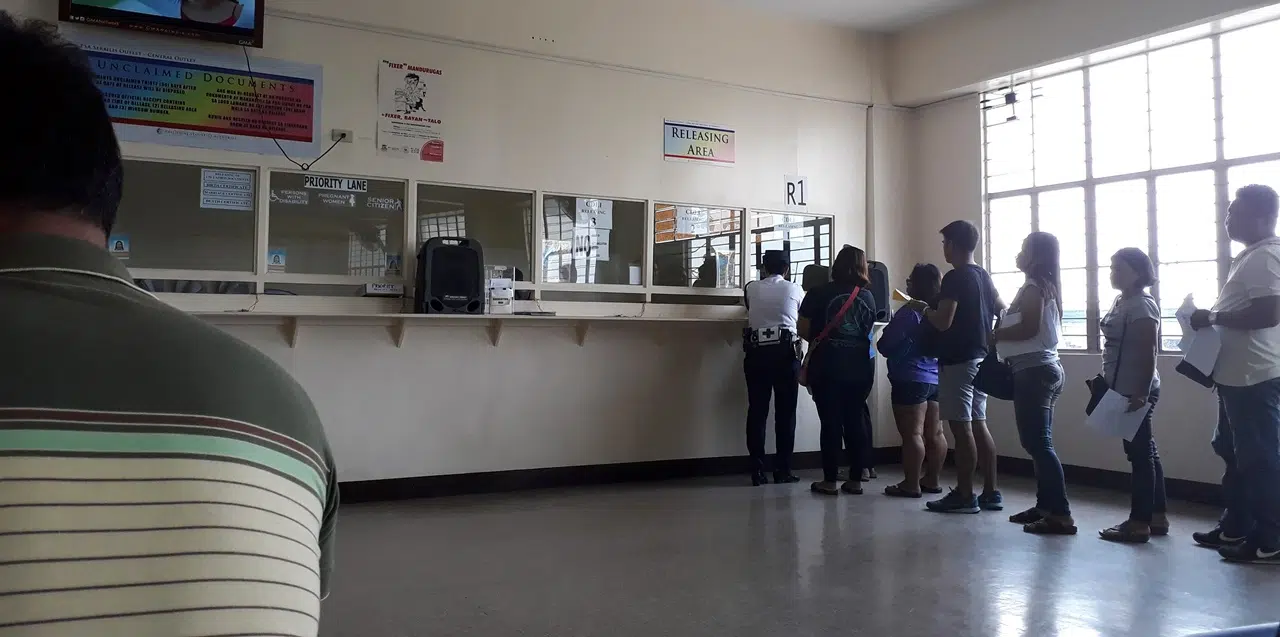 Usually, businesses are registered with the SEC, DTI, BIR, local city halls, and barangay halls.
Registering a sole proprietorship starts with a DTI business name registration.
Sole proprietorship registration is limited to the DTI and is simpler than that of a corporation as there are fewer requirements.
It’s a separate process altogether from the SEC.
After registration, generally a sole proprietorship’s only compliance requirement is that it must renew its registration every 5 years.
On the other hand, the Securities and Exchange Commission (SEC) regulates corporations and partnerships.
Registering with the SEC involves an application to reserve a corporate name and depositing the minimum paid-up capital stock with the designated government depository bank.
SEC registration is longer and has more requirements and there are several compliances required, such as board resolutions and secretaries certificates when there are major decisions and the annual submission of the General Information Sheet with Audited Financial Statements.
Business registration also includes registration and compliances at the local government level. These mean barangay renewal and City Hall renewal every year, along with fees and taxes.
All of these compliances must be completed to ensure that your business runs without issue.
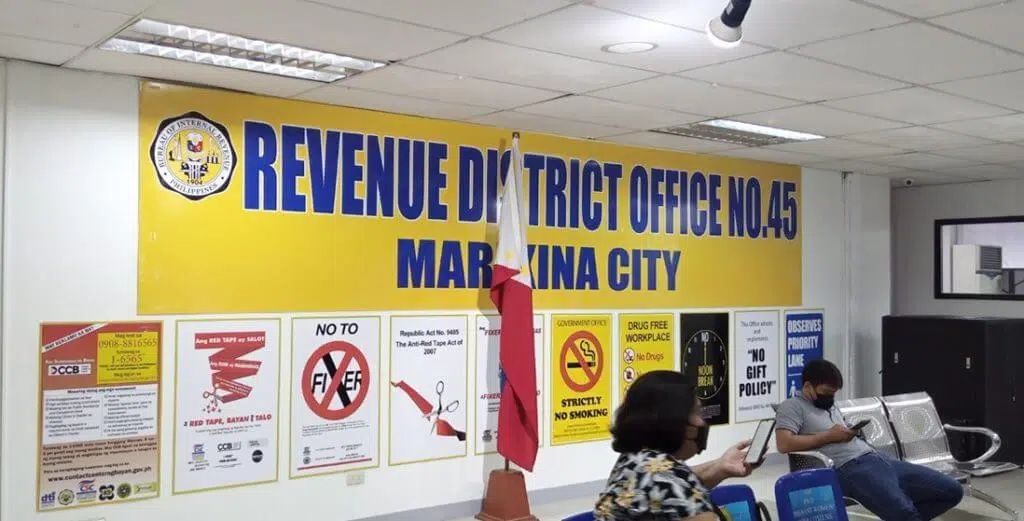
All businesses in the Philippines must have a TIN 30 days prior to the operation of the business.
After registration at the BIR, you will receive a TIN.
A TIN is a unique 9-digit number generated by the BIR to identify the taxpayer.
There are several taxes that businesses pay, and the type of taxes depend upon the entity. These taxes can be seen in the BIR Certificate of Registration.
Common taxes paid by businesses are:
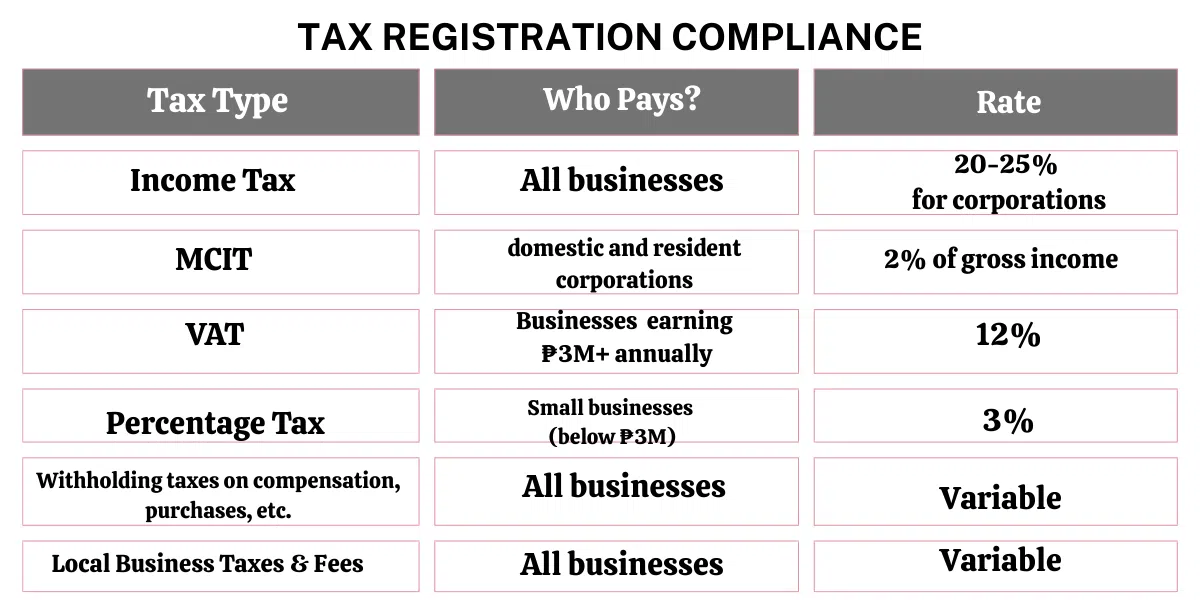
Tax compliance is vital in business registration in the Philippines; this will guide investors and businessmen in determining their tax obligation.
Different taxes apply depending on the type of entity and the situation.
For instance, 12% VAT applies if you are VAT registered due to revenue of above 3M annually but is only 3% if revenue is below 3M annually.
Additionally, non-revenue generating entities such as representative offices do not have any income taxes due to their nature as a cost center.
So, applicable taxes depend very much on the entity and situation.
Here, we provide examples of tax calculations that illustrate how different tax rules apply in real business scenarios to better understand tax obligations.
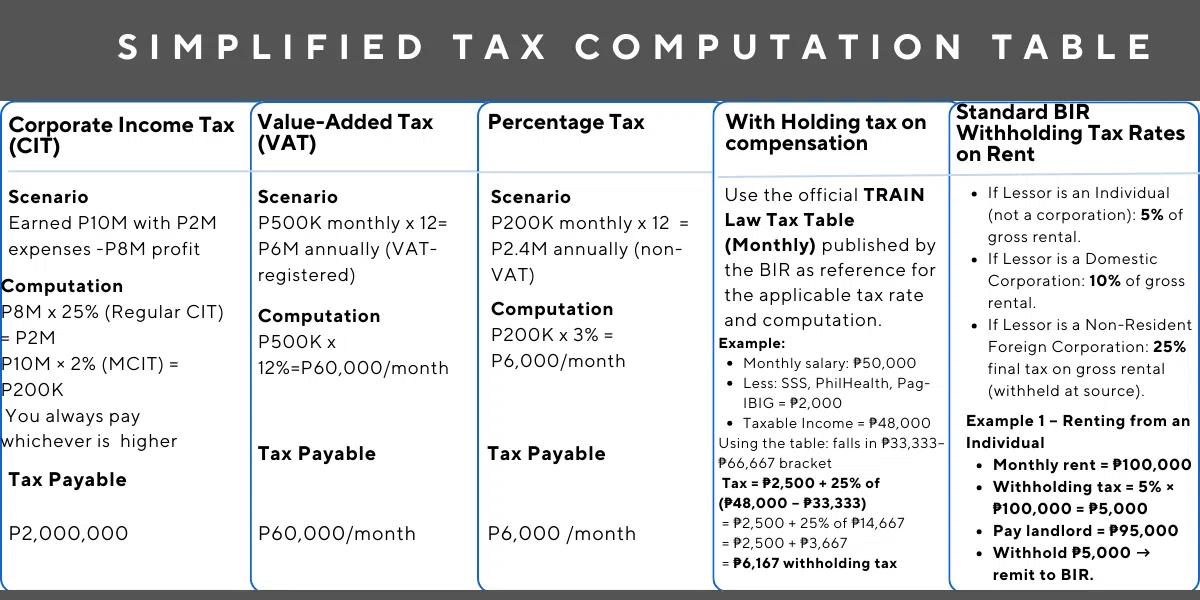
Corporate Income Tax, VAT, Percentage Tax and Withholding Taxes are the most common taxes in the Philippines.
Corporate Income Tax (CIT) Made Easy
Imagine you own a company that earned P10 million this year. You also had P 2 million in business expenses (like rent, salaries, supplies). So, your profit (taxable income) = P10M – P2M = P8 million
Option 1: Regular Corporate Income Tax which you pay 25% of your profit Option 2: Minimum Corporate Income Tax (MCIT) which You pay 2% of your total sales (P10M), if you are in the 4th year of operation and if you have reported a loss.
Say, you made a profit.
In that case you pay the regular CIT and this is P2 million.
Value-Added Tax (VAT)
Let’s say your business earns P6,000,000 annually with monthly sales of P500,000.
Since it is above P3 million, you must pay VAT.
VAT is 12% so you will pay 12% of the P6,000,000 which would be P720,000 annually or P60,000 monthly.
Percentage Tax Made Easy
Let’s say your business earns P2,400,000 annually or P200,000 monthly.
Since your annual income is below P3 million, percentage tax of 3% is applicable instead of VAT.
This comes out to P72,000 annually or P6,000 monthly.
As for the Withholding Tax on compensation, see the official Train Law Tax Table published by the BIR as references for applicable tax rate and computation.
Note: The tax computations presented are simplified for easier understanding. Actual tax liabilities are subject to official computation and assessment by the Bureau of Internal Revenue (BIR).

If you are a foreigner planning to invest or start a business in the Philippines, here are key things you must know about the business registration process.
If you are a foreign national who wants to invest or build a business in the country, the following are important things you need to consider for as part of the business registration Philippines process.
Foreign Ownership Restrictions:
Some sectors in the Philippines have foreign ownership limits, as outlined in the Foreign Investment Negative List (FINL) which categorizes restricted sectors into List A (constitutional/statutory limits) and List B (defense, health, or SME protection)
LIST A: Foreign Ownership Restricted by Constitution and Specific Laws
- 100% foreign ownership is NOT allowed in certain sensitive sectors such as:
- Mass media
- Practice of professions (e.g., law, medicine)
- Small-scale mining
- Security agencies
- Cockpits, firecrackers, and certain weapons
- Foreign ownership is limited to:
- 25% in private recruitment and defense construction
- 30% in advertising
- 40% in public utilities, land ownership, educational institutions, and natural resource use
LIST B: Foreign Ownership Limited for Reasons of National Security, Public Health, Morals, and Protection of Small Businesses
- Covers industries like:
- Firearms and explosives
- Dangerous drugs
- Gambling and massage clinics
- Micro and small domestic enterprises (with capital under $200,000)
- Some exceptions apply to:
- Tech startups
- Export-oriented manufacturers (with approval)
- Companies with majority Filipino workforce
Aside from foreign ownership restrictions, taxes and possible incentives such as PEZA or BOI-registered businesses should be looked into.
PEZA-registered enterprises are entitled to various incentives granted under the Special Economic Zone Act of 1995 (Republic Act No. 7916), as enhanced by the Corporate Recovery and Tax Incentives for Enterprises (CREATE) Act (Republic Act No. 11534).
- Income Tax Holiday (ITH):
- 4 to 7 years, depending on project location and industry classification.
- Post-ITH Options:
- Choose between:
- 5% Special Corporate Income Tax (SCIT) on gross income, or
- Enhanced Deductions (ED) for up to 10 years.
- Choose between:
- Tax and Duty-Free Importation:
- Covers capital equipment, raw materials, and related components.
- VAT Incentives:
- VAT exemption on importation
- VAT zero-rating on local purchases used exclusively for the registered activity
- Domestic Sales Allowance:
- 30% of total sales
- Local Tax Exemption:
- Exempt from local government taxes and fees during the 5% SCIT availment period.
[See the: https://www.peza.gov.ph/elligible-activities-and-incentives-category/fiscal-incentives as reference]
Additionally, Visa and Work Permit Requirements should be considered.
Foreign business owners may need a 9G work visa or Special Investor’s Resident Visa (SIRV), both of which will require processing.

Doing the process and document preparation yourself is not advisable for beginners.
Here are some of the most common pitfalls business registrations in the Philippines.
- Choosing the wrong business structure.
- Registering under the wrong tax category.
- Forgetting to renew business permits.
- Non-compliance with bookkeeping requirements.
How should we avoid this?
The best decision to avoid these pitfalls is to seek professional assistance if needed.
Consulting a lawyer during the business registration process in the Philippines is crucial for ensuring legal compliance, minimizing risks, and making informed decisions.
Lawyers specializing in business law can provide valuable guidance on choosing the right business structure, understanding legal obligations, and navigating complex regulations.
They can assist in drafting contracts, protecting intellectual property, and handling various legal aspects of company formation.
By seeking legal advice early on, entrepreneurs can prevent costly mistakes, safeguard their interests, and establish a strong legal foundation for their business, ultimately contributing to long-term success and sustainability.
Need help with business registration?
Contact our legal team for expert assistance!

How long does the Business Registration process take?
2-4 months at the SEC level (depending on business type and location) and then some months at the BIR and City Hall level
Can a foreigner own 100% of a business in the Philippines?
Yes, for certain industries (e.g., export businesses, IT-BPO).
What are the penalties for operating without business registration in the Philippines?
Fines, tax penalties, and possible business closure.
How to register a sole proprietorship in the Philippines or Paano magparehistro ng sole proprietorship sa Philippines?
Paano magparehistro ng sole proprietorship sa Philippines? Start by registering your business name with DTI, then secure a Barangay Clearance, Mayor’s Permit, and register with the BIR for tax compliance.
What are the requirements for business registration in the Philippines process with the BIR, DTI, and Mayor’s Permit?
[ Ano ang kailangan sa business registration BIR, DTI, Mayor’s permit ? ]
You need a valid ID, a business name, completed forms, and proof of business address—plus barangay clearance for the Mayor’s Permit and DTI and BIR certificates for full registration.
How much is the fee for business registration in the Philippines process?
The fee for business registration in the Philippines depends on the agency. DTI registration costs ?200 to ?2,000, BIR charges ?500 plus ?30 for documentary stamp tax, Mayor’s Permit fees vary by location, and SEC registration for corporations starts at around ?2,000 or more depending on capital.