Hague Child Abduction Convention in the Philippines: Insights from Atty. Francesco C. Britanico - Lawyers in the Philippines
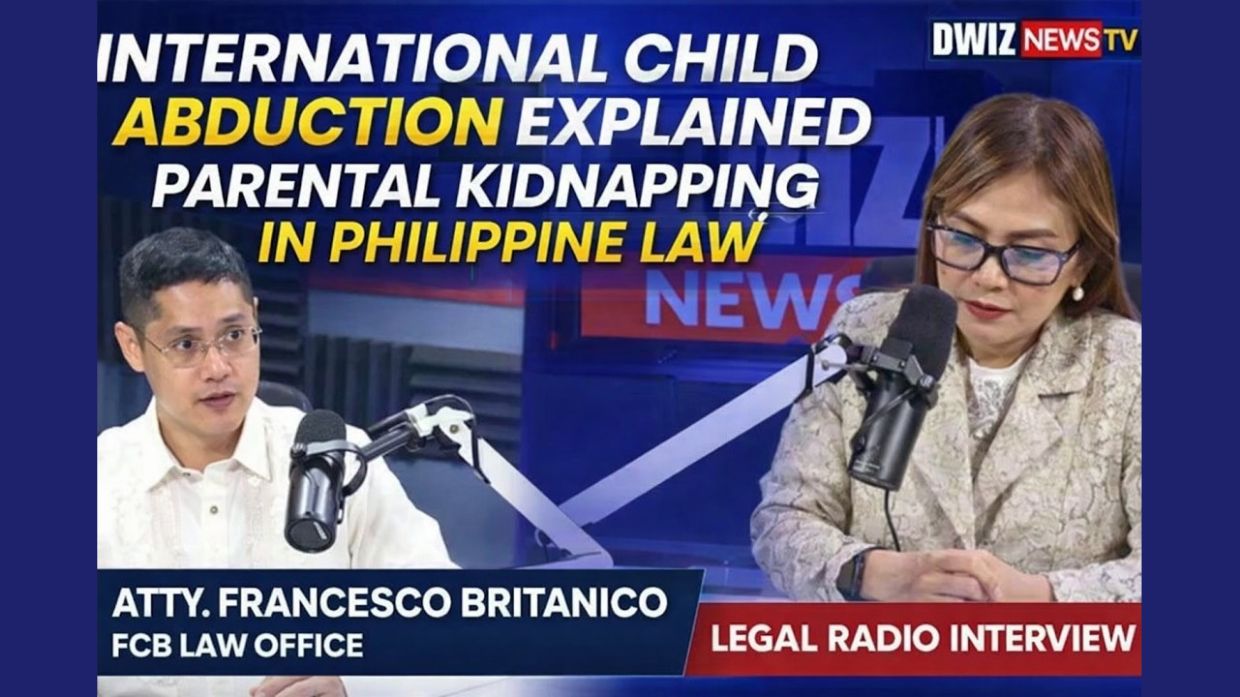

This radio interview of Sulong ng Bayan, host Ms. Lolly Acosta talks with Atty. Francesco Britanico of FCB Law Office about the international side of parental kidnapping. Across borders, it is handled as a civil matter under the Hague Convention, not a criminal case. The goal is the child’s best interest: a quick return to their habitual residence. Learn why parents must submit complete evidence when filing, and why the one-year deadline matters.
Major Key points are:
- Definition of Parental Kidnapping;
- Civil vs. Criminal Remedies;
- Best Interest of the Child;
- Implementation in the Philippines;
- Elements and Evidence Required;
- Critical One-year Window Filing; and
- Fast Tract Solution
Want to hear it directly from the lawyer first?
Watch the full radio interview here, where Atty. Francesco Britanico explains how the Hague Convention handles parental kidnapping across borders and why the one-year filing deadline matters.
Book a consultation or contact us for an initial assessment to discuss your situation and next steps.

Send us an email with the details for
personalized recommendations or schedule a consulation if needed.
Quick Facts:
- An international treaty between countries to resolve issues where a child is brought to another country by a parent without the other parent’s consent.
- Philippines agreed to this treaty in 2016
- Philippines started to process these cases in 2023, when the implementing rules were released
- The result of the treaty is to decide where the child should live to reduce disruption and psychological stress to the child and does not resolve custody issues and allows a “left-behind” parent to redeem the child.
- It is a civil action and is not a criminal action.
The Hague Abduction Convention is a multilateral treaty designed to resolve a specific, high-stakes crisis: the wrongful removal or retention of a child across international borders by a parent, in violation of the custody rights of the other parent.
As Atty. Francesco Britanico explained on DWIZ 882's Sulong na Bayan, the core mechanism of this agreement ensures that if a child is taken from a member country by one parent without the other’s consent, there is a formal process in place to immediately return the child to the country where they were habitually raised and accustomed to living.
It is crucial to understand that the Convention does not care who the "better" parent is. It does not exist to settle messy marital grievances or award permanent custody. Its sole, pragmatic purpose is to determine which country has the rightful authority to decide the child's future. It demands that the child be returned immediately to their habitual residence and is a civil action to do so.
As Atty. Francesco Britanico clarified on air, although the Philippines signed the international treaty regarding child abduction in 2016, the local implementing rules did not come into effect until 2023. Consequently, the legal mechanism to file these specific abduction cases in Philippine courts has only been available for approximately three years.
This 2023 activation was achieved through the landmark issuance of A.M. No. 22-09-15-SC (Rule on International Child Abduction Cases), promulgated by the Supreme Court En Banc. This procedural rule finally gave local family courts a concrete blueprint to handle international removals.
Quick Facts:
- When the child is removed from the country of his residence by a parent without the consent of the other parent – for example, the child is taken by one parent to another country without informing the other parent and the child was never returned
- When the child is retained in one country by a parent without the consent of the other parent such as when the child went for a holiday but was never returned
Cross-border situations are governed by the civil mechanism of the Hague Child Abduction Convention, provided that state country is a member of this convention.
The Hague Apostille Convention covers 2 situations:
1. Wrongful Removal
2. Wrongful Retention
Wrongful removal occurs when a parent sole takes a child out of their home country without the knowledge or consent of the other parent who shares custody rights.
For example, Maria and Mark live in Spain with their 4-year-old daughter Kitty and 7-year-old son John. They are married and both parents share equal custody rights. One weekend while Mark is away, Maria packs Kitty and John’s bags, buys one-way tickets, and flies to the Philippines, with the intention of permanent relocating there. Mark returns home find the house empty and learns his daughter and son is in the Philippines. Maria refuses to bring them back.
The Hague Convention applies in this situation because both children’s habitual residence is Spain and Maria’s decision to remove to the Philippines breached Mark’s custody rights.
Because both nations are Hague Convention Members, Mark can file using the Hague Convention to request prompt the children’s prompt return.
Wrongful Retention is slightly different.
This situation occurs when a child traveling abroad with the initial consent of both parents is not returned to his or her home country.
For example, Jayson and Lyka live in Czech Republic with their 9-year-old son Dave. They are not married and live separately but have joint legal custody through a court order, although Dave primarily lives with Jayson. Lyka requests Dave’s company for a vacation in the Philippines, which Jayson grants. However, at the end of the trip, Lyka announces that she has enrolled Dave in a Philippine school and they will not be returning to Czech Republic.
In this scenario, Hague Convention applies because Dave’s trip to the Philippines for one-month vacation was consented to but the child was wrongfully retained in the Philippines.
Quick Facts:
- It does not fall under kidnapping and serious illegal detention under Article 267 of the Revised Penal Code as parents are excluded from that.
- It might fall under RA 7610 or child abuse, depending on the situation.
In the Philippines, the law on child abduction is quite distinct because it often separates parental taking from criminal kidnapping.
Article 267 of the Revised Penal Code punishes the act of kidnapping where one is forcible transport or abduct of individual against their will.
However, the Revised Penal Code explicitly excludes parents form being charged with kidnapping their own child. This means that if a parent takes their own child, it is generally not classified as kidnapping under Article 267.
Another case that might be possible would be to file a criminal case under special laws like the Violence Against Women and their Children, but these can only be filed against men and requires that there is physical, economic and psychological harm.
Another possible case that can be filed is when a party violates a court order – in this case either the father or the mother can be filed.
Atty. Francesco Britanico has pointed out that the facts of the case are important and the correct case to file depends on the situation.
In other cases, some parents kidnap their own children or hide them from the other parent so that they can facilitate or directly engage in sexual abuse and molestation.
In such instances, the parent may face multiple criminal charges. This includes the crimes previously mentioned and also serious violation of RA 7610.
Quick Facts:
· Countries must both be a party to the Hague Child Abduction Treaty and it must be enforced between them for a left-behind parent to use this remedy
· Filed within one year of the child unlawful removal or detention
· Child is under 16 years old
· The elements that need to be present:
o Habitual residence of the child
o Breach of custody rights of the left-behind parent
o Left-behind parent must have been exercising those custody rights
o Removal or retention of the child was unlawful
When a parent takes a child to another country without the other’s parent’s consent, it triggers complex cross-border issues.
To solve this, countries across the globe rely on the Hague Abduction Convention, which is an international agreement between countries.
However, this agreement is not automatically enforceable to all nations who have signed the treaty.
Atty Francesco explained that even though the Philippines and countries like the United States, the United Kingdom, and Canada are all members of the Hague Convention on the Civil Aspects of International Child Abduction, the treaty is not yet automatically enforceable between them.
As the Philippines signed the treaty later than these nations, there is a formal process required before the rules actually apply between the Philippines and other countries.
This means that if a child is taken from the Philippines to these countries (or vice versa), you cannot yet use the fast-tracked legal remedies provided by the Hague Convention.
Instead, you are currently required to use the traditional, much slower legal routes to resolve these custody disputes.
The treaty can only be used once both the Philippines and the other specific country agree that it is officially in effect between them.
There are other requirements.
For instance, you have one year to file from the date of unlawfully removal or retention of the child.
If the left-behind parent files before the local courts in less than one year, the judicial authority of that country where the child is located is mandated to order the return of the child immediately.
The philosophy behind this rule is that if the child’s life has been disrupted, they must be returned. However, if you file the case after one year, you can no longer argue that their life is being disrupted because, they may have already adjusted and settled into their new environment.
Ultimately, as explained by Atty. Francesco Britanico, the law strictly looks at what serves the best interests of the child, and the time frame is a vital part of that calculation.
Atty. Britanico also pointed out another critical factor to consider: the age of the child.
Under the rule, if the child is under 16 years old and the case is filed within one year.
Then the treaty will apply and the entire process must be completed within 90 days. The court will rule wither to have the child returned, or it will state that the facts show the treaty does not apply, and therefore the child can remain.
Additionally, the case stresses that the habitual residence of the child must be determined. The habitual residence of the child is where the child resided for a long time.
Atty. Francesco Britanico clarified that if a child is moved from their home in another country, the parent seeking to prove this must provide concrete evidence, such as school documents, civil records, or hospital history to prove habitual residence.
These records serve as official proof of the child's long-term presence in a specific location, which is essential for courts to determine if the child was removed from their true home.
Another key requirement is proving a breach of custody.
The left-behind parent must show that he was actively and consistently exercising parental rights when the child is taken. Atty. Britanico emphasized that the parent must demonstrate they were not negligent in their duties and that they were fully involved in the child’s life until the other parent removed the child to another country without his/her consent.
Lastly, to successfully file a case under the Hague Child Abduction, it must be proven that the child was either be wrongfully retained or wrongfully removed from where the child should be.
Quick Facts:
|
Item |
Philippines |
Hague |
|
Name of case |
Child Custody |
Hague Child Abduction |
|
Principle |
Tender Years |
Habitual Residence and Best Interest of the Child |
|
Focus of the case |
Which parent has custody? |
Which country should the child remain in? |
|
Length of Case |
At least 2 years from filing, likely more |
90 days from filing |
|
In favor of |
Mother |
Both |
|
Prescriptive Period |
Anytime but before age of 18 |
One year from removal |
|
Impact of Age of Child |
After 7 years, child to choose; below 7 years in favor of the mother |
Below 16 years old |
|
Appeals |
Can file a motion for reconsideration and can file appeal |
No motion for reconsideration and No appeal |
|
Documents needed |
Evidence must show to determine the best interest of the child through deep evaluation of parental fitness. |
Evidence showing that the child was brought to the Philippines even though he resided elsewhere and the left behind parent was exercising his custody rights |
|
Process |
1. The pleading Stage 2. Case study 3. Pre-trial and Mediation 4. Trial Stage (typically takes 6 months or more) 5. Judgement
|
1. File with complete evidence 2. Other parent must file within 5 days 3. Both parents to appear for examination and compromise and testimony 4. Decision within 90 days |
|
Country this applies to |
All |
List all 46 countries |
|
Law Applies |
A.M. No. 03-04-04-SC |
The core difference between domestic Philippine law and the Hague Abduction Treaty comes down to one question: Are the courts deciding who gets the custody of the child or are they simple acting as an emergency button to send the child back home?
The main goal of the Philippine law is that it decides who gets permanent custody while the Hague Abduction Treaty’s main focus is to restore the status quo by returning the child from his/her habitual residence.
Philippine law is deeply rooted on the Tender Age presumption. The law establishes strict principle that a child under seven (7) cannot be separated from the mother that she is naturally best suited to take care of the child.
On the other hand, the treaty does not consider this and gender and parental fitness do not matter at this stage. It builds strictly on respecting international borders and returning to the status quo.
As explained by Atty. Francesco Britanico, the treaty applies equally to both parents, unlike Philippine domestic law which heavily favors the mother. That means the legal remedy is available not only when a mother is deprived of her child, but also when a father is deprived of the custody of the child.
As you can see, the Hague Child Abduction treaty has advantages for foreign fathers whose children have been retained or removed fromt heir foreign home wihtout their consent, as it offers a strong basis for the child to be retured and a much quicker resolution.
Here are the list of the countries where the treaty is enforceable with the Philippines:
|
Accession accepted by / Entry into force between Philippines and |
Date of acceptance |
Entry into force |
|
Andorra |
5-V-2017 |
1-VIII-2017 |
|
Argentina |
6-IX-2017 |
1-XII-2017 |
|
Austria |
30-XI-2023 |
1-II-2024 |
|
Belgium |
8-VI-2023 |
1-IX-2023 |
|
Brazil |
20-VI-2017 |
1-IX-2017 |
|
Bulgaria |
2-XII-2024 |
1-III-2025 |
|
Chile |
22-II-2017 |
1-V-2017 |
|
Colombia |
8-V-2020 |
1-VIII-2020 |
|
Croatia |
2-VI-2023 |
1-IX-2023 |
|
Cyprus |
2-X-2023 |
1-I-2024 |
|
Czechia |
1-VIII-2024 |
1-XI-2024 |
|
Denmark |
4-V-2023 |
1-VIII-2023 |
|
Estonia |
21-XII-2023 |
1-III-2024 |
|
Finland |
22-VI-2023 |
1-IX-2023 |
|
France |
12-VI-2023 |
1-IX-2023 |
|
Georgia |
28-X-2019 |
1-I-2020 |
|
Germany |
19-I-2023 |
1-IV-2023 |
|
Greece |
27-I-2023 |
1-IV-2023 |
|
Hungary |
19-X-2023 |
1-I-2024 |
|
Iceland |
20-III-2026 |
1-VI-2026 |
|
Ireland |
26-V-2023 |
1-VIII-2023 |
|
Italy |
31-V-2023 |
1-VIII-2023 |
|
Japan |
29-III-2016 |
1-VI-2016 |
|
Latvia |
24-III-2023 |
1-VI-2023 |
|
Lithuania |
17-II-2023 |
1-V-2023 |
|
Luxembourg |
25-IV-2023 |
1-VII-2023 |
|
Malta |
26-II-2024 |
1-V-2024 |
|
Mexico |
27-II-2020 |
1-V-2020 |
|
Monaco |
25-I-2021 |
1-IV-2021 |
|
Netherlands (Kingdom of the) |
16-XII-2022 |
1-III-2023 |
|
New Zealand |
28-IV-2017 |
1-VII-2017 |
|
Peru |
14-IV-2016 |
1-VII-2016 |
|
Poland |
28-XI-2024 |
1-II-2025 |
|
Portugal |
19-I-2023 |
1-IV-2023 |
|
Republic of Moldova |
14-VI-2016 |
1-IX-2016 |
|
Russian Federation |
22-XII-2021 |
1-III-2022 |
|
Serbia |
5-IX-2024 |
1-XII-2024 |
|
Slovakia |
10-III-2023 |
1-VI-2023 |
|
Slovenia |
21-X-2024 |
1-I-2025 |
|
South Africa |
25-IX-2020 |
1-XII-2020 |
|
Spain |
29-III-2023 |
1-VI-2023 |
|
Sweden |
28-XI-2023 |
1-II-2024 |
|
Switzerland |
9-VI-2023 |
1-IX-2023 |
|
Ukraine |
26-IV-2016 |
1-VII-2016 |
|
Uruguay |
7-VIII-2019 |
1-XI-2019 |
|
Venezuela (Bolivarian Republic of) |
16-X-2017 |
1-I-2018 |
Reference: Philippine – HCCH| Acceptance of Accessions
Prefer to read? Get the full transcript of the radio interview, where Atty. Francesco Britanico explains the evidence required and the one-year filing window for a Hague Abduction case in the Philippines.