Philippines 9G Visa: Step-by-Step Guide for Foreign Professionals - Lawyers in the Philippines


Are you a foreign professional planning to work in the Philippines?
The 9G visa is a Philippine pre-arranged employment visa that allows you to legally work and reside in the country, but the application process can be complex.
This guide explains an easy way to get the 9G visa Philippines or Philippines Pre-Arranged Employment Visa and goes through important information, such as:
- What is a 9g visa and what are its benefits
- the documents required for a 9g visa application
- how to apply for a 9G visa in the Philippines
Let’s begin.

Send us an email with the details for
personalized recommendations or schedule a consulation if needed.

The 9G Visa can be renewed
The 9G visa Philippines is a Philippine pre-arranged employment visa that allows foreign nationals to work in the Philippines under a local employer.
A Philippine 9g visa holder has the following benefits:
- Legal work authorization in the Philippines.
- Long term residency tied to the 9G visa validity
- You can come and go from the country several times.
- Allows you to open a bank account and helps in the purchase of property
- Dependents such as a legal spouse and children under 21 can be included
As a work visa, the 9G visa is linked to the company that sponsors it. It is important to know this link.
The visa holder can only work for the company that gave them the visa. They can only take the job that is written in their visa application.
The company that helps with the visa is very important. They need to apply for the worker. They must also provide some documents, like a Labor Market Test. This test checks that there are no suitable Filipino candidates for the job. The Labor Market Test is also needed for the Alien Employment Permit (AEP).
If the company changes, or the job changes, the 9g must change as well.
Who is eligible for a 9G visa for foreign workers?
A 9g is Pre-Arranged Employment Visa for those with the following eligibility criteria:
- The Philippine 9g visa is for foreign nationals hired by a Philippine-based company
- The company must be legally registered with the SEC (Securities and Exchange Commission) or DTI (Department of Trade and Industry).
- The applicant must have a valid employment contract.
- No criminal or immigration violations

The 9G visa for foreign nationals in the Philippines is the primary work visa that allows foreigners to be legally employed by a Philippine-based company.
The Philippine Pre-Arranged Employment Visa (9G Visa) has two main visa types.
- 9(g) (Commercial):This is a common work visa. It is for foreign nationals who want to work in the country and get paid. The pay can be a salary or other forms of compensation. Click here for requirements checklist for 9G (commercial)
- 9(g) (Non-Commercial) or 9(g) (Missionary):This visa is for foreign nationals who come to the Philippines for missionary work, social projects, or rehabilitation. It is not meant for business purposes. This visa mainly helps people who are in volunteer or nonprofit roles. Click here for requirements for 9G (non-commercial or missionary)
While waiting for the 9G visa to be approved, a Provisional Work Permit can allow you to work.
This permit is good for 3 months.
It is valid from when you get it or until your 9g visa is approved, whichever comes first.
There are several documents required for a 9G visa application.
They have to be correctly gathered so that the 9g visa application process is as smooth as possible.
When these documents are not complete, this can lead to delays or rejection.
The 9g visa requirements are the following:
For the applicant:
- Bureau of Immigration 9G visa application form
- The applicant’s resume
- The petitioner’s income tax return
- A valid passport that won’t expire for at least six months, along with a valid visa
- Marriage and birth certificates for dependents
- Medical clearance from the Bureau of Quarantine for certain nationals.
- Clearance Certificate from the Bureau of Immigration.
For the sponsoring company:
- A request letter signed by both the employer and employee.
- An employment contract from the sponsoring company
- A certified true copy of the Alien Employment Permit (DOLE issues this), plus the actual publication.
- A Special Temporary Permit for certain jobs listed by the Professional Regulation Commission (PRC).
- Business documents from the sponsoring company such as Company registration (SEC/DTI Certificate), Latest General Information Sheet (GIS), Business permits and tax clearance
- A notarized Certificate of Workforce Composition.
There are two main government agencies involved in the 9g visa application process:
- The Department of Labor and Employment which releases the Alien Employment Permit (AEP) and
- The Bureau of Immigration (BI) which handles the visa itself
Since one of the Bureau of Immigration 9G visa requirements is the alien employment permit from DOLE, your first step is actually to go to DOLE.
How do I obtain an alien employment permit from DOLE?
An Alien Employment Permit (AEP) from DOLE (Department of Labor and Employment) is one of the 9G visa requirements.
An AEP is necessary for more people than just those applying for a Bureau of Immigration 9g visa. It is also needed for people with other visas, like SIRV, SRRV, and SVEG. So, an AEP applies to those who have executive, advisory, or technical roles in a Philippine company.
An AEP will only be given to a foreign worker if there is no qualified local worker available, which must be proved. Additionally, generally a company must have at least a minimum of USD 200,000 in paid up capital to be a sponsor.
The requirements are:
- Alien Employment Permit DOLE Application Form
- Passport Bio-page with valid visa
- Contract of employment
- Letter Request
- Secretary Certificate for elective positions
- Passport with current visa
- Business Permits, Mayor’s Permits, DTI
- Proof of Publication of the job vacancy in a newspaper of general circulation, with a notarized affidavit stating that no local applications were received
These should be sent to the DOLE regional office that looks after the area where the foreign worker will be.
A brief overview of the process is:
- Gather all Alien Employment Permit DOLE documents
- Publish the Job Vacancy in a newspaper of general circulation
- File the application at the DOLE office
- DOLE will process the documents
- Pay the fees
- Collect the AEP card
While the AEP is being processed, the BI can provide a Provisional Work Permit.
This permit allows you to work legally while processing the Alien Employment Permit from DOLE.

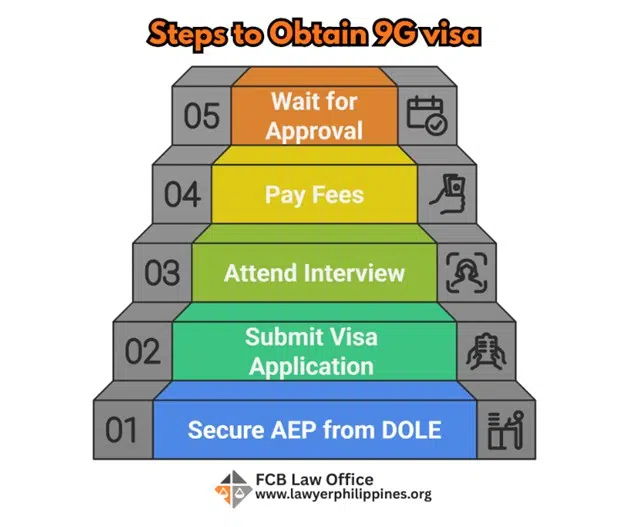
Below are the steps to obtain a 9G visa in the Philippines:
Step 1: Secure an Alien Employment Permit (AEP) from DOLE
Employers must first apply for an AEP on behalf of the foreign employee (as stated above).
Step 2: Prepare and Submit Visa Application to the Bureau of Immigration (BI)
Submit the required documents for the Bureau of Immigration 9G visa to the Visa Extension Section at the BI Main Office or any authorized satellite office.
Step 3: Attend Interview & Biometrics Capture
The applicant is required to appear in person for fingerprinting and photo capture.
Step 4: Pay 9G visa fees at the BI
After the Interview and Biometrics, you’ll need to pay 9G visa fees.
9G visa fees vary depending on the length of the work contract, the number of dependents as well as the size of the company, but they typically start at 10,000 or more.
Step 5: Wait for Visa Approval and ACR I-Card Issuance
Processing time: 2-3 months (may vary).
The Bureau of Immigration will issue an ACR I-Card (proof of residency).
Over all, expect this 9g visa application process to take several months.
This is because many of these steps to obtain a 9G visa in the Philippines
are done manually, leading to extended 9G visa processing times.
Many people often make mistakes during the 9g visa application process, so we’ve listed some of the most common errors below and how to avoid them.
1. Incomplete Documentation
Ensure that your employer provides all necessary business permits and financial documents.
2. Delays in DOLE Alien Employment Permit Approval are common.
Start the AEP application at several months before your intended work start date to avoid issues.
3. Employer Non-Compliance
The employer must comply with labor laws; otherwise, the application may be denied.
These issues can lead to delays during the 9g visa application process or even denial, so it’s important to keep them in mind.
Need help with your application?
Consult with an immigration lawyer to ensure a smooth process.
Check out our guide on business registration in the Philippines if you’re planning to start your own company instead.

The employer or the foreign national must submit the required documents to the DOLE Regional Office where the employment will take place
1.What are the documents required for 9G visa in the Philippines?
The 9G visa requirements are corporate documents, an employment contract, a passport with a valid visa, an Alien Employment Permit from the DOLE, and medical and law enforcement clearances.
2.How long does it take for 9G visa application process in the Philippines?
The 9G visa processing time in the Philippines typically takes around 6 months, depending on the completeness of the documents, compliance with Bureau of Immigration 9g visa requirements, and the volume of applications being handled. The 9G visa processing time may be extended when issues with the documents.
3.How long is the 9G visa validity once issued?
The 9G visa validity typically lasts for one to three years upon initial issuance, although it can be extended depending on the employment contract and company sponsorship. 9G visa validity is tied to the job, so if the job or company changes a new 9g visa must be acquired
4.Who is eligible to apply for a 9G visa for foreign workers in the Philippines?
Foreign nationals with gainful employment in the Philippines can apply for the 9G visa for foreign workers
5.What happens if I am promoted or if I change companies?
Since the Philippine Pre-Arranged Employment Visa is tied to the company and job you are hired for, you will need to apply for a new 9g visa if you are promoted or change companies.
6.Can family members be included in an application for 9G visa for foreign workers?
Yes, family members can be included in an application for 9G visa for foreign workers as dependents. They must submit proof of the family relationship.
7.How much are 9G visa fees?
There are several fees at the DOLE and the BI.
The DOLE fees start at Php 10,000. After this first payment, you will need to pay an additional Php 5,000 for each year or any part of a year.
The 9G visa fees at the BI depend on the length of stay for the visa holder.
These fees range from 10,000 to 24,000 for the main applicant.
If there are dependents, extra fees will apply.
The ACR card costs from USD 50 to 150.
This means you will pay about 50 each year.
However, these are just the government fees.
The true cost of getting a Philippine Pre-arranged Employment visa Philippines or 9g visa is the time and effort you spend going to DOLE and BI.
There are many trips you can take.
You will need to spend a lot of time.
Plan to take several days for one task.
In a 9g visa Philippines, there are several tasks to do.
The main reason for the high costs is the time required.
The biggest part of the cost to handle this is the time we spend.
8.Can I switch jobs with a 9G visa?
No, the 9G visa Philippines is employer-specific. If you change jobs, you must apply for a new 9G visa.
9.What happens if my visa expires?
Overstaying can result in fines or deportation. Apply for renewal at least one month before expiration.