Guide to Child Support in Philippine Law: Amounts, Process, Evidence, and What To Do If the Parent Won’t Pay - Lawyers in the Philippines


This Guide to Child Support in Philippine Law is designed to cover what you need to know about child support laws in the Philippines, how to file a case for child support, and what to consider when the other parent is abroad or is a foreign national.
Child support is often a major area of disagreement between separating spouses or a separated family. It involves parents who live separately from each other, children who live with one parent permanently or with each parent for periods of time, and sometimes children who live with neither parent because a relative is caring for them.
Disagreements over support can slow down other proceedings and fuel hostile negotiations. The practical answer is preparation: proof of filiation, proof of the child’s expenses, and proof of the other parent’s capacity to pay—before you negotiate or file.
TLDR (Article Summary): Philippine law requires parents to support their children, but the court sets the amount by balancing the child’s real needs with the parent’s capacity. If cooperation fails, a written demand and an enforceable court order (including provisional support while the case is pending) are usually the most effective path. Evidence—especially filiation/paternity, expenses, and capacity—often decides the outcome.
Action: If you want a confidential case assessment, email admin@lawyerphilippines.org with the child’s age, your monthly expense estimate, and the other parent’s last known address/employer.
If you still have any questions after reading this article or if you wish to discuss your particular situation or want to engage a lawyer for a Child Support case you can Contact Us

Send us an email with the details for
personalized recommendations or schedule a consulation if needed.
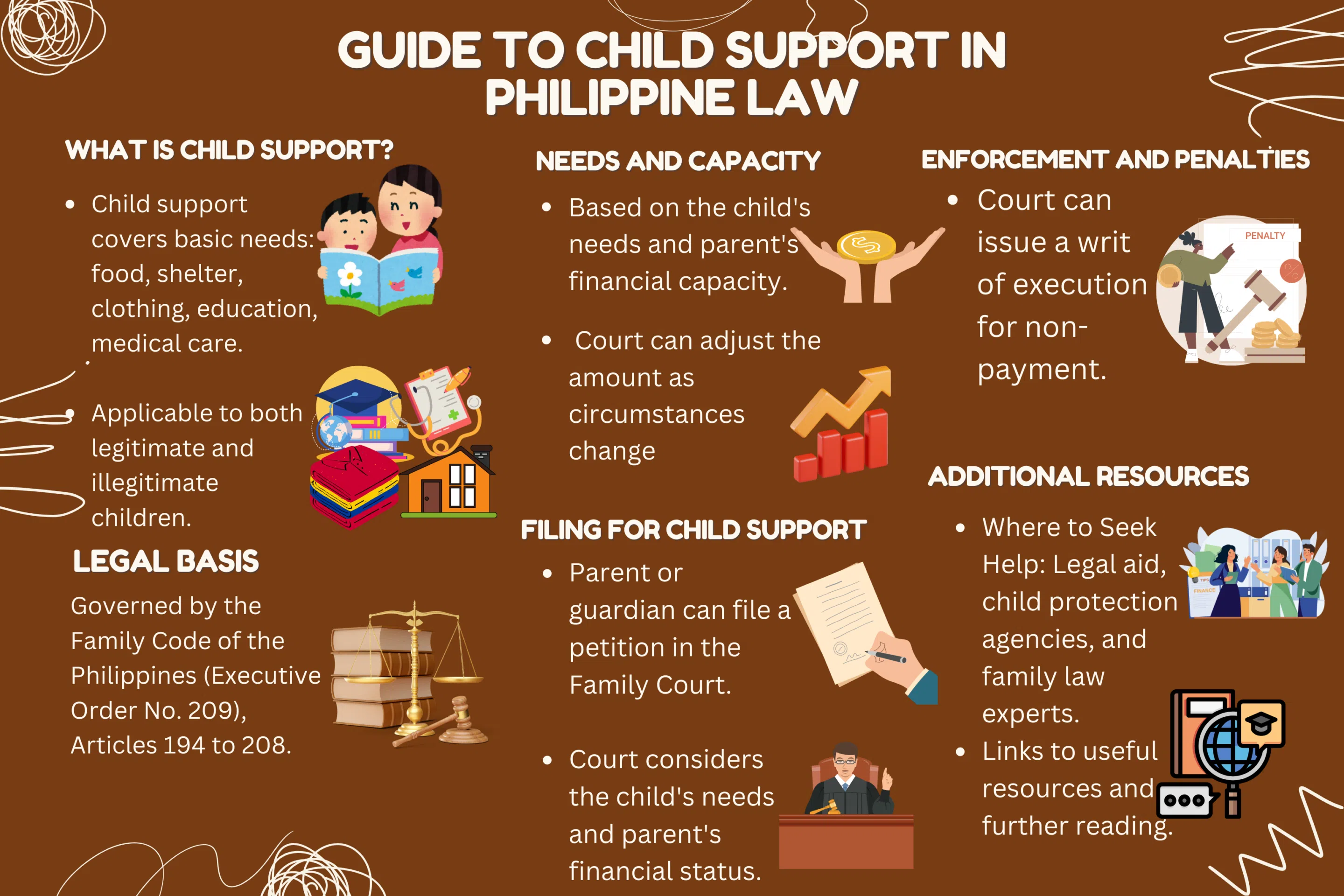
the Philippine legally requires parents to support their children at least until the age of majority.
Philippine law requires parents to support their children, and courts decide the amount by balancing the child’s real needs with the parent’s ability to pay; courts can also order provisional support while the case is pending, and enforcement is usually stronger when support is reflected in a court order rather than a private promise.
- Child support covers essentials like sustenance, dwelling, clothing, medical attendance, education, and transportation, consistent with the family’s means (Family Code, Art. 194).
- Support applies to both legitimate and illegitimate children; both parents have obligations (Family Code, Art. 195).
- There is no standard child support computation; the court looks at needs versus capacity (Family Code, Art. 201).
- Support is generally demandable from the date of judicial or extrajudicial demand, so proof of demand matters (Family Code, Art. 203).
- When the legal elements are present, remedies under R.A. No. 9262 (VAWC) may be relevant (R.A. 9262, Sec. 5(e)(2)).
TLDR: Child support is required by law, but the amount depends on evidence of needs and financial capacity. A court order (including provisional support) is usually the most enforceable path.
Action: Start a “support file” today—one folder for expenses, one folder for proof of the other parent’s income/assets—and email your checklist to admin@lawyerphilippines.org so we can tell you what’s missing.
 “Support” covers what is essential for a child’s sustenance and day-to-day living—including dwelling, clothing, medical attendance, education, and transportation—measured in light of the family’s financial capacity Family Code of the Philippines Child Support:
- Support is not limited to cash; orders can be structured as direct payments for tuition, health care, or housing, depending on the facts.
- Support includes schooling or training for a profession, and may apply even beyond the age of majority when legally justified (Family Code, Art. 194).
- Support exists to protect the child’s welfare—not to punish or reward a parent.
TLDR: Child support is a broad legal obligation covering basic living, healthcare, and education. It must be aligned with the family’s means.
Action: Make a one-page monthly budget of the child’s needs (school, food, transport, rent share, medical, childcare) so your request is clear and realistic.
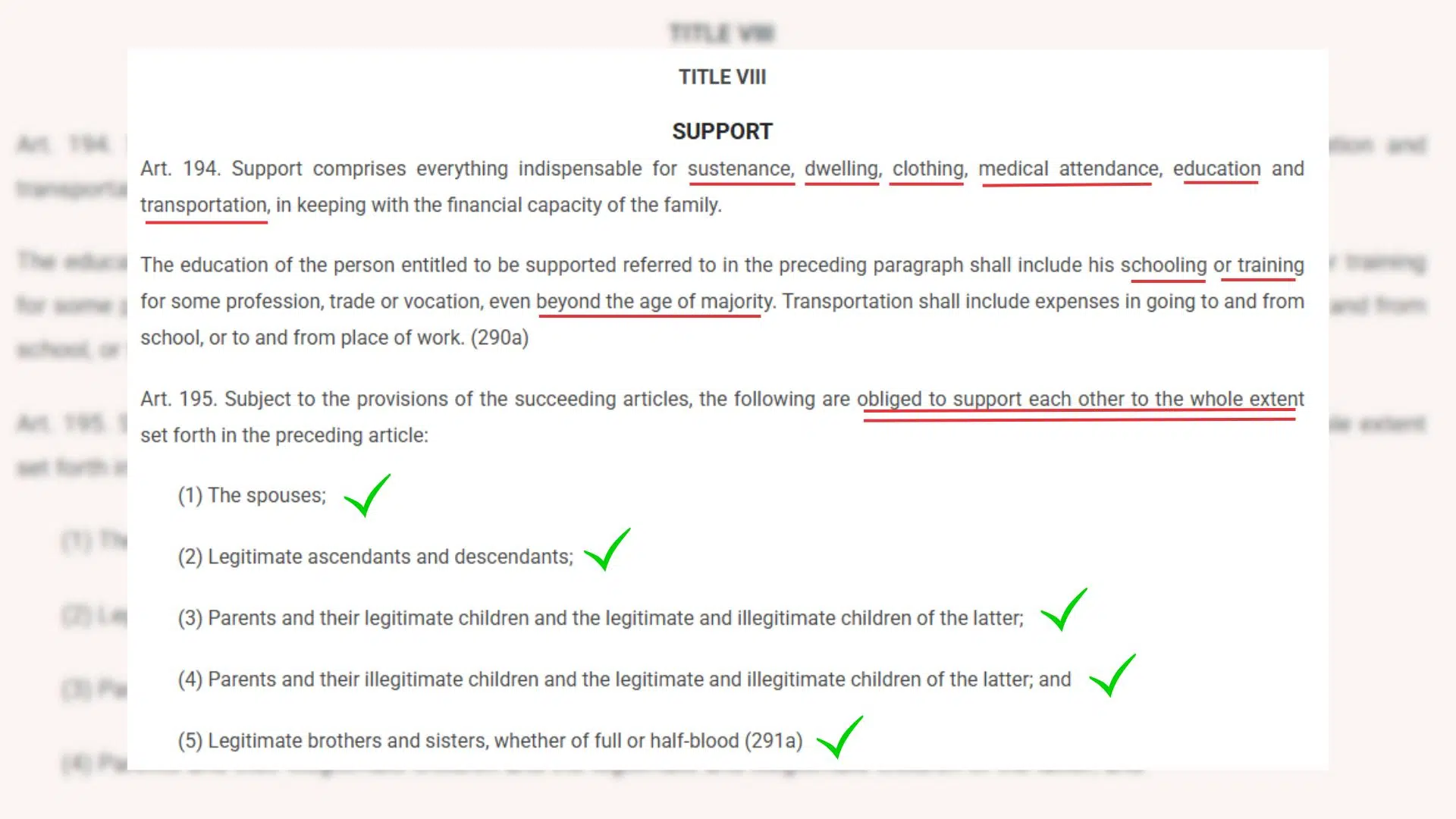
Support under Articles 194–195 covers basic needs and is owed between spouses, parents, children, and legitimate siblings.
Child support is governed primarily by the Family Code provisions on support and implemented through court procedures on actions for support, provisional support, and enforcement.
- Family Code: defines support, identifies persons obliged to support each other, and states that the amount must be proportionate to resources and necessities (Family Code, Arts. 194, 195, 201).
- Demand rule: support is generally payable from the date of judicial or extrajudicial demand, which is why written demand is often a key step (Family Code, Art. 203).
- VAWC remedy (when applicable): deliberate deprivation of legally due support can fall under R.A. 9262’s economic abuse provisions (R.A. 9262, Sec. 5(e)(2); Sec. 6).
- Cross-border recovery: international cooperation frameworks may apply when the parent is abroad (for example, the 2007 Hague Child Support Convention, where applicable).
TLDR: Support is not just a family arrangement—it is a legal remedy with rules on how to file, prove, and enforce it.
Action: Ask a lawyer which legal remedy fits your facts (support petition, request for provisional support, or another remedy) because procedure affects speed and enforceability.

Verbal child support promises are not enforceable. It must be in writing or ordered by court.
Verbal promises can collapse when conflict rises; formalizing support through clear written arrangements and, when needed, an enforceable court order helps protect the child and makes lawful enforcement possible.
- Informal support often becomes irregular and dependent on goodwill.
- School and medical costs change, but informal amounts rarely adjust fairly.
- Without an enforceable order, options are limited when the payer suddenly stops.
- A written record reduces later arguments about what was promised and what was paid.
TLDR: Informal support can work when there is trust, but it often fails when conflict increases. Written and enforceable arrangements protect the child when cooperation fails.
Action: Shift to traceable payments (bank/remittance) and label transfers “child support” to create a clean paper trail.

Both parents must support their children, even if the child is illegitimate.
Both parents are obligated to support the child, and the duty to support applies regardless of whether the child is legitimate or illegitimate (Family Code, Art. 195).
- The obligation is not limited to married parents; it can apply even if parents were never married.
- In many cases, the first real dispute is filiation/paternity—not the amount.
- In limited situations, other relatives can also be obliged to support under the Family Code’s order of persons bound to support each other (fact-dependent).
TLDR: Child support is not limited to legitimate children. The key practical issue is proving the child’s relationship to the parent being asked to pay.
Action: Secure the child’s PSA birth certificate and gather proof of acknowledgment (messages, remittances, school forms, photos, sworn statements).
There is no fixed child support computation or government-set minimum table; the amount is determined by balancing the child’s necessities with the paying parent’s resources and means. [Art 201, Family Code of the Philippines Child Support]

In Support cases the essential needs of the child are balanced with the income generated by the parent.
- Courts look at itemized needs (tuition, food, transport, medical, clothing, rent share) and real capacity (salary, business income, properties, other resources).
- If capacity is limited, the court weighs that reality—so credible proof matters on both sides.
- Support can be revisited through the proper process if circumstances materially change (job loss, illness, custody changes, schooling changes).
- A private agreement may guide behavior, but enforceability is stronger when embodied in a court order or court-approved compromise.
TLDR: There is no standard formula. Courts decide support based on evidence of needs and capacity, and the amount can change when circumstances change.
Action: Build a 3?month average expense sheet with receipts/assessments so your request is defensible and realistic.

Retroactive support is limited!
As a general rule, support is not payable except from the date of judicial or extrajudicial demand, so timing and proof of demand matter (Family Code, Art. 203).
- A dated demand letter with proof of receipt can affect what period you can realistically claim.
- Keep proof of demand: registered mail receipts, courier tracking, emails, and message screenshots.
- Keep records of voluntary payments because they may affect disputes about amounts and credibility.
TLDR: Written demand is often the practical turning point in support disputes. Claims for earlier periods are harder without the correct legal basis and proof.
Action: Send a written demand that itemizes monthly needs, proposes a payment method, and preserves proof of receipt.

Court can order child support even while the case is still ongoing.
Yes. Courts may order provisional support or support pendente lite while a case is pending to address immediate needs and prevent harm during litigation.
- Common children may be supported from the properties of the Absolute Community or the Conjugal Partnership, as applicable (this often matters in ongoing cases between spouses).
- Subject to the court’s discretion, either parent or both may be ordered to give what is necessary for the child’s support, maintenance, and education.
- In fixing provisional support, courts commonly consider: (1) the financial resources of the parents and the child; (2) the child’s physical and emotional health and special needs; (3) the standard of living the child is accustomed to; and (4) the non?monetary contributions of each parent (caregiving).
- Courts may direct salary deduction or structured payments when there is a clear order and reliable employer/payroll details.
TLDR: You do not always have to wait for a final decision to get support. Provisional support exists to protect the child during the case.
Action: Prepare a “provisional support packet” (recent expenses + best proof of income/assets + employer details, if known) so urgent relief can be requested properly.

The Republic Act 9262 may apply in appropriate cases involving deliberate deprivation (or threats of deprivation) of financial support legally due to the woman or her child (R.A. 9262, Sec. 5(e)(2)), but the facts and evidence matter—courts do not treat every non-payment as automatic criminal liability (see Acharon v. People, G.R. No. 224946, 9 November 2021).
- VAWC is not the same as a civil petition for support; they serve different purposes and have different proof requirements.
- Evidence commonly focuses on capacity to pay, proof of demand, and deliberate refusal or deprivation when support is legally due.
- Because these remedies can be high-stakes, the safest path depends on your facts and your safety situation.
TLDR: VAWC may be relevant when deprivation is deliberate and fits the law’s elements. It is not automatically applicable to every non-payment situation.
Action: Make a factual timeline (demands, replies, payments, refusals, urgent child needs) and keep screenshots/receipts in chronological order before consulting counsel.

Securing child support begins with filing a case.
A child support case is usually strongest when you build the evidence first, attempt realistic negotiation where safe, and then file the proper petition in the correct court with a request for provisional support if the child’s needs are urgent.
- Step 1: Confirm filiation/paternity evidence (birth certificate, acknowledgment, other proof; discuss DNA options with counsel when relevant).
- Step 2: Prepare an itemized expense list with supporting documents.
- Step 3: Gather proof of the other parent’s income/assets (employment, business, properties, remittances).
- Step 4: Send a written demand and consider mediation/settlement if safe and practical.
- Step 5: File the petition for support (and, if needed, request provisional support).
- Step 6: The court will issue summons and require the other party to answer; conferences are often held to explore settlement before trial.
- Step 7: Support can be filed as an independent case, or it can be sought as part of a larger family case where support issues are incidental, depending on your situation.
- Step 8: If no settlement is reached and provisional support is not granted, the case proceeds to trial where evidence and witnesses are presented, and the court issues its decision.
TLDR: A strong support case is built before it is filed: filiation proof, expense proof, and capacity proof. Better preparation usually means faster resolution.
Action: Prepare a one-page “case packet” (names, addresses, child details, expense total, proof list) so a lawyer can assess your next steps quickly.


You generally need documents that prove (1) the child’s relationship to the parent, (2) the child’s needs and expenses, and (3) the parent’s capacity to provide support.
- Filiation/paternity: PSA birth certificate; written acknowledgment/admission; messages acknowledging the child; other documents showing recognition; DNA results when appropriate and legally obtained.
- Needs/expenses: school assessments and receipts; medical records and receipts; documentation for food, transport, childcare, and rent share (as available).
- Capacity: payslips, employment contracts, ITRs (where available); business registrations; proof of properties and other assets; remittance records and prior support payments.
TLDR: The best evidence package proves relationship, needs, and capacity. Missing any one of these often slows down the case.
Action: Scan everything into dated folders (Filiation, School, Health, Expenses, Payments, Income/Assets) to avoid delays when the court asks for documents.

Courts are strict about proof, and many cases fail because the evidence is incomplete or improperly presented.
Most disputes come down to paternity denial, hidden income, or messy payment records; these are solvable when you focus on independent documents, consistent records, and lawful processes.
- If paternity is denied: gather written admissions, remittance history, and third?party documents (school/medical forms), then discuss with counsel whether DNA testing is appropriate and how to request it properly.
- If income is hidden: collect objective indicators (work history, business registrations, properties) and avoid exaggeration that can damage credibility.
- If payments are informal/cash: shift to traceable channels and keep labeled receipts and screenshots.
TLDR: Evidence problems are common, but they can be fixed by moving to traceable records and independent proof. Early organization reduces delay and denial.
Action: Make a “missing evidence list” and assign each item a realistic way to obtain it (PSA request, school records, hospital records, remittance proof, affidavit).

Cross-border support is more complicated because enforcement depends on jurisdiction and the rules of the country where the parent lives, but international cooperation frameworks can improve recovery options in cases involving contracting states (for example, the Hague Agreement on Child Support)
- A Philippine support order is enforceable in the Philippines; enforcing abroad may require recognition/enforcement steps in the foreign country or use of treaty-based cooperation mechanisms.
- You usually need precise identity and location details: full legal name, nationality, current address abroad, employer/business information.
- Filiation proof becomes even more crucial in cross-border cases, where weak paternity evidence can stall proceedings.
Let’s do an example for the UK –
If the Foreign Father is from the UK, then the Philippines via the UN has Reciprocal Enforcement of Child Support matters.
There are two potential routes:
1. File a Petition in the UK for Child Support.
You will need a Court Order from the Philippines first, then you will need to hire a UK Lawyer to file a case in a UK court.
You will most likely be required to attend at least one Court Hearing in the UK.
You may also be required to prove paternity through documentation or a DNA test.
However, once a Child Support Hearing has concluded it is easier for the UK court to enforce a Child Support order.
2. Apply for a Reciprocal Enforcement of Maintenance Order (REMO) in the UK.
You will need to secure a Maintenance Order in a Philippine court first and then you will need to hire a lawyer in the UK.
Once your UK lawyer has the Philippine court Maintenance Order he can then apply for a Reciprocal Enforcement of Maintenance Order (REMO) on your behalf.
REMO enables a Maintenance Order, issued in a Philippine court, to be registered and enforced by a UK court against the errant parent in the UK.
The Order will be registered in the UK by the REMO unit, who will ensure the parent is personally served with the Order and requested to attend any Hearings. You will need to know the full name and UK address of your ex-spouse/partner so he can be Served.
TLDR: Support is still possible when the parent is abroad, but enforcement becomes procedure-heavy. Accurate identity and location details often decide whether the case moves.
Action: Create a “foreign enforcement packet” (name, date of birth, nationality, last known address, employer, child documents, proof of demand) before you start cross-border steps.

There is no single fixed cost or timeline because it depends on whether parents can compromise, whether paternity and income are contested, and how quickly the court process moves; more dispute usually means more time and cost.
- Typical cost components include: lawyer’s acceptance fee; filing/court fees; notarization and service of pleadings; and evidence-gathering costs (certifications and, in some cases, DNA testing).
- Timeline drivers: willingness to settle; completeness of proof; paternity disputes; and whether provisional support is granted early.
- Practical note: cases often move faster when both sides see a realistic, documented budget and a realistic, documented capacity picture.
TLDR: Cases move faster when evidence is complete and settlement is realistic. The more contested the facts, the more time and cost you should expect.
Action: Ask counsel for a milestone plan (what to file first, what documents are needed, and what the “fast track” looks like for your facts).

Filing a case takes money and time.
?Filing a case takes money and time, so many parents try structured negotiation, mediation, and help from local support services first—while still preparing evidence and protecting the child’s immediate needs.
- Document everything: maintain records of education, healthcare, and daily living expenses.
- Negotiate openly: use your documented expenses as the foundation of your request.
- Seek mediation where safe: barangay-level processes or other mediation options may help resolve issues faster in some cases.
- Seek assistance: depending on your situation, agencies like DSWD, the Philippine Commission on Women (PCW), PAO, and university legal aid clinics may guide you or refer you.
- If there is intimidation, harassment, or risk of harm, prioritize safety and consult counsel on the appropriate remedy.
TLDR: Practical pre-filing steps can save time and reduce conflict, but they work best when backed by documentation. If safety is a concern, get proper legal help sooner.
Action: Prepare a negotiation script: monthly amount, payment date, payment method, and which expenses are separate (tuition/medical), then use it in your next discussion.

Supreme Court affirms child support as a constitutional duty, clarifying liability under VAWC and civil remedies in the Family Code.
A key Supreme Court decision often cited in VAWC-related non-support discussions is Acharon v. People (G.R. No. 224946, 9 November 2021), which shows that courts look closely at evidence, intent, and circumstances when economic abuse is alleged.
- Client lesson 1: build proof of capacity to pay, plus proof of demand and refusal—don’t rely on assumptions.
- Client lesson 2: even when criminal proof is difficult, civil support remedies may still be pursued based on evidence and Family Code obligations.
- Client lesson 3: strategy should consider both enforceability and safety, especially where intimidation or threats exist.
TLDR: Courts look for evidence that fits the law’s requirements. If you file without proof, your case can stall—or backfire.
Action: Before filing a VAWC-related complaint, ask counsel to identify the exact evidence needed for “capacity + demand + deliberate deprivation” in your specific facts.

It is best to seek the help of a lawyer for child support.
If you are negotiating support, preparing to file, or dealing with a parent who refuses to pay—especially if the parent is abroad—a focused legal strategy can reduce delay and increase enforceability, starting with the right evidence and the right remedy.
- The fastest cases are usually the most organized: clear filiation proof, credible expense proof, and credible capacity proof.
- The hardest cases are usually the least documented: cash payments, no written demand, unclear paternity, hidden income, or cross-border issues with missing addresses.
- A lawyer can help you choose: negotiated settlement vs. petition for support, request for provisional support, and (when legally appropriate) other remedies.
TLDR: Child support is a legal right of the child and a legal duty of parents. The best next step is to organize documents and pick an enforceable legal path.
Action: Email admin@lawyerphilippines.org with (1) the child’s age and school level, (2) your monthly expense estimate, and (3) the other parent’s last known address/employer, then request an initial child support assessment.

1) What if my ex-partner refuses to pay any support at all?
If your ex-partner refuses to pay, start with a clear written demand that itemizes the child’s needs and proposes a payment method, because proof of demand often becomes important later. If refusal continues, you may file an action for support and request provisional support if the child’s needs are urgent. Your evidence should show both the child’s actual needs and the other parent’s capacity to pay, not just anger or general accusations. If there is any safety risk, prioritize protection and consult a lawyer about the safest remedy for your facts. Action: Send a dated demand letter via registered mail or a reputable courier and keep proof of receipt in your support folder.
2) Can child support be modified later?
Yes. Child support can be adjusted when there is a substantial change in circumstances, such as job loss, illness, change in custody, or a significant change in a child’s educational or medical needs. The proper approach is to go through the correct legal process and present proof, not to stop paying or renegotiate informally and assume it will be accepted. Courts expect documents showing the change and its impact on needs and capacity. Keeping a consistent record of expenses and payments makes it easier to justify an increase or defend against an unfair decrease. Action: Start a “change log” and attach supporting documents each month (new bills, school assessments, medical records, proof of employment changes).
3) How is child support calculated in the Philippines?
Philippine courts do not use a fixed percentage formula for every family. The amount is based on evidence of the child’s necessities and the parent’s resources and means, so families with the same number of children can receive different orders. This is why an itemized expense sheet is essential: it shows the court what the child actually needs, not what someone guesses online. It is equally important to present credible proof of the other parent’s capacity, because unsupported allegations can damage credibility. Action: Make a simple monthly expense spreadsheet and attach photos or scans of receipts and official billing statements.
4) How long does child support last?
Support generally lasts until the child turns 18. In some situations, support can continue beyond majority, particularly connected to education or training, but the correct approach depends on facts and the proper remedy. Updated proof of schooling and dependency status helps reduce disputes about duration. If your child has ongoing medical issues or special needs, detailed records often become even more important. Action: Request a certificate of enrollment and updated fee assessment at the start of each semester and file it with your expense records.
5) Can I still ask for child support if the parent is abroad?
Yes, but enforcement depends on jurisdiction and the rules of the country where the parent lives. You typically need solid filiation proof, the parent’s correct address abroad, and a strategy that may involve treaty-based cooperation and or foreign-country processes. Many cases stall because petitioners do not have reliable location information for service and enforcement and because people do not have the knowledge or capacity to pay a lawyer abroad (which you may need). Action: Verify the parent’s current address and employer abroad and save supporting messages, documents, or screenshots in a dated folder.
6) Is the mother also required to provide child support?
Yes. Child support is not a “father-only” duty; both parents have obligations, and courts may consider each parent’s resources and contributions when fixing support. Even when one parent is the primary caregiver, the other parent’s financial and non-financial contributions can be weighed in the overall picture. The focus remains the child’s welfare and realistic support, not “winning” against the other parent. Documenting your own contributions helps show the real burden you carry and supports fair arrangements. Action: Keep a monthly log of what you personally pay and provide, including receipts and brief notes on caregiving responsibilities.
7) What if the father denies paternity?
Paternity denial often becomes the first battleground in a support case. Courts rely on legally recognized ways of proving filiation, such as public records and written admissions, and in some cases DNA testing becomes relevant if properly requested and obtained. The practical goal is to build independent proof that can withstand scrutiny, not only verbal accusations. Start with documents you can obtain independently, then consult counsel on what additional steps are appropriate for your facts. Action: Collect written acknowledgments, remittance records, and third-party documents (school or medical forms) that link the father to the child.
8) Can I enforce a private child support agreement without going to court?
A private agreement can help cooperation, but enforcement is usually far stronger when reflected in a court order or another legally enforceable instrument. If the other parent suddenly stops paying, you may have limited tools without an enforceable order, especially when you need stronger execution mechanisms. Converting workable agreements into enforceable instruments often prevents future disputes by clarifying dates, amounts, and how school and medical costs are handled. A lawyer can also check whether any clause is legally risky or unrealistic. Action: Bring your draft agreement and proof of payments to counsel and ask how to convert it into an enforceable order or court-approved compromise.
9) Can the court require salary deduction or withholding for child support?
Courts can implement lawful enforcement mechanisms when there is an enforceable support order. In appropriate cases, salary withholding or direct payment arrangements may be ordered, but practical enforcement often depends on accurate employer details and a clear order that payroll can follow. If employer information is missing or outdated, enforcement becomes harder even with a favorable decision. If the paying parent changes jobs often, updating employer details becomes part of your enforcement strategy. Action: Maintain an updated employer sheet with company name, office address, and HR or payroll contact details obtained through lawful means.
10) What if the paying parent claims they have “no job” or “no money”?
A claim of “no money” does not automatically end the analysis; courts look at capacity and resources, which may include business income, properties, and other objective indicators depending on available evidence. Your best approach is to stay credible and focus on documents, not rumors or social media speculation. If capacity is truly limited, the court will weigh that reality, which is why accurate evidence is important for both sides. When capacity is unclear, your practical goal is to collect objective facts and avoid exaggeration that can backfire. Action: List objective indicators you can document (business registration, property ownership, remittance history) and keep copies of any reliable proof you can lawfully obtain.
11) What documents are most important for a quick start?
If you want to move quickly, begin with documents that unlock the rest of the case: the child’s PSA birth certificate, proof of schooling and medical needs, and proof of the other parent’s income assets or employment, plus the parent’s address for service. Many delays come from missing addresses and missing proof of demand. A simple, organized starter pack often saves months because your lawyer can immediately identify strengths and gaps. Even if you do not have everything, starting with core documents helps your consultation become specific and practical. Action: Create one PDF “starter pack” with your top documents and a one-page summary of your request for your first lawyer meeting.
12) Is child support different from child custody?
Yes. Custody is about who has primary care and decision-making, while support is about financial and other contributions to meet the child’s needs. They often affect each other in real life because caregiving changes expenses, but they remain separate legal issues with separate remedies. You can pursue support even when custody is still being discussed, and you can also negotiate support terms without final custody being resolved. Keeping the issues separate usually makes your evidence clearer and your filings easier to understand. Action: Separate your evidence into two folders—Custody and Support—and keep a one-page summary for each so you don’t mix issues in discussions or pleadings.