Zero-Rated Sales in the Philippines: How to Protect Your VAT Position and Avoid Costly BIR Disputes - Lawyers in the Philippines

Zero-rated VAT is supposed to encourage exports and priority investments.
In practice, it also creates one of the most sensitive audit and refund areas of Philippine tax administration.
A single missing document or a misclassified transaction can turn your “0%” sale into a costly deficiency VAT exposure.
Many disputes begin with a simple gap: the business considers the transaction zero-rated, but the BIR sees insufficient proof that the buyer qualifies, that the sale fits the statutory category, or that the required payment and documentation conditions were met.
These issues are especially common for export sales, services to non-residents, and local purchases linked to CREATE incentives.
The best approach is preventive. Before you file a return or a refund claim, you should confirm the exact legal category you’re relying on and build a quarter-by-quarter evidence file that matches that category.
- Zero-rated status is a legal classification, not just an accounting choice.
- CREATE-era rules added certification and “directly and exclusively used” requirements for certain incentive-based zero-rating.
- Refund timelines and documentary completeness rules are strictly enforced.
Action: Create a “Zero-Rated Master File” per quarter: contracts, invoices, shipment/service proofs, foreign currency payment evidence (if required), and incentive certificates.

Send us an email with the details for
personalized recommendations or schedule a consulation if needed.
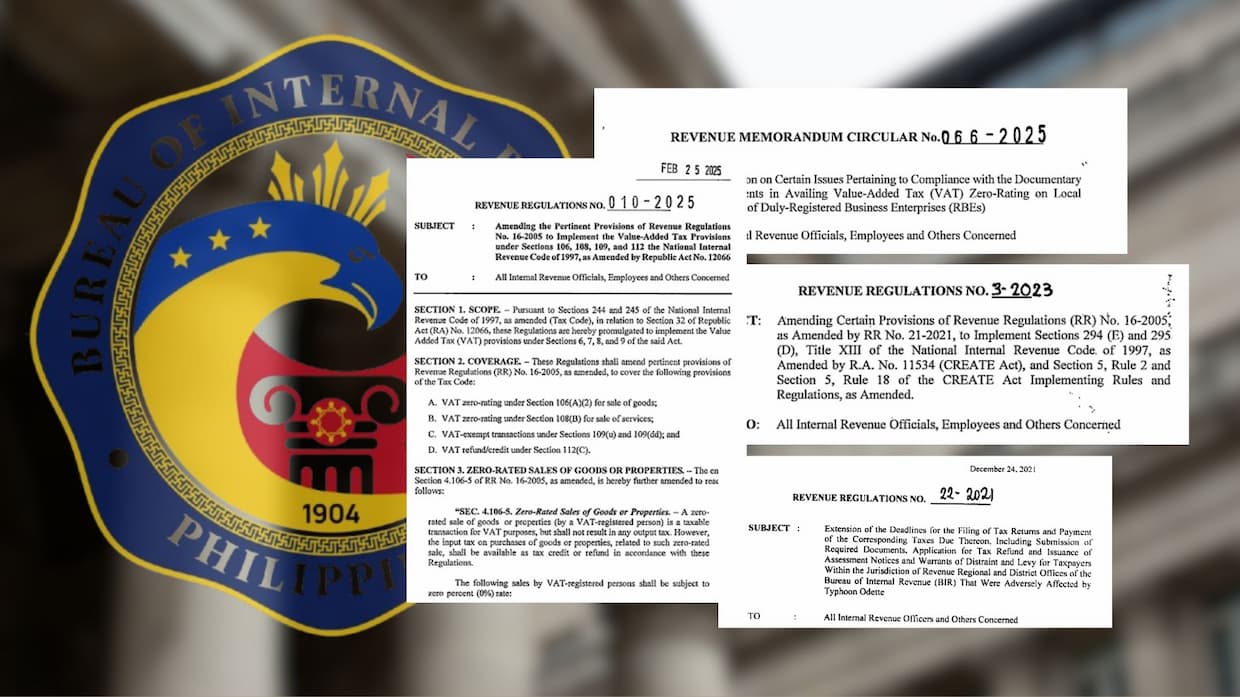
Zero-rated sales of goods are anchored on Section 106(A)(2) and zero-rated sales of services on Section 108(B) of the Tax Code, implemented primarily through RR 16-2005 and later amended by rules issued to align with the CREATE framework and updated VAT provisions. RR 10-2025, issued on February 27, 2025, further amends the regulations to implement VAT zero-rating for goods and services and refine related refund rules, with key application points for claims filed starting April 1, 2025.
- RR 21-2021 implemented CREATE-related amendments affecting zero-rating tied to registered business enterprises.
- RR 3-2023 refined procedures for zero-rating on local purchases of registered export enterprises and removed certain prior-approval
- RMC 66-2025 clarified that a sworn declaration by the RBE-buyer is no longer required under the updated framework, emphasizing reliance on the proper certification and post-audit compliance.
Email admin@lawyerphilippines.org if you want a quick checklist customized to your zero-rating category.
Action: Print your applicable legal basis (Tax Code section + RR + RMC) and attach it to your quarterly evidence file so your documentation matches the exact rule you are invoking.
Zero-rated transactions are VAT-taxable at 0% and may allow input VAT credit/refund, while VAT-exempt transactions are outside the output VAT system and generally do not allow input VAT credit allocation to exempt sales.
Mislabeling a transaction can lead to input VAT disallowance or deficiency assessments.
- A sale “entitled to zero-rate” may be treated differently if required conditions or certifications are missing.
- BIR audits often focus first on classification before computing amounts.
- Correct classification influences your refund strategy under Section 112.
Action: Before filing a refund or responding to an audit, reconcile your sales categories (zero-rated vs exempt vs taxable) against the specific statutory language and current BIR rules.
The most common zero-rated sales of goods involve export sales, generally requiring actual shipment abroad and compliance with payment and accounting requirements under BSP rules as reflected in the implementing VAT regulations.
- Export sales under the regulations emphasize shipment from the Philippines to a foreign country and payment in acceptable foreign currency (subject to specified rules).
- Sales to entities enjoying indirect tax exemption under special laws or international agreements may also be effectively zero-rated.
- Sales of specified goods to qualified registered business enterprises can fall under incentive-related zero-rating.
Action: Match each zero-rated goods sale to its exact category and prepare a single page “export sale proof sheet” per transaction.
Zero-rated services commonly include services rendered in the Philippines to non-residents or entities doing business outside the Philippines, subject to regulatory conditions that often include foreign currency payment and proper supporting documentation, as well as services tied to special law or international agreement exemptions.
- BIR scrutiny often focuses on where the buyer is, where the business is conducted, and what documents prove the nature of the service and payment.
- Misalignment between contract terms and invoicing language is a frequent trigger for reclassification.
- Clear service descriptions and evidence of foreign business context reduce audit risk.
Action: Ensure your contracts and invoices explicitly describe the service, the non-resident context, and the payment terms that align with the applicable zero-rating rule.
The CREATE Act introduced VAT incentives for registered business enterprises (RBEs), including VAT exemption on importation and VAT zero-rating on local purchases of goods and services directly and exclusively used in their registered project or activity, implemented through BIR regulations such as RR 21-2021 and RR 3-2023 and further refined by later issuances.
A major 2025 Supreme Court development, as reported by the Court’s public release, clarified that domestic market enterprises can also enjoy the VAT zero-rating incentive under CREATE and struck down provisions of the IRR and certain BIR issuances that unlawfully limited the incentive to export enterprises.
- This area remains a high-conflict zone because eligibility depends on registration status, the nature of purchases, and proper certification.
- The VAT zero-rating certificate issued by the relevant investment promotion agency is central to compliance for qualifying local purchases.
- A sworn declaration requirement was clarified as no longer required under the updated framework in light of RR 10-2025 and RMC 66-2025.
Action: If you sell to an RBE, request and file the IPA-issued VAT zero-rating certificate before billing as 0% and keep it in your quarterly audit folder.
When the BIR rejects your zero-rated classification, the sale may be reclassified as subject to regular VAT, potentially resulting in deficiency VAT assessments and the denial of input VAT refunds or credits tied to the disputed transactions.
This risk is highest where the rules require specific documentary conditions, certifications, or payment proofs.
- Refund claims can fail even when the underlying sale is truly zero-rated if statutory timelines are not followed.
- Incentive-based zero-rating may be denied if purchases are not proven “directly and exclusively used.”
- Poor documentation creates cascading issues across VAT returns, audits, and refund filings.
Action: Run an internal “zero-rating audit” every quarter to confirm that each 0% sale has complete category-specific evidence.
In a typical dispute, the taxpayer must first validate the legal category, then present transaction-level documents that prove eligibility, and finally reconcile these documents to VAT returns and books to show that the 0% treatment and any input VAT claim are properly supported under the applicable regulations.
- Confirm the precise zero-rating basis under Sections 106 or 108 and the governing RR/RMC.
- Prepare a schedule linking each zero-rated invoice to the contract and supporting evidence.
- For RBE-related zero-rating, secure and validate the relevant IPA certificate.
- Consider whether your strategy is purely audit-defense or also a future refund track under Section 112.
Action: Use a standardized “Zero-Rated Transaction Checklist” for every invoice so your audit response is consistent and complete.
For export sales, the BIR commonly expects proof of actual shipment abroad, properly issued VAT invoices, and documentation showing compliance with payment and accounting requirements referenced in the VAT regulations for export categories.
- Export documentation (shipping or customs-related proofs, as applicable).
- Contracts and purchase orders showing foreign buyer details.
- Proof of payment in accordance with the regulatory requirements for the category.
- Clear quarterly reconciliation to your VAT returns.
Action: Assemble a transaction packet per export sale that a third party can verify in five minutes
Zero-rated services are often disputed when the BIR finds insufficient proof that the buyer is a non-resident or that the service qualifies under the specific statutory category and regulatory conditions, including payment and documentation requirements.
- Contracts that fail to describe the qualifying nature of the service.
- Invoices that use generic descriptions inconsistent with the contract.
- Missing documents connecting the service to the buyer’s overseas business context.
- Poorly organized proof of payment where the rule requires it.
Action: Update your invoice templates to mirror the qualifying language in your contracts and the applicable regulation.
The Supreme Court has repeatedly emphasized strict compliance with the statutory framework for VAT refunds related to zero-rated sales, especially the mandatory timelines and procedural requirements under Section 112, while also addressing policy disputes arising from CREATE-era incentive limitations.
- CIR v. San Roque Power (G.R. No. 187485, 2013): Reinforced the mandatory nature of the 120+30-day rule for VAT refund claims, with limited exceptions based on specific BIR issuances during a defined period.
- Aichi Forging line of cases: Highlighted the jurisdictional impact of failing to observe the statutory waiting period before going to the CTA.
- Mindanao II Geothermal cases: Demonstrated denial of refund claims for late judicial filings even when the taxpayer had zero-rated sales.
- CREATE zero-rating entitlement (2025 SC pronouncement): The Court’s release indicates that domestic market enterprises should not be unlawfully excluded from CREATE VAT zero-rating incentives, striking down limiting IRR/BIR provisions.
Action: If you’re planning a VAT refund, build your timeline backwards from the statutory periods and document the date you completed your submissions.
You should consider legal support when the amounts are material, when your zero-rating relies on incentive-based rules, or when you intend to file or defend a VAT refund claim subject to strict statutory timelines.
- Multi-quarter export or non-resident service arrangements.
- Sales to RBEs where “directly and exclusively used” is fact intensive.
- Any refund strategy that may raise 120+30 timing issues.
Action: Bring your contracts, invoices, RBE certificates (if any), and a draft refund or audit timeline to your first consultation.
Can I treat a sale as zero-rated just because my buyer is foreign?
Not automatically. Zero-rating depends on the specific statutory category under Sections 106 or 108 and the implementing rules that define the conditions for export sales and zero-rated services. The BIR will look for documents showing that your transaction fits the legal definition, not just the nationality of the buyer. Your contract, invoice language, and category-specific evidence must align with the applicable regulation.
Action: Review your transactions against your exact zero-rating category and prepare a one-page proof checklist per sale.
What is the biggest mistake businesses make with CREATE-related zero-rating?
Many businesses bill at 0% without securing or validating the required IPA-issued VAT zero-rating certificate or without proving that the goods or services are directly and exclusively used in the RBE’s registered project or activity. These are high-risk audit points under RR 21-2021 and subsequent amendments. The 2025 Supreme Court development, based on the Court’s release, also shows that eligibility disputes can be policy-driven, so documentation matters even more.
Action: Ask for the buyer’s certification before applying 0% and keep it in your quarterly file.
Do I still need a sworn declaration from the RBE-buyer?
Under the updated framework clarified in 2025, the submission of a sworn declaration by the RBE-buyer is no longer required in light of RR 10-2025, with reliance placed on the proper certification and subject to post-audit. This clarification is reflected in RMC 66-2025.
Action: Update your internal checklist and confirm you have the correct IPA certificate instead of relying on older sworn-declaration practices.
Why do VAT refunds for zero-rated sales get denied even when the sales are real?
Because the rules on timing and procedure are strict. The Supreme Court has consistently enforced the framework under Section 112, including the 120-day period for the CIR to act on the administrative claim and the 30-day period for judicial filing in the CTA upon denial or inaction. If you miss these windows, a valid claim may still be dismissed.
Action: Build a calendar with your submission-completion date and compute the 120+30 schedule before filing.
What should I prepare if I expect a zero-rated audit?
Prepare a quarter-by-quarter reconciliation tying your contracts, invoices, shipment or service proofs, and category-specific requirements to your VAT returns. For RBE-related zero-rating, keep the buyer’s registration documents and the IPA-issued certificate. This structure makes it easier to show compliance under the current VAT regulations and CREATE-related issuances.
Action: Create a “zero-rated audit folder” per quarter and assign one person to maintain a master index of supporting documents.
This article is for general information and does not substitute for legal advice tailored to your facts and documents.
Action: If your zero-rated sales are being questioned—or you’re preparing a VAT refund—email admin@lawyerphilippines.org with your category, quarters involved, and your document list for a focused review.