Understanding the Affidavit of Loss in the Philippines - Lawyers in the Philippines


Losing an important document like an ID, passport, or car registration can be stressful.
But did you know that you can legally declare its loss and request a replacement with an Affidavit of Loss in the Philippines?
An Affidavit of Loss is used to replace missing documents in the Philippines.
It is required when an ID or other important document goes missing.
This article explains an easy way how to write an Affidavit of Loss and goes through important information.

Send us an email with the details for
personalized recommendations or schedule a consulation if needed.
Understanding an Affidavit of Loss in the Philippines and its purpose is essential when you lose something valuable and need to formally report or replace it.
Affidavit of Loss Philippines is a signed and notarized legal document that confirms the loss of a valuable item or document. It is used when a school or government ID goes missing and a replacement is requested.
It has information such as:
- what was lost,
- how it was lost, and
- any identifying information.
The affidavit serves a specific purpose such as telling authorities or institutions about the loss.
It is notarized by a notary public to make the document legally binding and acts as a witness who checks the signer’s identity, confirms that the signature is real and that the statements are made under oath.

An Affidavit of Loss in the Philippines is often issued when a valuable of legal or financial value is lost.
An Affidavit of Loss in the Philippines is used whenever something of value is lost.
Frequent situations in which an Affidavit of Loss is used are:
- Government-Issued IDS
When a driver’s license in lost, the Land Transportation Office will require an Affidavit of Loss before replacing the ID. Likewise, the DFA requires this document to begin the replacement process when a passport is lost.
- Bank Documents
For a lost Credit Card, banks will usually request this document as part of the process of replacing a lost credit or debit card.
- Property and Business Records
When a Land Title is Lost, the first step in the process to replace is submitting the Affidavit of Loss to the Registry of Deeds after which the court case or administrative process to reissue the title can occur.
An Affidavit of Loss in the Philippines can be important when making insurance claims if a valuable item that has insurance is lost or stolen.
This helps them review the claim and process the refund and stops people from making false claims.
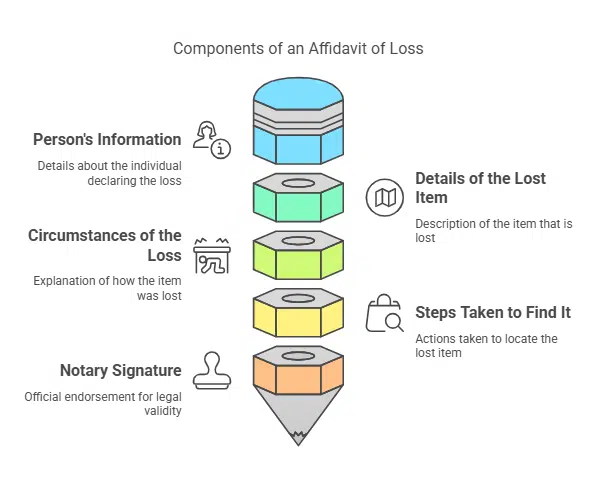
An Affidavit of Loss in the Philippines contains four essential elements:
- Affiant’s details such as his full name, address, contact information and any other identifying details
- Description of the lost item specify what was lost, including any relevant details
- Circumstance of the loss a brief explanation of when, where, and how the item was lost. For instance, if the lost item was a driver’s license, the affidavit can mention if it was stolen, misplaced, or damaged
- Statement of Good faith A sworn statement confirming that the loss was unintentional and that the item has not been recovered.
All the information should be present so that the Affidavit of Loss is complete and accepted.
Take note that for the Affidavit of Loss to be a legal document, it must be signed and notarized in notary public office.
The notary will require proof of identity such as passport, driver’s license or any government-issued ID’s.
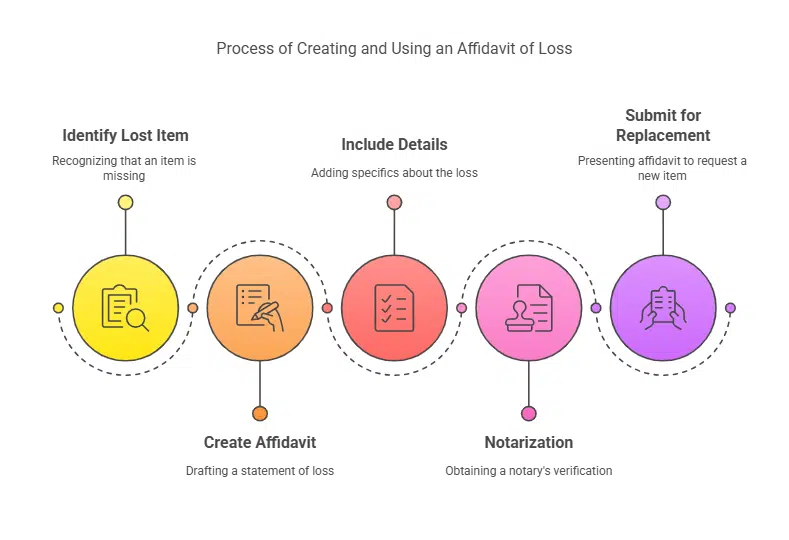
Learn how to easily create an Affidavit of Loss for your lost documents in the Philippines with our comprehensive guide.
Step 1: Gather Information
Write down the details of the lost item, including any identifying numbers or marks.
- Lost Item
- Card Number
- Account Holder Name
- Date Issued
- Date and Place of Loss
- Circumstances
- Additional Info
Step 2: Draft the Affidavit of Loss Philippines
Use an Affidavit of Loss form and fill-in your personal details, item description, and the circumstances of loss.
- Your name, age, status, nationality, and address
- A description of the lost item
- The circumstances of the loss (how, when, and where)
- A declaration of intent to request a replacement
Step 3: Sign in Front of a Notary Public
Take the affidavit to a notary public and sign it in their presence for it to be legally valid.
Step 4: Submit the Affidavit Where Required
After notarization, the next step is to submit the Affidavit of Loss Philippines to the appropriate institution that issued or manages the lost item.
We will provide a ready-to-use template to help you to easily draft their own affidavit.
Below is a sample format for an Affidavit of Loss form commonly used in the Philippines.
This is a basic template and the specific content and format may vary depending on the intended use and affidavit of loss requirements of the requesting organization.
AFFIDAVIT OF LOSS
REPUBLIC OF THE PHILIPPINES
CITY/MUNICIPALITY OF [City/Municipality Name]
S.S.
I, [Your Full Name], of legal age, Filipino, [Civil Status], and a resident of [Your Complete Address], after being duly sworn in accordance with law, do hereby depose and state that:
1. I am the lawful owner of [Describe the lost item/document], bearing [Identification details/Serial number], issued on [Date of Issuance] by [Issuing Authority/Organization].
2. On [Date of Loss], the said [Item/Document] was missing from my possession. I believe it was lost under the following circumstances: [Explain how the item was lost].
3. I have made diligent efforts to locate the said [Item/Document], but my efforts have been unsuccessful.
4. I am executing this affidavit to attest to the truth of the foregoing and for the purpose of [State the purpose of obtaining the affidavit, e.g., “applying for a replacement.”].
5. I am executing this affidavit in good faith and without any intention of misleading any person or entity.
IN WITNESS WHEREOF, I have hereunto set my hand this ___ day of ____, 20__, in [City/Municipality], Philippines.
[Your Signature]
[Your Printed Name]
SUBSCRIBED AND SWORN to before me this ___ day of ____, 20__, in [City/Municipality], Philippines.Affiant exhibited to me his/her competent evidence of identity.
[Signature of Notary Public]
Doc. No. ____;
Page No. ____;
Book No. ____;
Series of 20__.
This Affidavit of Loss form outlines the key elements and structure of Affidavit of Loss.
However, it’s essential to note that individual requirements may vary, and seeking legal advice for specific situations is advisable.

Losing a valuable item can be a real hassle, and if you are unsure of what to do next, getting expert advice is always your best bet. A lawyer can help you draft an Affidavit of Loss in the Philippine standard format and provide a clear breakdown of the associated fees.
You can have an Affidavit of Loss in the Philippines notarized at a law office, notary public or, government official providing notarial service like PAO.
The cost typically ranges from PHP 100 to PHP 500, depending on the notary public and location.

Avoid vague details, missing IDs, wrong format, no notarization, and false claims when writing a valid Affidavit of Loss in the Philippines.
Here are the common mistakes to avoid when writing an Affidavit of Loss:
- Vague Description of the Lost Item
Always include the item’s details such as serial number, ID number, or account number.
- Incorrect or Inconsistent Information
Ensure that all names, dates, and details match the records of the issuing authority.
- Not Getting It Notarized
An affidavit without notarization has no legal weight.
- Failing to Submit It to the Proper Agency
Each agency (DFA, LTO, banks) has its own process. Check their requirements before submitting.
An Affidavit of Loss is a crucial legal document that helps replace lost items. Ensure it is properly written, notarized, and submitted to the correct agency.
Need help drafting an Affidavit of Loss? Contact us today!
Check out our guides on notarization, lost ID replacement, and legal document drafting in the Philippines

1. Is notarization mandatory for an Affidavit of Loss in the Philippines?
Yes, in the Philippines, having the document notarized by a notary public is a key Affidavit of Loss requirement. It is legally valid and accepted in official matters only when a notary public confirms that the affidavit was signed by someone who is of legal age and is mentally sound
2. Can multiple lost items be included in a single Affidavit of Loss?
Yes, you can list several lost items in one Affidavit of Loss in the Philippines. Just make sure to include clear details for each item you have lost. Remember, an Affidavit of Loss is a legal paper. It’s important to be honest and accurate with the information to prevent issues like perjury.
3. How to make an Affidavit of Loss? [ paano gumawa ng Affidavit of Loss? ]
To make an Affidavit of Loss, draft or visit a notary public and write a sworn statement about the lost item and have it notarized.
4. What are the steps to retrieve a lost document after declaring it in an Affidavit of Loss?
If you have lost a document and declared it in an Affidavit of Loss Philippines, you need to reach out to the agency that issued the document to request a replacement. The exact steps can be different based on the type of document. This information is meant to help you and is not legal advice.
5. How is an Affidavit of Loss used for lost government IDs or licenses?
If you lose a government ID or license, like your driver’s license, you need to submit an Affidavit of Loss Philippines. You will send this to the agency that issued the ID, such as the LTO, along with other needed documents to get a replacement. Having a notary public confirm the affidavit helps make your declaration more legal in the Philippines.
6. Are there any specific fees for filing an Affidavit of Loss?
A common question is how much are notary fees. In addition, others may also ask “magkano and documentary stamp tax sa Affidavit of Loss Philippines, o kasali ba ito.” The answer is that it depends on the notary – these fees vary.
7. Do I need a police report to file an Affidavit of Loss?
Not always, but some agencies may require it for valuable lost items.
8. How long does an Affidavit of Loss remain valid?
It does not expire but should be used as soon as possible after the loss.
9. Can I create my own Affidavit of Loss, or do I need a lawyer?
You can draft your own, but a lawyer can help ensure accuracy.
10. Can I use one Affidavit of Loss for multiple lost items?
It’s best to create separate affidavits for different types of lost items.
11. How much is the documentary stamp tax for an Affidavit of Loss? [ Magkano ang documentary stamp tax sa Affidavit of loss Philippines? ]
The documentary stamp tax (DST) for an Affidavit of Loss in the Philippines is 30 pesos, a standard rate for affidavits and is usually paid during notarization.