Complete Guide to Business Incorporation in the Philippines


Incorporation in the Philippines is an attractive choice for those who want to take advantage of the country’s well-educated, English-speaking workforce as well as those who want to be part of the consistently high GDP growth in the last few years.
There are several ways to enter the Philippines:
- Sole Proprietorship
- Domestic Corporation
- Representative Office
- Branch Office
Each has their pluses and minuses, and the correct corporate structure will depend on your exact situation and goals.
In this article, we will go through every single step in detail, starting from what a corporation is to its legal basis to the exact steps that you need to go through to set a company up.

Send us an email with the details for
personalized recommendations or schedule a consulation if needed.
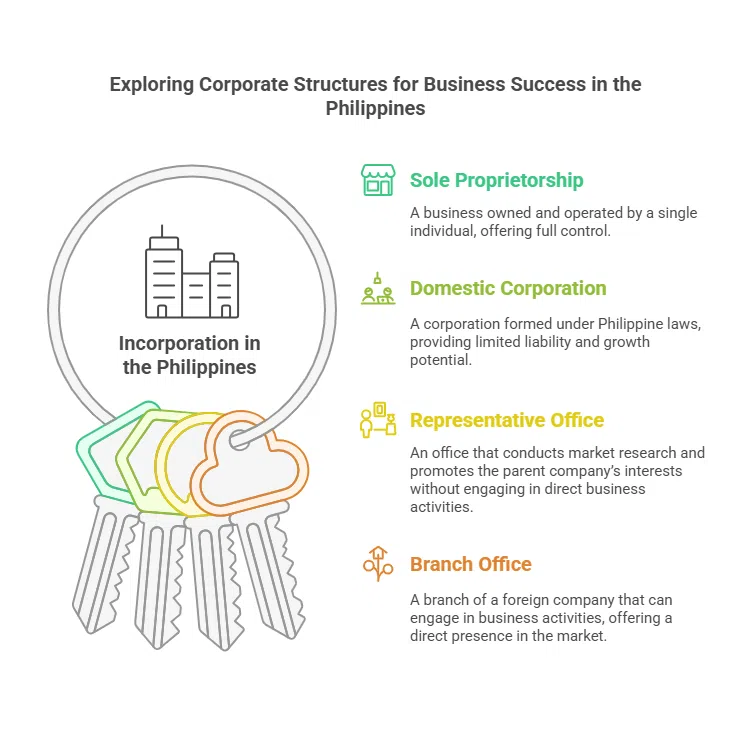
Incorporation is the legal process used when creating a company.
People incorporate because there are seveal benefits a corporation has over an individual, which often outweigh the additional costs of doing business:
- Limited Liability Shareholders are not liabile for a company’s debts or liabilities beyond the initial amount that was invested.
- Access to Capital Companies are able to raise capital from the stock and bond market, which are most often closed to individuals
- Perpetual Existance A corporation can exist independently of its shareholders, regardless of whether these shareholders pass away or their shares are sold
- Access to Markets and Credibility Other companies will require the company’s business incorporation papers before purchasing products or services from them.
- Regulation and Oversight Companies are regulated by the SEC which allow a healthy environment for all business to thrive.
An important part of a corporation is its right of succession. This allows the corporation to keep going even if its shareholders or members die, retire, or sell their shares. This ongoing presence makes a corporation a good choice for businesses as it separates its identity from that of its founders.
Incorporation also gives more flexibility. Corporations follow their own rules and regulations in their bylaws. This allows them to adjust their operations to fit their needs better. They are free from the limits that other business types often have.
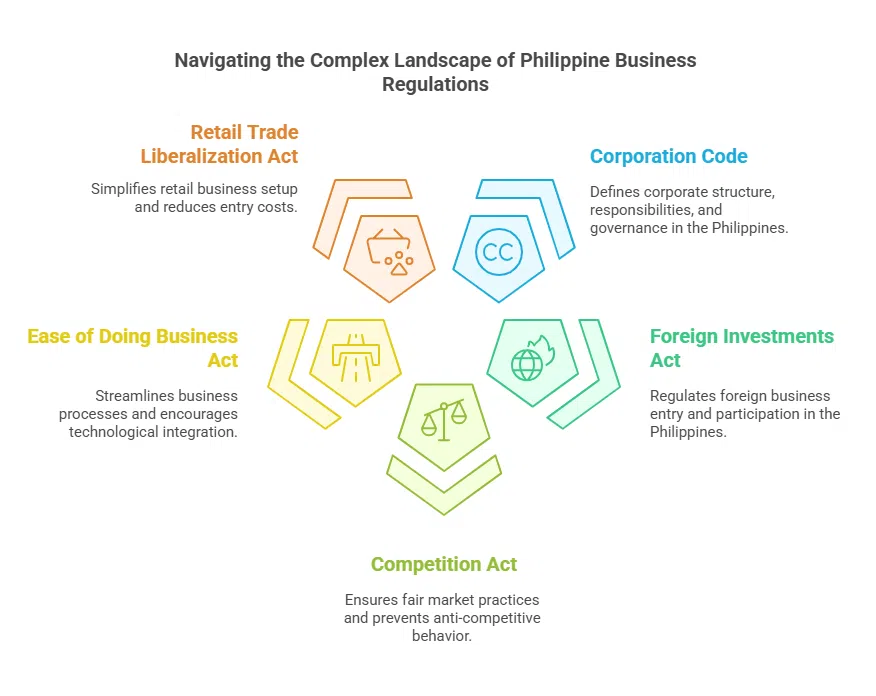
Corporations are regulated by several laws which all interact with each other and can get a little complicated. For particular advice on your desired company set up, it is important to talk to a lawyer, especially if you are looking at tax incentives.
- Corporation Code of the Philippines or RA 11232 is the main law that defines and regulates what a corporation is, its responsibilities and its rights. It underwent a major change in 2019, introducing several changes, among them:
-
- The One Person Corporation, which I discuss in detail down below
- Changes to the Board and Officers, such as allowing for remote voting, removal of the maximum number of trustees and minimum number of incorporators and the requirement for a Corporate Compliance Officer for corporations with vested public interest
- Enhanced corporate governance
- Electronic Filing is expressly encouraged as well as other actions the help make it easier to do business
- Foreign Investments Act enumerates areas of business that foreign companies can enter into through the Negative List. This is often revised every few years, with more and more industries and professions open to foreigners
- Philippine Competition Act which tries to ensure a fair and effective marketplace for industries, and examines M&A that reduce competition as well as prohibiting anti-competitive behavior.
- Ease of Doing Business Act which sets forth standard processing times and encourages the use of technology in the Philippines, as well as puts accountability measures in place
- Retail Trade Liberatlization Act which reduces the incoporation to PHP 25 million and reduces the cost to set up a retail business in the Philippines to USD 200,000. It also does away with certain burdensome compliance requirements.
- Anti-dummy law bans the use of Filipino shareholders to get around foreign ownership limits for certain industries and imposes penalties for infractions.
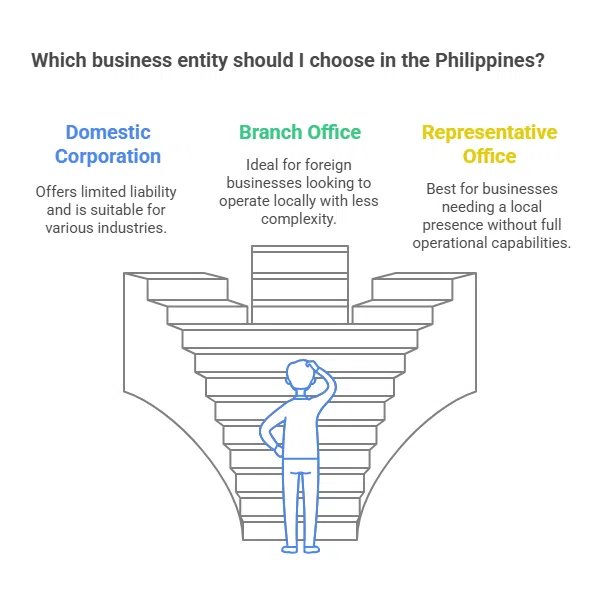
The Philippines gives entrepreneurs different types of business structures to choose from, and each have its own benefits and considerations. If you want to start a business, you need to pick a structure that suits your goals, budgets and requirements.
Some of the things that you will need to think about are:
- Capitalization
- Industry Specific Foreign Ownership Llimits
- Limited Liability
- Ease of Operation
- Purpose of the organization and taxes
Knowing the details of each business type, like how much liability you have, how easy it is to manage, and the tax effects, will help you make a smart choice.
In many cases, a domestic corporation is a good choice but we have also found that branch offices or representative offices are also popular choices, depending on the incorporator’s goals and business objectives.
Sole proprietorships and corporations are two different types of business structures.
Sole proprietorships are well-known and often referred to but they are not quite as robust as corporations in terms of liability protection since they are tied to the life of the founder.
The founder owns and runs the business. The structure is very simple and gives the owner full control. There is less reporting for sole proprietorships, but this also means that the founder is liable for any debts that the business may incur.
In contrast, a domestic corporation is often used for more complex businesses. It creates a separate legal entity for the business. This protects the personal assets of the owners by limiting their liability. However, corporations have more rules and require extra paperwork and compliance.
A One Person Corporation (OPC) is a special type of corporation in the Philippines.
It has the following features:
- It has greater limited liability than a sole proprietorship
- It can be founded by a trust, estate or natural person including foreign national (although a foreginer is still subject to the negative list)
- No minimum captial requirements unless required by a specific industry/law.
- A Corporate Secretary as well as a Corporate Treasurer must be appointed 15 days from incorporation, and 2 Nominees must be appointed in case the stockholder cannot run the business.
- If the stockholder and treasurer is the same person, then a surety bond must also be provided with the amount depending on the authorized captial stock.
An OPC provides some of the benefits of a sole proprietorship while at the same time providing some of the benefits of a corporation. It can be the correct structure if you are want a simpler structure and organization and ease of management. However, becuase power is concentrated in the hands of only one shareholder, that shareholder has to prove that the company was adequately financed because otherwise that shareholder then becomes liable for the OPC’s liabilities.
A domestic corporation is a type of business that is set up and registered in the Philippines and is the equivalent of a limited liability corporation abroad.
There are many advantages to a corporation:
- Limited Liabilty as the company’s liabilties are separate from that of the shareholders
- Foreign ownership is possible except if limited by the Negative List, which defines the areas which only Filipinos can enter
- 100% Foreign ownership is possible if:
- if export oriented or not limited by the negative list
- USD 200,000 if catering to the local market and
- USD 100,000 under specific situations such as 50+ employees, or in a high tech space
- Taxes such as Income taxes, withholding taxes, VAT and MCIT apply.
A domestic corporation is a very common and highly utilized corporate structure.
It has a full board and set of directors and officers and has a regulated decision making process and so there is often a lot of paperwork and compliance involved in running a corporation, but the limited liability protection is very important to most founders which is why this structure is the most common type.
A Philippine Branch Office lets foreign companies set up a direct presence in the Philippines. It’s an extension of the main company and is allowed to earn money in the country. This option is attractive for foreign companies that want to grow their business and join the Philippine market.
- A Branch office is an extension of a foreign company and so shares liability with its parent
- Capitalization is USD 200,000 or USD 100,000 if it is a high tech company or has 50+ employees
- Taxes are income tax, withholding tax, VAT
- Profit remittance is 15% but can be lower if there is a tax treaty in place. It can be exempt if it is in PEZA.
- Can sell to the Philippine market
- Easier administration as it requires only a Representative Agent
Although a branch office provides direct access to the market, remember that it is not a separate legal entity. This means that the parent company is still responsible for any issues that arise in the branch office. This may be a concern for some companies, so it is important to evaluate this with a legal professional.
A Philippine Representative Office is a point of contact for a foreign corporation. It helps the corporation have a presence in the Philippines, but it can’t engage in direct commercial activities and cannot sell to the Philippine local market. This setup is good for foreign companies that want to look at market chances, do research, or make business connections before starting full operations.
- A Representative Office in the Philippines is an extension of a foreign company so liability is extended to the parent
- Cannot sell to the Philippine market but is instead ideal for back offices
- Capitalization is USD 30,000 which must be remitted yearly
- Taxes are withholding tax and VAT
- Representative Agent needed
Like a Branch Office, a Representative Office in the Philippines shares liablity with its foreign parent.
It is however, the ideal structure for those who want to set up back office operations and have their cost center here.
Beyond sole proprietorships and corporations, the Philippines offers additional business entities. These are
- Partnerships
- Cooperatives
- Regional Headquarters
- Regional Operating Headquarters
Partnerships pool together resources and expertise from two or more individuals. Partnerships can be general partnerships or limited partnerships, with the distinction being the amount of liability assumed.
On the other hand, cooperatives, registered under the Cooperative Development Authority, promote shared ownership and decision-making among their members.
Each structure comes with unique advantages and considerations, necessitating careful evaluation based on the specific needs and goals of the business.
Of particular interest to foreign incorporators may be the Regional Headquarters or Regional Operating Headquarters. A Regional Headquarters requires an annual remittance of USD 50,000 and serves as a logistical, communication and coordination hub for regional operations. A Regional Operating Headquarters requires USD 200,000 and serves as a back office for regional operations.
A careful look at your business type, planned activities, and long-term goals is important when choosing the right business structure. You should think about factors like liability, ease of administration, and tax implications.
It’s also vital to understand the capital requirements for your chosen structure. This means not only having the minimum paid-up capital but also including operational costs, plans for growth, and any unexpected expenses. By knowing your financial capacity well, you can run your business smoothly.
The number of employees you plan to hire affects the capital you need. Planning your workforce size ahead of time can help you avoid compliance issues later. By examining these factors thoroughly, you can approach the incorporation process with a clear path for your business’s future.
Compliance with documentary requirements is key in the company registration process. Meeting all the requirements makes everything smoother and prevents delays. It’s best to check the official guidelines from the relevant government agency, like the Securities and Exchange Commission (SEC).
Different documents are required for different entities – for instance, an OPC will need a Letter of Appointment of Nominee and Alternate Nominee while a FIA Form is needed for those applying for a license to do business in the Philippines
- Cover Sheet for Registration
- Articles of Incorporation and Company By Laws
- ID documents of the incorporators
- SPAs would be required if someone is working on this for you
- Clearance or Endorsement from other government office, if there are industry specific clearances required
- Treasurer’s Affidavit, if needed
- Joint Undertaking to Change Name, if not in the Articles
- Notarized Bank Certificate of Deposit or Proof of Inward Remittance by Non-Resident Aliens/Subscribers, as applicable and as required
- For an OPC:
- Letter of Appointment of Nominee and Alternate Nominee
- Proof of Authority if the single stockholder is a trustee, executor or other person excercising fiduciary duties
- For foreign subsidiaries: FIA Form (F-100)
- Foreign Investment Application Forms, for Branch, Representative, Regional Headquarters and Regional Operating Headquarters as well as Financial Statements
The Articles of Incorporation (AOI) are very important to a company. This legal document includes the company’s name, purpose, main office address, details about ownership, and other key information. It’s really important that the information in the AOI is accurate and complete.
On the other hand, the bylaws create the rules for how the corporation runs. They cover things like how meetings are held, how officers and directors are elected, and other ways the company is managed. Together, these documents set up the legal system that the company follows.
The Articles and the By Laws are created for new corporations, but since Branch Offices, Representative Offices, Regional Headquarters and Regional Operating Headquarters are extensions of an already existing entity, then the parent entity’s Articles and By-Lawe are what will be submitted.
Note –
There are also very specific requirements for lending companies, condo corps, home owners associations, etc. This can be confusing, and so its best to discuss with a lawyer regarding the exacct requirements.
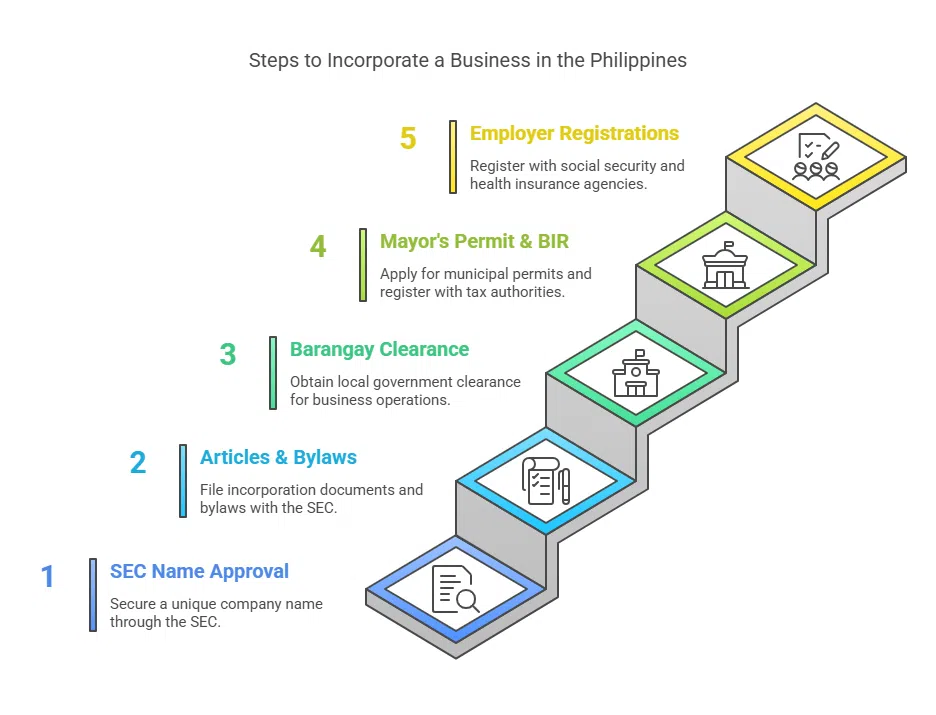
Aside from the above list of requirements, you will be working with a lot of government offices.
These government offices are:
- The Philippine Securities and Exchange Commission (SEC) which gives the primary business incorporation documents
- Barangay Office for the barangay business permit
- Mayor’s Office for the City Business Permit
- Bureau of Internal Revenue to which taxes are paid and reported
- Statutory Benefit Goverment Agencies
- Social Security System which provides loans to its members for disaster, disability or illness
- Philhealth which is the public healthcare system
- Pag-ibig which allows public borrowing for home purchase
- Industry Specific Agencies There are industry specific agencies that you may need to liaise with
These government bodies are crucial and you will be interacting with them frequently.
In some cases such as the Mayor’s Permit and the Barangay Permit, the registrations will need annual renewal.
In other cases, annual compliances or reporting will be needed.
You must also abide by each agencies pronouncements and jurisdiction.
Starting your business in the Philippines requires a careful and organized way to do things. You need to follow all the legal steps to meet the requirements. By doing this, you can speed up the process and create a solid base for your venture.
It is important to know the newest rules and guidelines. Getting help from business advisors or legal experts can give you helpful advice and make the groundwork smoother for your business.
Step 1: Securing a Company Name with the SEC
The first step to starting your business in the Philippines is registering your company name with the Securities and Exchange Commission (SEC).
The SEC will check to see if your proposed business name is unique and it is important to have a few backup names ready, just in case your first choice is used or too similar to another company’s name. This name verification usually takes a few business days.
The name verification can be done online or in person at the SEC.
Step 2: Filing Articles of Incorporation and Bylaws or Initiatory Documents at the SEC
The SEC process has the following steps:
- Document Gathering There is a lot of preparation prior to filing, with the several decisions and the required registration documents to be gathered.
- Online Application The information and documents are uploaded into the SEC Onling System, which is also where a name is reserved
- Payment The payment for the application can be paid online
- Processing and Approval The SEC will take time to process your business registration and approval it if all is well. If there are deficiencies in the information, then they must be addressed before proceeding
- Hardcopy Submission Harcopies must be submitted.
Generally, if everything goes well, the SEC will approve the business permit application.
Should there be a request for more information or an issue with the documents, the SEC will raise it. These issues must be resolved before moving on to the next steps.
Step 3: Obtaining Barangay Clearance
After you launch your company, the next step is to get a Barangay Clearance from the local government unit (LGU) where your business is located. The Barangay is the smallest unit of government in the Philippines. This clearance shows that your business follows the rules of that specific area.
To get the Barangay Clearance, you must bring the right documents to the Barangay Hall where your business is registered. Commonly required documents include a certified copy of your SEC Certificate of Incorporation, a lease contract or proof of your business address, and any other papers that the LGU asks for.
This step shows that the local government knows about your business and that you are serious about following local rules and laws. Getting the Barangay Clearance is usually needed before you can get other business permits. It makes sure your company operates legally in its local community.
Step 4: Applying for a Mayor’s Permit and BIR Registration
With the Barangay Clearance in hand, you need to apply for a Mayor’s Business Permit at the city or municipal hall where your business is located. The Mayor’s Permit allows you to run your business in the city or municipality. It shows that your business is legitimate and follows local rules.
The Business Permit at City Hall requires several things:
- An application form
- The SEC Certificate
- The Clearance from the Barangay
- The Contract of Lease and sketch of location
- Certificate of Occupancy, that your landlord should be able to provide you with
- Building Permit, Fire Inspection and Sanitary Permit
It takes a bit of back and forth with the Mayor’s Office as well as the payment of the correct fees, so be prepared to work through this patiently.
At the same time, you must register with the Bureau of Internal Revenue (BIR). This is an important step that makes your business recognized by the tax authorities. When you register with the BIR, you will get a BIR Certificate of Registration, receive your Taxpayer Identification Number (TIN), and register your books of accounts.
These actions help you meet your tax obligations and support the national revenue. Registering with the BIR allows the government to monitor your income and tax duties, which helps promote transparency and accountability in your finances.
Step 5: Employer Registration and other Registrations
As a responsible employer in the Philippines, your next step is to register with different government agencies to provide benefits for your employees.
- Social Security System (SSS)
- Philippine Health Insurance Corporation (PhilHealth)
- Home Development Mutual Fund (HDMF), also called the Pag-IBIG Fund.
These are all mandatory compliances and must be complied with as part of Philippine labor laws.
The SSS gives social security protection for private-sector employees. It acts as a safety net during situations like disability, sickness, maternity, retirement, or death. PhilHealth helps ensure that all Filipinos have access to affordable and quality healthcare services.
The Pag-IBIG Fund focuses on housing needs, offering affordable housing loans and saving programs for Filipino workers. By meeting these requirements, you not only follow Philippine labor laws but also show that you care about your employees’ social security and well-being.
On the other hand, PhilHealth offers access to affordable healthcare services at public and local hospitals.
Additionally, depending on your business activities, you may require special licenses or permits to operate legally. These can vary significantly based on the industry and local government regulations, so it’s crucial to gather all necessary documentation early in the process to ensure a smooth operational launch.
Often, people are so concerned with the company’s business permit application, that they forget there are on-going business requirements that must be complied with.
- BIR monthly and annual quarterly reports, which will depend on the what your BIR Certificate of Registration says
- SEC Compliances such as filing the annual GIS
- Corporate Secretary / Resident Agent must be updated
- Compliance requirements, depending on the industry
The on-going requirements must be strictly adhered to.
The Philippines is a little bureaucratic, so it is best that everything is fully complied with.
What is the Minimum Capital Requirement for Incorporation?
The minimum capital needed in the Philippines depends on whether you want to create a domestic corporation or a foreign corporation. It can also change based on the industry you are part of and how much foreign equity is involved.
Can a foreigner start a business in the Philippines?
Yes, a foreigner can form an business in the Philippine subject to the Foreign Investment Negative List. The Negative List is a list of industries that cap foreign ownership at various percentages, due to public interest or national security concerns. This is amended every few years as more industries have been opened to foreign investment.
What is the minimum captial to start a business in the Philippines with 100% foreign ownership?
If it is export oriented or not on the negative list, the capitalization can be as low as 100%. If it sells to the local market, it may need USD 200,000 or USD 100,000 depending on the situation.
Who serves as the director and officer of an OPC?
The shareholder is the director and president of the OPC.