Foreign Business Ownership in the Philippines - Lawyers in the Philippines


Foreign business ownership in the Philippines continues to be liberalized through new laws and pronouncements, such as the Foreign Investment Negative List, the Retail Trade Liberalization Act, Amendments to the Public Service Act, and the Foreign Investments Act and its Amendments.
Along with the existing option for a foreigner to own 100% of an export oriented company, these collective change promote higher foreign equity under easier capitalization loads, or even 100% foreign equity.
For any foreign investor determining investment options in the Philippines, it’s worth looking at the framework for foreign investment and the corresponding laws to determine the correct path forward to incorporate in the Philippines and make use of its outsourcing infrastructure and well-trained labor pool.

Send us an email with the details for
personalized recommendations or schedule a consulation if needed.

Philippine law now allows easier 100% foreign business ownership with reduced equity restrictions.
Yes! Foreign business ownership Philippines is possible!
Foreigners currently can own 100% of an export-oriented domestic corporation, which is often used for outsourcing companies that serve foreign clients or manufacturers that primarily export abroad.
That – in and of itself – allows many foreigners to set up shop here and to service client abroad.
In addition to this, new developments in the law reduce foreign equity restrictions that make owning a business for foreigners easier by reducing capital requirements – such as those found in the Retail Trade Liberalization Act – or open up areas of investment previously reserved for Filipinos, such as the most recent Foreign Investment Negative List.
The framework for foreign equity is essentially as follows:
- Foreign equity is allowed depending on the type of industry, with industry caps for foreign investment specified in the Negative List.
- Foreign equity must first be assessed against this list to see what the industry caps are, with general rules of thumb being that most corporations can be 40% foreign owned, excepting certain industries linked to defense or national interest.
- Foreign equity can be 100% in export-oriented businesses – in fact, most foreigners do end up setting up large call centers or manufacturing operations under these rules.
- Retail businesses such as restaurants or stores require 25M for full foreign ownership.
- Aside from a Philippine domestic corporation, there are several other ways that foreigners can enter the Philippines, but these are considered extensions of the foreign parent and so liability extends to the foreign parent although they do offer 100% foreign ownership
- Branch Office
- Representative Office
- Regional Operating Headquarters and Regional Headquarters
- For more information on licenses to do business, read this and this.
Most prefer domestic corporations since their liability is stronger and they do not require a pre-existing foreign entity.
However because of the above equity restrictions, it is possible that some industries would allow 100% foreign equity while others would not.
So, for example, a foreigner wanting to have 100% foreign equity for a call center would be allowed without minimum capital requirements, whereas a foreigner desiring 100% foreign equity in restaurants might face a 25M capitalization rule. However, a foreigner can own 40% of a restaurant business without a minimum capitalization requirement.
TLDR: Foreign equity is generally about 40% but this can be higher or lower depending on the Negative List – but a specific exception is that 100% Foreign equity is available for export-oriented businesses such as call centers. In addition, some industries may allow 100% foreign equity but only under minimum capitalization requirements (e.g. Retail)
Action: Check industry specific caps in the latest Negative List first to determine what is available to you in your specific situation and email admin@lawyerphilippines.org for situation specific advice.

Philippine foreign ownership shaped by Constitution, laws, and Negative List with key industry limits.
Foreign ownership in the Philippines is bounded by the 1987 Constitution, RA 7042 and RA 11647, Executive Order No. 175 or the Foreign Investment Negative List as well as some industry specific and professional laws.
- The 1987 Constitution, limits foreign ownership in areas in specific areas such as public utilities, mass media, advertising, land and natural resources; furthermore it grants congress the right to reserve areas of investment for Filipinos and specifies the 60% that is so familiar to us.
The Congress shall, upon recommendation of the economic and planning agency, when the national interest dictates, reserve to citizens of the Philippines or to corporations or associations at least sixty per centum of whose capital is owned by such citizens, or such higher percentage as Congress may prescribe, certain areas of investments. (Article XII, Section 10, Philippine Constitution)
- Executive Order No. 175 (2022), which promulgates the Twelfth Regular Foreign Investment Negative List identifying sectors either closed to or partly restricted for foreign business ownership Philippines.
- Republic Act No. 7042 and its amendment Republic Act No. 11647 collectively form the Foreign Investments Act of 1991, which provides a framework for foreign investment. Among other items, it defines the very popular entities of the branch office and representative office, which are under a foreign license to do business. (As a side note, the Regional or Area Headquarters (RHQ) and Regional Operating Headquarters (ROHQ) – which are also foreign licenses to do business – come instead from Republic Act No. 8756, amended by the Omnibus Investments Code.)
- Republic Act No. 8762, as amended by Republic Act No. 11595, or the Retail Trade Liberalization Act govern retail trade and is now revised to allow a lower minimum paid-up capital and relaxed conditions for entry into the Philippine retail landscape.
- Commonwealth Act No. 146 (Public Service Act) as amended by Republic Act No. 11659, defines “public utility” differently so that the businesses subject to the 40% foreign equity cap are less.
- Executive Order No. 175 (2022), which promulgates the Twelfth Regular Foreign Investment Negative List identifying sectors either closed to or partly restricted for foreign business ownership Philippines and should be the “first stop” for any foreign investor in the Philippines who wants to operate in the Philippines.
TLDR: Foreign equity investments into the Philippines are defined by both broader laws such as the constitution as well as sector specific laws, and the laws applicable to you depend on the entity and the industry you choose to be in.
Action: Create a 1 page company profile explaining what the company does in detail, what desired liability protections you have, and what your percentage of foreign equity would be. Have this assessed by a lawyer to determine what industry classification it would be.

The newly amended business laws relating to 100% foreign ownership align investment policies with the government’s goal of balancing economic growth and the protection of national interests.
Jointly, RA 11595 (Retail Trade Liberalization), RA 11659 (Public Service Act amendments), and RA 11647 (Foreign Investments Act amendments) eased restrictions around foreign equity, making it both cheaper and easier to have 100% foreign ownership in the Philippines.
The newly amended business laws relating to 100% foreign ownership align investment policies with the government’s goal of balancing economic growth and the protection of national interests. With them, 100% foreign ownership in the Philippines is now easier than ever, since these reforms have significantly lowered capitalization thresholds and redefined certain industries—such as telecommunications, shipping, and retail—making them more accessible to foreign investors.
A specific example is the removal of telecommunications, airlines, railways, and subways from the “public utilities” classification by RA 11659 – meaning that these now can qualify for 100% foreign equity so long as there is a corresponding reciprocity agreement with that foreign national’s country for what the Philippines calls “critical infrastructure”.
Another change is that the Retail Trade Liberation Act (RA 11595) reduced the capital maintenance amount from its previous USD 2.5 million: “The foreign retailer shall be required to maintain in the Philippines at all times the paid-up capital of Twenty-five million pesos (P25,000,000.00).”
By opening up previously restricted sectors and streamlining entry requirements, the Philippines has positioned itself as a more welcoming destination for global business.
These changes reflect the government’s commitment to attracting long-term foreign investment and fostering inclusive economic growth.
These new developments – along with the 2022 Negative List – have allowed foreign ownership of several new industries.
TLDR: New laws have allowed foreign equity into more sectors subject to certain conditions such as reciprocity and the Foreign Investment Negative List.
Action: Because the laws on foreign ownership are the domain of many different laws, it’s very important to check with a lawyer as to what your exact foreign equity percentage would be due to the interplay of industry specific and broader laws like the Foreign Investments Act.

Retail trade is the habitual selling direct to the general public of merchandise, commodities or goods for consumption.
The amendments to the RA 11595 RTLA made it much easier for foreigners to participate in retail in the Philippines as it removed pre-qualification requirements – for instance, the requirement to have 5 branches or franchise operations – as well as by reducing capital from USD 2.5M to Php 25 million, which is considerably lower.
Since retail trade is the habitual selling directly to the general public of merchandise, commodities or goods for consumption, this amendment covers a broad array of enterprises, including restaurants, clothing stores, drug stores, department stores, and groceries.
One of the most significant items in the Retail Trade Liberalization Act is the reduction of the minimum capitalization of foreign retailers from $2.5 million to Php 25 million and the reduction of the minimum investment per store from $250,000 to P10 million.
Because of this, 100% foreign ownership in the Philippines or a retail business is now made more affordable through the reduced capitalization requirements.
Additionally, the amendments also removed the extensive pre-qualification requirements for retailers in the old law.
These were often prohibitive barriers because they required the retailer to have:
- A minimum of Two hundred million US dollars (US $200,000,000.00) net worth in its parent corporation for Categories B and C, and Fifty million US dollars (US $50,000,000.00) net worth in its parent corporation for category D;
- 5 retailing branches or franchises in operation anywhere around the word unless the such retailer has at least one (1) store capitalized at a minimum of Twenty-five million US dollars (US$25,000,000.00);
- Five (5)-year track record in retailing
- The retailer was further obliged to secure a Certificate of Prequalification Compliance from the Board of Investments to prove that these requirements had been met.
In place of pre-qualification, the Department of Trade and Industry, the National Economic and Development Authority and the SEC were tasked to monitor companies’ continuing compliance with the minimum paid-up capital.
The Retail Trade Liberalization Act has thus really streamlined the requirements and made it far more affordable to invest in the Philippines for foreign retailers.
Take note that it is important to fully comply with the capital requirement since the failure to maintain Php 25M without notifying the SEC or DTI of the intent to cease operations and repatriate capital can lead to penalties and restrictions on future trading in the Philippines.
To register the retail enterprise with the SEC or the Department of Trade and Industry, the foreign retailer must submit either a certificate of inward remittance of its capital investment from the Bangko Sentral ng Pilipinas (BSP) or present other proof certifying that its capital investment is deposited and maintained in a Philippine bank.
TLDR: Due to the Retail Trade Liberalization Act, capitalization cost has been lowered to PHP 25 million, investment per store reduced to PHP 10M and pre-qualification requirements have removed, allowing foreigners easier and cheaper access into retail.
Action: Create a one page checklist with your lawyer to ensure that you have complete requirements to qualify to enter the Philippine’s retail market and review your compliances and document with him.

The protectionist language of the Public Service Act[i] previously required all companies engaged in industries that the law classified as “public service” to be at least 60% Filipino-owned.
This was because of a broad interpretation of the term “public utilities” which the law specifically reserved for Filipino-owned and controlled companies.[ii]
The Public Service Act Amendments removed enterprises that are classified as public service from the public utilities list, now allowing up to 100% foreign equity subject to reciprocity.
Previously, the protectionist language of the Public Service Act [i] required all companies engaged in industries that the law classified as “public service” to be at least 60% Filipino-owned.
This was because of a broad interpretation of the term “public utilities” which the law specifically reserved for Filipino-owned and controlled companies. See Santos v. The Public Service Commission, G.R. No. 26771, September 23, 1927, where the distinction between public utility and public service was blurred:
It will first be observed that the phrases “public services” and “public service” substitute and supercede the phrases “public utilities” and “public utility.”
The Supreme Court previously used the two terms to refer to the same thing, despite their being found in different laws, and it is from this perspective that the protectionist provisions in the 1987 Constitution were crafted.
Thus, companies engaged in “public services” such as telecommunications, freight or carrier transport, railway operations, and others were all considered to fall within the language of “public utilities” which were excluded from foreign control or investment.
The new amendments to the Public Service Act change all this.
The amendments create a clear distinction between the two terms, making it plain that they are not the same.
This now means that “public utilities” which the law restricts to Filipino-owned and controlled companies are confined to a smaller subset of industries than “public services” which are not necessarily so restricted. [iii]
The amendments of the Public Service Act narrow the scope of what is considered a “public utility”, limiting it to only those that operate, manage, or control for public use the following sectors:
- distribution of electricity,
- transmission of electricity,
- petroleum and petroleum products pipeline transmission systems,
- water pipeline distribution systems and wastewater pipeline systems, including sewerage pipeline systems,
- seaports, and
- public utility vehicles
The Public Service Act amendments explicitly state that no other person shall be deemed a public utility unless a subsequent law provides for it.
So, sectors not included in the above list are no longer subject to foreign equity restrictions which now means that railways, airports, subways can be 100% foreign owned so long as:
- the foreign country of the owner allows the same reciprocity to a Filipino
- the enterprise is not controlled by a foreign government
- it is not classified as critical infrastructure
This allows foreign capital to now enter many sectors since “public services” encompass a far wider list of sectors than those enumerated as “public utilities”. [iv]
There are still certain safeguards – mainly those dealing with national security considerations.
For instance, companies controlled by foreign governments or state-owned enterprises are prohibited from investing in public utilities or critical infrastructure.
Entities owned or controlled by foreign governments or state-owned enterprises cannot make new investments in any public utility or critical infrastructure, with the exception of sovereign wealth funds and independent pension funds of states which are subject to a 30% foreign equity restriction or limit.
Furthermore, critical infrastructure is defined as:
any public service which owns, uses or operates systems and assets, whether physical or virtual, so vital to the Republic of the Philippines that the incapacity or destruction of such systems or assets would have a detrimental impact on national security, including telecommunications and other such vital services as may be declared by the President.
Elaboration by NEDA PSA IRR (took effect 4 April 2023) states that only public services engaged in the provision of telecom services are treated as critical infrastructure, so right now the prohibition applies only telecommunications, although this can change.
But the benefits of these amendments to the Public Service Act include attracting more global players in order to modernize sectors like telecommunication, shipping, air carriers, railway, and subways.
The greater foreign investment is intended to create more domestic jobs and income.
The opening of industries is also meant to stimulate increased competition in terms of services and products to the consumers’ benefit, resulting in better quality services and more competitive pricing.[v]
[i] Commonwealth Act No. 146.
[iii] Republic Act No. 11658.
[iv] Public services include any common carrier, railroad, street railway, traction railway, sub-way, motor vehicle, either for freight or passenger, or both, with or without fixed route and whatever may be its classification, freight or carrier service of any class, express service, steamboat, or steamship line, pontine, ferries, and [small] watercraft, engaged in the transportation of passengers [and] freight, shipyard, marine railway, marine repair shop, warehouse, wharf or dock, ice plant, ice refrigeration plant, canal, irrigation system, [sewerage,] gas, electric light, heat and power, water supply and power, petroleum sewerage system,[telephone] wire or wireless [telegraph] system [and] broadcasting [radio] stations.
[v] Department of Trade and Industry Secretary Ramon Lopez, https://www.dti.gov.ph/archives/news-archives/amended-public-service-act-to-fuel-economic-rebound/
TLDR: Public utilities are now limited to distribution of electricity, transmission of electricity, petroleum and petroleum products pipeline transmission systems, water pipeline distribution systems and wastewater pipeline systems, including sewerage pipeline systems, seaports, and public utility vehicles – for the rest 100% foreign equity is allowed, subject to reciprocity and so long as the entity is not controlled by a foreign government. Critical infrastructure also has special restrictions.
Action: Created a detailed list of all the functions that the enterprise is expected to do, and evaluate this carefully, to ensure that you are not classified as a public utility.
The amendments to the Foreign Investments Act reserve to Philippine nationals those micro, small, and medium-sized enterprises (MSMEs) with a capitalization of less than $200,000.
The guiding principles of the Foreign Investments Act state that foreign investments can reach up to 100% in a domestic enterprise subject to other laws , and to the principles of transparency, reciprocity, equity and economic cooperation (Sec 1 and Sec 6 of RA 11647).
This creates a framework where foreign investment is welcomed, and forms the backbone for much of the deregulation seen in other laws.
RA11647 does reserve to Philippine nationals those micro, small, and medium-sized enterprises (MSMEs) with a capitalization of less than $200,000 as it states that only Filipinos can own SME business.
However –
It allows foreign ownership and control of MSMEs with a capitalization of at least $100,000 so long as they meet the following conditions:
- Utilize advanced technology (as determined by the Department of Science and Technology);
- Endorsed as startup enablers or as a startup under the Innovative Startup Act; or
- The company hires no less than 15 Filipino employees (down from the previous requirement of 50).
- Remember that prior to availing of this lower capitalization, certifications must be collected from various agencies since permission must be granted by the government body first, before stating that the company is eligible for the lower capitalization – without doing so, you might be sanctioned or forced to increase capital to continue to operate. (And it is going to be very, very difficult to get out of that.)
- Rule VI of Section 19 of the Implementing Rules and Regulations (IRR) of the IFA states that availing of the exception requires you to submit certificates form the DOST for advanced technology, DICT for startups or startup enablers, or DOLE for employment of 15 employees to qualify for the reduced capital.
Furthermore, there are tax incentives possible.
The amended FIA law requires foreign export enterprises to register with the Bureau of Internal Revenue and follow the export requirements provided by Title XIII of the national tax code to avail of any tax incentive or benefit such as income tax holidays.
Also, the amended FIA law provides for the creation of an Inter-Agency Investment Promotion Coordination Committee (IIPCC). The IIPCC will henceforth be the body that integrates all promotion and facilitation efforts to encourage foreign investments into the country.
The IIPCC shall be composed of the:
- Secretary of the Department of Trade and Industry to preside it as Chairperson;
- Secretary or Undersecretary of the Department of Finance (DOF) as Vice-Chairperson;
- Board of Investments (BOI) Managing Head;
- Director-General of the DTI-Philippine Economic Zone Authority (PEZA);
- Undersecretary of the Department of Foreign Affairs (DFA), Office of the Undersecretary for
- Multilateral Affairs and International Economic Relations (OUMAIER);
- Secretary of Socioeconomic Planning of the National Economic and Development Authority (NEDA);
- Secretary of the Department of Information and Communications Technology (DICT);
- Chairperson of the Commission on Higher Education (CHED);
- Director-General of the Technical Education and Skills Development Authority (TESDA); and
- Four representatives composed of a representative each from the National Capital Region, Luzon, Visayas and Mindanao, to be chosen from a list of nominees prepared and submitted by nationally recognized leading industry or business chambers, who must be of known competence, probity, integrity and expertise in any of the fields of investment, advertising, banking, financial management and law, with at least ten (10) years of outstanding management or leadership experience.
The amended Foreign Investments Act explicitly provides that it does not cover banks and other financial institutions as those are covered by special banking and financial laws (e.g., General Banking Law, BSP regulations).
It also does not cover the practice of professions so the law should not be read to exclude foreigners from practicing their profession in the Philippines.
The practice of professions is not regulated under the Foreign Investments Act, but only specially regulated by professional regulatory boards or similar bodies or reciprocity agreements with other countries.
This adopts the view that the practice of professions is not an investment activity under the scope of the Foreign Investment Act.
The latest Negative List, issued in June 2022 after the passage of these three laws, reflected the relaxation of restrictions that they provided.
It is also worth noting that the amended Foreign Investments act specifically provides that a new Negative List shall not be issued more than once every two years.
TLDR: While the FIA reserves micro, small, and medium-sized enterprises (MSMEs) with a capitalization of less than $200,000 for Philippine nationals, it also allows tax incentives in conjunction with the tax code and possible lower capitalization for foreigners at USD 100,000 under certain qualifications.
Action: Identify if your business falls under any of the lower capitalization rules with counsel as you will need to apply to the DOST/DICT/DOLE for the certificate of endorsement that needs to be attached to your SEC application.
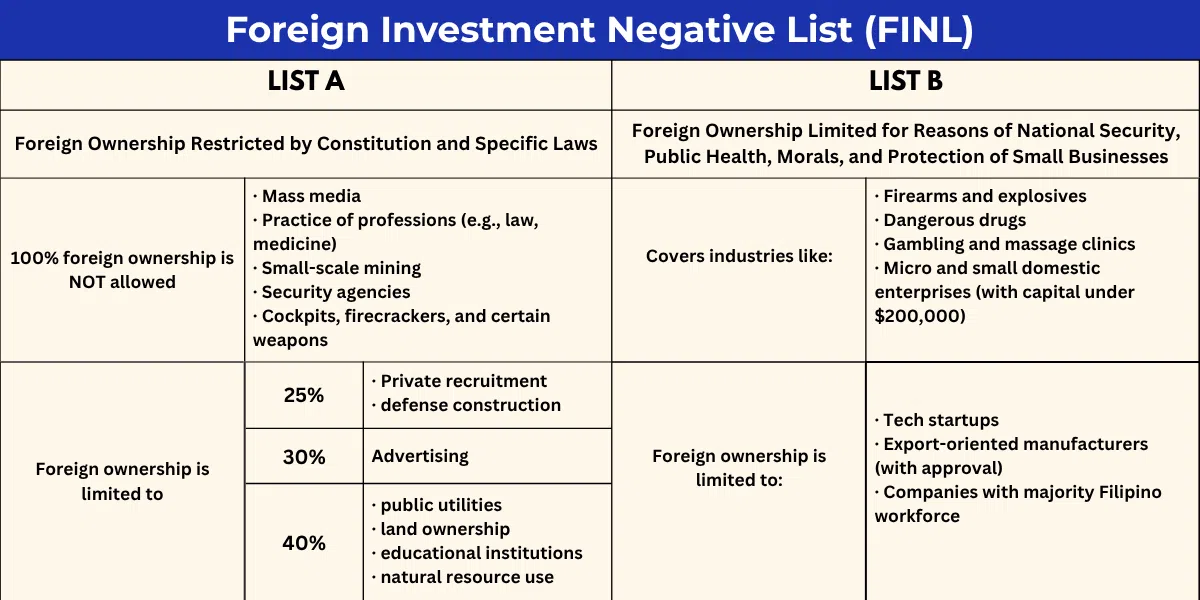
The guidelines in the Negative List Philippines is compiled based on the restrictions set by the Constitution, various laws, and administrative regulations.
The Foreign Investment Negative List (FINL) generally has foreign equity caps on items specified by the constitution and specific laws such as the Public Service Act Amendments as well as those for National Security, Public Health and Morals and small business.
The guidelines in the Negative List Philippines are compiled based on the restrictions set by the Constitution, various laws, and administrative regulations.
The Foreign Investment Negative List (FINL) specifies industries that have restrictions on foreign ownership.
These categorize restricted sectors into List A (constitutional/statutory limits) or those reserved industries for Filipino citizens and List B (defense, health, or SME protection) which are industries with partial foreign ownership.
LIST A: Foreign Ownership Restricted by Constitution and Specific Laws
100% foreign ownership is NOT allowed in certain sensitive sectors such as:
- Mass media
- Practice of professions (e.g., law, medicine)
- Small-scale mining
- Security agencies
- Cockpits, firecrackers, and certain weapons
Industries that 100% Foreign ownership is reduced and limited to:
- 25% in private recruitment and defense construction
- 30% in advertising
- 40% in public utilities, land ownership, educational institutions, and natural resource use
LIST B: Foreign Ownership Limited for Reasons of National Security, Public Health, Morals, and Protection of Small Businesses
Covers industries like:
- Firearms and explosives
- Dangerous drugs
- Gambling and massage clinics
- Micro and small domestic enterprises (with capital under $200,000
Some exceptions apply to:
- Tech startups
- Export-oriented manufacturers (with approval)
- Companies with majority Filipino workforce
As you can see, barring the above, there are several sectors open to foreigners.
Some cases can be a little complicated.
For instance, how do you classify an internet content owned platform?
Is that internet or mass media?
These types of cases can cause confusion over what the foreign equity cap would be as it straddles both the internet and news and information dissemination.
Now, as an example of a successful foreign business, let’s take Grab Philippines.
Grab Philippines is now a common household name.
In the Philippines, it has grown from a simple ride-hailing app into one of the most recognized tech brands in the country.
Since entering the Philippine market, Grab quickly scaled its operations by acquiring Uber Philippines in 2018, giving it a dominant foothold in the transport sector.
It then expanded into food delivery (GrabFood), logistics, and digital payments (GrabPay), positioning itself as an all-in-one “super app” for Filipino consumers.
Grab’s success is largely attributed to its adaptability and strong partnerships with local regulators such as the LTFRB and DTI, ensuring compliance while innovating.
By solving everyday problems such as commuting, food access, and cashless transactions, Grab became a household name and a platform for thousands of Filipino drivers, riders, and small businesses to thrive.
Its growth demonstrates that with the right approach, foreign tech companies can successfully navigate Philippine regulations, tap into its mobile-first population, and build long-term value in the market.
TLDR: The FINL places foreign equity caps for areas aligned to the public interest based on the constitution and sector specific laws most notably restrictions placed on land and SME business ownership.
Action: The FINL should be the first stop to understand whether or not there is a cap applied to your specific industry.

?Investing in the Philippines is now easier than ever, due to the amendments to Philippine business laws, liberalization of foreign equity restrictions and the reduction of minimum capital requirements.
100% foreign equity in a domestic corporation is very straightforward in export oriented, BPO and other FINL sectors, but the proposed business still must be evaluated against the FINL but also on industry law, especially in areas of heavy regulation.
These take advantage of the Philippines’ well educated and cheaper workforce and are often incorporated to support foreign businesses.
Aside from just ownership however, it’s important to also determine the right business structure, the incorporation process and applicable taxes – and this can be a little complicated.
In this article, we have focused on 100% foreign ownership mainly within the structure of a domestic corporation.
However, there are other possible structures available to foreigners such as:
- Branch Office
- Representative Office
- Regional Headquarters
- Regional Operating Headquarters
These are all possible structures as well, but they have significant differences in liability, governance, tax and operations, and it’s often best to hire local legal experts or team up with Filipino firms to understand the best fit for you.
When it comes to foreign business ownership Philippines, they know the ins and outs of the system and can help you avoid costly mistakes.
Foreign investors can start a business in the Philippines, but must navigate ownership restrictions and compliance requirements.
TLDR: There are several options for 100% foreign equity in the Philippines such as domestic corporations, branch offices, representative offices or regional headquarters; but they all must abide by the FINL list and certain sector specific laws. It’s often best to evaluate the proposed company with counsel.
Action: Need assistance? contact us Our legal team can guide you through the process.
1. Can I have 100% foreign ownership of my business in the Philippines?
Yes, especially in export-oriented businesses and businesses whose capitalization is higher than USD 200,000 but since there are foreign equity caps due to the constitution, Foreign Investment Negative List and sector specific laws your proposed business activity must be checked. Recent amendments to laws have made foreign ownership much easier, with the Public Service Act amendment removing entire business types such as airlines, railways and subways from the classification of “public utility” which has opened it up to 100% foreign investment, subject to reciprocity and other conditions.
Action: Check your proposed business activity against RA 11595, 11647, 11659 and the FINL and consult a Philippine lawyer for borderline cases.
2. How much capital do I need as a foreign investor?
Capitalization for exporters of services or goods can incorporate for as low as PHP 5,000 however, capitalization is USD 200,000 if the business is not export oriented. Reduced capital of USD 100,000 is also possible with certifications from the DOST, DICT or DOLE endorsing the business as either advanced technology, a startup, or employing at least 15 Filipinos. Retail companies are subject to a different minimum capitalization of PHP 25,000,000.
Action: If the business is not export-oriented, evaluate capitalization requirements with a lawyer since currency fluctuations and updated implementation guidelines can affect your application.
3. Can a foreigner own land in the Philippines?
No, but they can lease land or own a condo (up to 40% of a building) due to the 1987 Constitutional limiting land ownership to Filipinos and majority owned Filipino corporations. Generally, it is best to do a long term land lease from a local Filipino or joint ventures with Filipino firms if you are a foreigner. Avoid using Filipinos as dummy owners – this just exposes you to risk and is not defensible, leading to prosecution of the Filipino and yourself.
Action: Enter into long term leases or Joint Ventures if your project requires land, and strictly avoid dummy Filipino owners.
4. Can a foreigner be the sole director or president of a corporation in the Philippines if Filipinos own 60% of the shares?
No, a corporation must have a president, a treasurer and a corporate secretary under RA 11232 although there is no prohibition on a director being a foreign in fully liberalized industries. However, in partially nationalized industries, board control must mirror ownership as specified in the Anti-Dummy Law or Commonwealth Act No 108 as amended by RA 134 stating that “the election of aliens as members of the board … shall be allowed in proportion to their allowable participation or share in the capital of such entities.”
Action: Ensure that board control always reflects actual ownership to avoid Anti Dummy Law legal risk.
5. How does foreign business ownership Philippines work for an online-only business serving clients abroad?
If you are a foreign with an online-only business that is operated from the Philippines, it is best to incorporate as a domestic corporation or branch office since these activities will be classified as doing business in the Philippines. Without a corporate entity, you run the risk of being shut down and fined heavily. Without a Philippine entity, you also have no legal recourse when 3rd parties do not fulfill their obligations, as you have no ability to sue.
Action: Incorporate if you are doing business in the Philippines to avoid risks of being shut down and fined.
6. Does a foreign spouse of a Filipino get special rights in foreign business ownership Philippines or landholding?
No, there are no special rights as a foreign spouse of a Filipino since what the law looks at here is citizenship of the owner, and not the citizenship of the spouse. As a foreigner, the constitutional caps on land holding (Art XII of the Philippine Constitution) and those on business (Constitution and FINL) still apply. Generally, the only way to acquire land as a foreigner is through intestate succession.
7. What happens if my foreign shareholding accidentally exceeds the allowed cap in a restricted industry?
If your foreign shareholding accidentally increases and now violates a restriction in law – say in FINL – you may be forced to divest or restructure the business. Furthermore, there is a risk of being in violation of the anti-dummy law and face fines or loss of privileges as you may be thought of as trying to circumvent the law.
Action: Remedy this though share buy-backs, transfers or restructuring to avoid any risk.
8. Can a foreign company simply set up a representative office and still earn income in the Philippines?
No. A representative office is specifically designed not to earn income from the Philippines as it is supposed to be a cost center fully subsidized by the foreign head office and it is limited to performing back office functions such as quality control, information dissemination, accounting and the like. A branch office is the correct entity to enter the Philippine market using a foreign license to do business.
Action: Incorporate as a branch office or domestic corporation if you want to sell to the local Philippine market.
9. What visas are available for foreign investors who want to reside in the Philippines to manage their business?
Ther are several possible visas as available for foreigners managing a Philippine business: SIRV those investing at least USD 75,000, Treaty Investor (9d) for qualifying countries for those foreigners who invest a substantial amount and direct operations, Pre-arranged Employment Visa (9g) for those who are engaged to work in a Philippine entity and is applicable to investor-owners who have an active role in the company, and also the SRRV as this does allow working in the Philippines even though it is primarily a retirement visa. A lot depends on the size of the investment and whether the investor will be actively involved in the business.
Action: Work with an immigration specialist to identify the correct visa for you as they all have different privileges.
10. Are there special tax incentives for 100% foreign-owned IT-BPO companies in the Philippines?
Yes, there are several tax incentives for businesses and these were recently rationalized under the CREATE law (RA 11534) providing income tax holidays, special corporate income taxes or customs duty or VAT exemptions. The process usually begins after incorporation by applying a specific business activity to the Investment Promotion Agency (IPA) through the PEZA or BOI.
Action: Evaluate your business activities to see which qualify for tax incentives.
11. How often does the Foreign Investment Negative List change, and how does this affect existing foreign-owned companies?
The Foreign Investments Act or RA 7042 expressly states that the FINL should not change sooner than 2 years after the last change to promote stability and avoid constant change.
Action: Check with the latest FINL for the newest list since there are several versions, which can lead to the wrong assessment.