When an Heir Waives His Share of the Inheritance

by | Updated: Jan 9, 2026 | Blog, Estate Law, Wills & Inheritance, Ownership and Possession

Siblings bonding together

Sadly, inheritance is one of the reasons families fighting.

It can happen that an heir to a Philippine inheritance might want to waive his share of the estate. A waiver may be total or partial.

These two scenarios have different requirements. They also have different tax implications.

When an heir makes a total waiver of inheritance

Handing a black heart to another person

Some heirs waive their inheritance as they are no longer interested in the property.

One or some of the heirs can make a total waiver and decide to have no part of the inheritance at all.

This can be put in writing as an extrajudicial settlement with waiver of rights. This is a formal, sworn document, approved by all the heirs, where one or more confirm that they waive their entire inheritance with the others agreeing on how the estate is to be divided.

Perhaps one sibling is well off enough compared to others whom he feels would benefit from the inheritance much more than he would. Or he no longer lives in the country and does not want to be responsible for a property here. Or the sibling does not want to worry how to sell inherited property in the Philippines. For these or other reasons, an heir might not want to inherit.
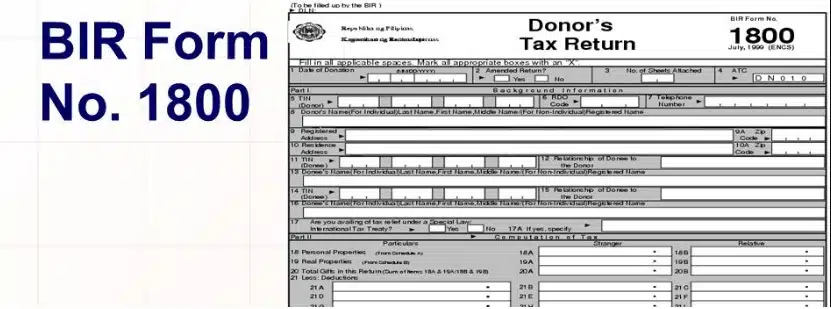
BIR form No. 1800

Donor’s tax can apply depending on the situation.

For tax purposes, this scenario is treated as one of pure inheritance among the remaining heirs. The estate is simply liable for the 6% estate tax before the assets can be distributed to them.

However, if one of the heirs makes only a partial waiver, then that is treated as a mix of donation and inheritance for tax purposes.  The partially waiving heir becomes liable for a donor’s tax.

The latter scenario happens more often than people realize.

When an heir partially waives his inheritance

A conversation inside a café

In the absence of a will, intestate succession takes place

When someone dies without leaving a last will and testament, the heirs can decide among themselves how to partition the inheritance.

The law, of course, provides for the default shares of inheritance. For example, if three legitimate children are the only heirs, then they will inherit in equal shares.

But there can be practical reasons for heirs to forego equal shares. They can agree on a different partition.

Take a situation where a parent dies, leaving only three legitimate children as the surviving heirs.

Three identical houses

Donor’s tax applies in a partially waived inheritance.

Let us say that the parent’s estate is comprised of three separate real estate properties. Since the children each have their own lives and priorities, they may find it practical to agree that each inherits one of the properties instead of all becoming co-owners of three undivided properties.

They can agree to each accept a house each — for convenience and because of personal preferences — not minding that the appraised value of one property might be more or less than another’s. This agreement is itself embodied in an extrajudicial settlement.

In such a situation, one or two heirs will effectively be making a partial waiver of their share of the estate in favor of another heir.

The BIR has decided to treat this partial waiver as a donation from one heir to another.
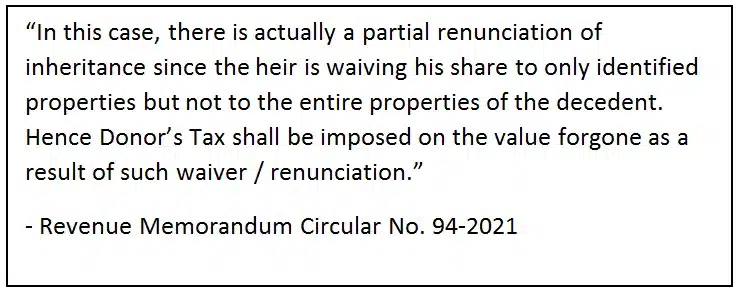
This qualifies an earlier BIR circular which provided that a total renunciation by an heir of his/her share in the estate is not subject to donor’s tax unless done in favor of specific heir/s to the exclusion or disadvantage of the other co-heirs.

So, an heir’s total waiver of inheritance is not subject to donor’s tax. However, a partial waiver – to the extent that it favors another heir – is further subject to the donor’s tax.

I can’t quite agree with the BIR’s interpretation. A distinction between a total and partial waiver does not seem to justify burdening the latter with a further tax. But we must come to grips with its consequences since it is imposed by the tax bureau.
BIR logo in front of tax documents

Estate Tax and Donor’s Tax can be paid through any BIR accredited bank

Even though donor’s and inheritance taxes are both set at 6%, the distinction between the two is not merely academic. Aside from being levied on different parties, the estate and donor’s taxes are subject to their own distinct exclusions and periods within which they must be paid, thus affecting the final computation of the total tax.

The estate tax should be filed and paid within a year of the person’s death. The donor’s tax, on the other hand, should be filed and paid within 30 days from the act of donation. Failure to pay either within the period results in distinct penalties, surcharges, and interest. These consequences can be substantial.

For this reason, the taxes due on an extrajudicial settlement with a partial waiver by some heirs should be readied at the time of the signing of the settlement so that the donation incorporated in the document does not become subject to penalties, surcharges, and interest.

The BIR has provided an illustrative example of how the donor’s tax is computed in the settlement of an estate with partial waiver of shares.

In the BIR’s example, the estate has three heirs who stand to inherit property comprised of three separate properties: Residential Land valued at P3 million, Commercial Land valued at P2.4 million, and Agricultural Land valued at P2.1 million.

Rather than crowding as co-owners of three undivided properties, the three heirs decide to allot one property to each of them. Heir X gets the Residential Land, Heir Y gets the Commercial Land, and Heir Z gets the Agricultural Land.

As a result, they each get more or less than the equal shares that the law on inheritance allotted them in default.

Considering that the donor’s tax is 6% of total donations in excess of P250,000, the BIR computes the donor’s tax in this scenario as follows:
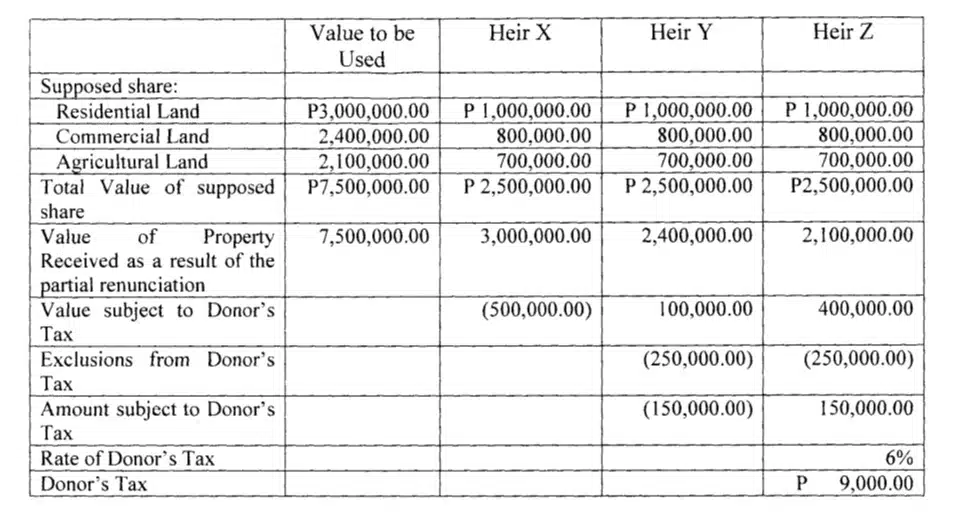
Although very manageable in this example, the additional donor’s tax can be significant enough in other cases that the heirs should take it into account as they decide on how to divide an estate.
When a parent waives in favor of the children

An old couple holding hands

Conjugal property is not included in the computation of the total estate if one of the spouse is still alive.

A scenario with similar implications for the donor’s and inheritance taxes is the case of a widowed mother whose children also survived their father.

Half of the conjugal property – those properties she and her husband had owned in common under Philippine law – would be hers outright.

Because of how conjugal property is defined under Philippine law, the husband’s half comprise his entire estate. This estate would be divided among his heirs, including her. Thus, if there were three children and the total assets are worth P48 million, the legal division may be as follows:

P24 million – mother’s share of the conjugal property

P6 million – mother’s share of the estate

P6 million – Child 1’s share of the estate

P6 million – Child 2’s share of the estate

P6 million – Child 3’s share of the estate

But it often happens that a mother wants to spare her children of having to again go through the estate settlement process when she herself passes away. For this reason, she might choose to transfer her share of the estate and even half of the conjugal property to the children in the same act. That amounts to P30 million.

The document drawn up for this would, in effect, be an extrajudicial settlement with waiver and deed of donation.
A mother and daughter picture

A living spouse can waive her inheritance share and half of her conjugal share to her children subject to donor’s tax

In this situation, the mother’s donation to the children of her P24 million share of the conjugal property is subject to the 6% donor’s tax, but the total waiver of her P6 million inheritance is not.

It would be different if the mother donated her entire P24 million share of the conjugal property, but retained half of her P6 million inheritance. The latter would be a partial waiver in favor of the other heirs. In that case, her P3 million donation would also be subject to the 6% donor’s tax.

If you wish to consult on your inheritance issues, fill out our form on www.lawyerphilippines.org or contact us at admin@lawyerphilippines.org.

We will be happy to help you with estate planning or settlement of properties in the Philippines.


Atty. Francesco Britanico

62 Comments

  1. Catherine Racho

    Good evening, Atty.

    My father died in 2013 and my mother died last year. There is a property under the name of my father which was mortgaged for my loan in GSIS. I’ve complete payment for the said loan after my mother died. I was informed that GSIS will not release the land title unless we submit an extrajudicial settlement. My siblings would like to waive their rights and agreed to transfer the property under my name. what would be the tax implication if they waive their rights and transfer the property to me. Should they mention that in their waiver they should just waive theri rights without mentioning that they are transferring their rights to me? what’s the tax implication? please help me on this. thank you.

    Reply
    • lawyerphilippinesadmin

      A total Waiver of Rights should not incur donor’s tax, but we would need to fully assess all the details to be certain. Please send an email to admin@lawyerphilippines.org

      Reply
      • Jeannette Aguilera

        Good afternoon Attorneys,

        My father died in 6/2024. There is a property under the name of my father. It has been over a year and we have not done the transfers of the property.

        My mother, two sisters, and brother are waiving their rights. What would be the tax implication if they waive their rights and transfer the property to me. Is there a donation fees if there is a waiver ? please help me on this. thank you.

      • Atty. Francesco C. Britanico

        Hello. Based on your situation, the two primary tax implications are the Estate Tax and the Donor’s Tax. The Estate Tax is levied at a flat rate of 6% of the net estate’s value and must generally be filed and paid within one (1) year from the date of death. Since your situation is overdue, you should expect the Bureau of Internal Revenue (BIR) to impose corresponding penalties, surcharges, and interest. Regarding the Donor’s Tax, which applies to lifetime transfers, the law explicitly requires the Donor (the giver) to pay the tax. However, in practice, the burden of payment is often agreed upon privately between the donor and the donee (the recipient), provided the Donor’s Tax Identification Number (TIN) is correctly indicated on the BIR tax return.

  2. cor gutierrez

    If an EJS has a waiver of rights in favor of 1 heir, is it automatic that a Donor’s Tax has to be paid?
    How can the Donor’s tax be avoided in this case?

    Reply
    • Atty. Francesco C. Britanico

      Donor’s tax may be excluded if the heirs with the right to waive generally renounces their rights over the property. It means that the heir waives inheritance without naming anyone as beneficiary. But if he waives specifically in favor of another heir, this is considered as donation and subject to donor’s tax.

      Reply
  3. Bei

    Good day atty!

    What if child #3 died and left some properties and both parents are alive. Parents waived their rights of inheritance as well as child 1. Will this be counted as inheritance or a donation? Thank you

    Reply
    • Atty. Francesco C. Britanico

      If the parents and first child waived their rights to inherit from third child property it is still, consider inheritance, not a donation, as long as the waiver is made without specifying a recipient. However, if the waiver is made in favor of a specific person, it may be treated as a donation and subject to donor’s tax.

      Reply
  4. Joy

    Dear Attorney,

    I would like to ask for your advice. There is untitled land owned by a deceased parent. Currently, the youngest child has been residing there for almost 20 years. Can the title be transferred directly to the youngest child or she needed to secure a waiver of rights from the other siblings?

    Reply
    • Atty. Francesco C. Britanico

      Based on your situation, there are two things you need to consider.
      1. The untitled land from your deceased parent, and
      2. The transfer of ownership from your parents to heirs through EJS.
      Prior the transfer of ownership, the untitled land must go through the land registration process. This involves proving ownership, applying for judicial or administrative titling, paying fees and taxes, and securing an original certificate of title from the Registry of Deeds. When this done you proceed to land transfer. However, you cannot be transferred directly to one child without the consent of the other heirs. IYou must execute an Extrajudicial Settlement of Estate with waiver of rights in favor to your youngest sibling.

      Reply
  5. Heirsha

    Will the waiver be valid if executed and the heir who waives his right will get compensation?

    Reply
    • Atty. Francesco C. Britanico

      Yes, in fact, that is a common arrangement in estate settlement in the Philippines.

      Reply
  6. LORNA NAVARRO

    My brother and our spouses bought 2 condominium units in Makati. All four of us are in the two titles. My brother passed away in November 2022. We are trying to sell the properties. Do we have to remove my brother’s name from the title? Can you please let me know what we need to do?

    Reply
    • Atty. Francesco C. Britanico

      You cannot just automatically, removed from titles, the law requires that his estate be settled first. What happens to your brother’s share will automatically passes to his legal heirs and must be formalized through as estate settlement before the Registry of Deeds. Since there are four of you as co-partnership, this must be first divided, and when our brother’s estate is settling and update, you can proceed to selling. On the other hand, when the deceased heirs agree on the sale, they can execute and EJS with Deed of Sale, stating that as heirs they agree to sell the property.

      Reply
  7. Luz

    Can a person renounce his/her rights to real property from his/her father (decedent) straight to his/her son using extra judicial settlement? Thanks

    Reply
    • Atty. Francesco C. Britanico

      Yes, this can be done through Extrajudicial Settlement of Estate combined with a Deed of Assignment or Waiver of Rights. This must be done properly, and much better assisted with a lawyer drafting the EJS.

      Reply
  8. Glessie Eula

    Dear Atty Francesco,

    Can siblings still execute a complete waiver of rights in favor of another sibling after an extrajudicial settlement was already processed naming all the children to be the lawful heirs? What could be the possible remedy for this case?

    Thank you.

    Reply
    • Atty. Francesco C. Britanico

      Once an Extrajudicial Settlement of Estate has already been executed and registered, all heirs are recognized as co-owners of the inherited property. The possible remedies are to execute a new document such as Deed of Donation, Deed of Sale, or Deed of Waiver.

      Reply
  9. Franklin Chu

    Dear Attorney Francesco,

    I live in the United States for 22 years and I’m already a US Citizen. We have a property in Marikina, Philippines. My mother and my older brother lives there. I am not interested to the property. I would like to waive any rights, share/interest. I would like to ask your advise what should I do.

    Sincerely,
    Franklin

    Reply
    • FCB Law

      You may have to sign a formal renunciation of inheritance if it is inherited property.

      Reply
      • Franklin Chu

        Dear Attorney Francesco,

        I appreciate your quick response. It so happen the property is not yet transfer to us by our mother. Do you have any forms that I can download?

        Sincerely,
        Franklin

      • Atty. Francesco C. Britanico

        As much as we can provide form for you to fill in, it is necessary to seek a legal counsel to determine what type of document actually needs based on the situation you have.

  10. V

    I would like to verify if all of the heirs agreed and signed an SPA authorizing one person/heir to represent and sign the extrajudicial settlement estate, would that be acceptable according to standard/requirement of the RD when I use that(extrajudicial settlement estate) to transfer the title to my name?
    Just confused since Extrajudicial needs to be signed by all parties, but having SPA and representative contradicts the point.

    Reply
    • Atty. Francesco C. Britanico

      Direct signing is the standard requirement if all heirs are personally sign the EJS. SPA is an option if an heir cannot sign, they may execute a notarized SPA to sign the settlement in their place.

      Reply
  11. leila ponio

    can u send the requirement of transferring extra judicial settlemet with waiver of rights

    Reply
    • FCB Law

      We would need to know considerably more about the situation to address it properly.

      Reply
  12. Trish

    6 children inherited 9 properties. Child number 1 refused to cooperate in the filing of extra judicial proceedings to transfer undivided properties to all heirs. What legal courses of actions or what options can be taken by the rest of the children to force child 1 to cooperate. Division of properties will take place at a later time after titles has been transferred to heirs.

    Reply
    • Atty. Francesco C. Britanico

      If executing extrajudicial settlement of estate cannot be done despite efforts, you can settle the estate judicially. You can file a petition in court for partition of estate action. The court will compel of all heirs so the estate can be settled.

      Reply
  13. Anthony

    If the heir is dead, and he living wife and children, who will be the heir for his share?
    Will it be his children? Wife? Or all of them?

    Reply
    • Atty. Francesco C. Britanico

      Both of them, as they are compulsory heirs stated the law.

      Reply
  14. Keith B

    What if there is a sale of land executed before the owner/seller dies, and deed of absolute sale was made. Assuming the seller died, but the transfer of title is yet to be completed, will extrajudicial still be applicable? Who will sign the affidavit of transferor and other documents applicable to the owner.

    Reply
    • Atty. Francesco C. Britanico

      Since the property is already sole, it is no longer part of the estate. The deed of sale executed remains binding because it was perfected during the seller’s lifetime. The buyer must proceed with paying taxes and registering the deed with the Registry of Deeds. However, this can be a problem on the part of the heirs, they still have the right to question the transaction made by the seller and the deceased owner.

      Reply
  15. Emma Lagaras

    Ang nanay ko po ay may naiwang bahay at lupa na nd pa fully paid. Ako bilang anak ang nagtuloy ng pagbabayad. Kinausap ko na ang mga kapatid ko na sa akin na mapupunta ang bahay at ako na rin ang nagbabayad. Pumayag naman sila. 9 kaming magkakapatid, 6 ang nasa pilipinas at 3 ang nasa abroad at citizen na sila duon. Isa po ako sa 6 na nasa bansa. Maaari po bang ung 5 kong kapatid dito na lang ang ilalagay sa extrajudicial settlement?
    Maraming salamat po

    Reply
    • Atty. Francesco C. Britanico

      Sa batas malinaw ang nakasaad, na dapat lahat ng heirs ay kailanagn isama at pirmahan ang document. Since, kasalukuyang nasa ibang bansa ang 3 mong kapatid, they can execute an SPA para -authorize and kapatid dito sa Pilipinas para sa kanila.

      Reply
  16. jojo fajardo

    we are 6 heirs to the property of my parents. Heir 1 waived 75% of her rights in favor of heir 3 and 25% in favor of heir 4. Heir 2 waived 75% to Heir 4 and 25 % to Heir 5. An affidavit of waiver was executed by Heir 1 and 2. Will there be still a donors tax on the waived shares? Thank you

    Reply
    • Atty. Francesco C. Britanico

      Depending on whether the waiver is with no payment or with compensation.
      If it waives with no payment, the BIR will treat as a donation, but if the waiver is with compensation, the transaction is treated as a sale and there will be a donor’s tax aside from estate tax.

      Reply
  17. ACL

    A mother and her 4 sons inherited a property from their deceased father. The 3 sons waived their rights to the property. The property has one title with 3/4 under the mothers name and 1/4 under one of her sons name. If the mother passed on, will the waiver stand and the property automatically be owned by the son who’s name is on the land title?

    Reply
    • Atty. Francesco C. Britanico

      No, the waiver is effective only after the estate of the deceased parent is settled and the property is transferred to the heirs. Since your mother owns, one and 3/4 of the estate, when she dies, this will be divided among the heirs (the children). Even the other 3 children executed waiver of rights from their father estate, this will not apply the same effectivity when their mother died. If they wish to pass all the property one of the children, the other sibling will have to execute another waiver of rights from their mother’s estate.

      Reply
  18. Aurea Gruyal

    Can a non-relative be the benificiary of the waiver of rights to inheritance by the legal heirs? The heirs are based abroad and no longer interested in the properties.

    Reply
    • Atty. Francesco C. Britanico

      Yes, a waiver of hereditary rights is valid whether in favor of another heir or even a third part (non-relative).
      With this case, the heirs can execute EJS and after the estate is settled, heirs who wish to waive in favor of a non-relative must execute a separate deed.

      Reply
  19. Ariel Ugalde

    Can the heirs execute a waiver/renunciation of rights in favor of the grandson of the deceased (grandson’s father is one of the heirs)

    Reply
    • FCB Law

      Yes.

      Reply
  20. Michael George

    Dear Atty. Uncle is an heir to grandpa’s property. Uncle will die soon but EJS for grandpa’s estate is not ready to be completed/signed to waive his rights in favor of nephew because the title of the property still needs to be sorted out. If uncle writes a “holographic will” now donating his share to nephew, is that “holographic will” allowed in EJS so nephew can have his share? Thank you.

    Reply
    • Atty. Francesco C. Britanico

      Under the law, when there is a holographic will, it cannot be used in an extrajudicial settlement because the estate must go through probate proceedings in court, and it is mandatory. Since the EJS for your grandfather’s estate is not yet completed, your uncle is technically still an heir. If he dies, before signing the EJS, hist share pass to his own heirs. If he leaves a will donating to his nephews, that will be probated in court.

      Reply
  21. Cris f

    Referencing your example where mother waives in favor of children, what happens if it was the other way around and it was the children waiving their rights to just one property (there are 2 properties total in their fathers estate) in favor of their mother?

    Reply
    • Atty. Francesco C. Britanico

      The waiver still valid regardless of who waived it. The process still applies.

      Reply
  22. Tina empedrad

    Dear Atty .3siblings .A B C. 4lots undivided.. A executed a waiver of rights to all her properties to B in 2014. But april 2022 B went home to revoke the waiver she executed and will just give 1 parcel to B .B refused as she paid partially the taxes..what’s remedy as the properties are still undivided.C keeps putting up his buildings encroching As property witbout B consent

    Reply
    • FCB Law

      The ultimate remedy would be to go to court if the siblings truly cannot agree among themselves, but it would certainly be more costly and difficult.

      Reply
    • C. Nova

      Title is still under the name of deceased parent.
      ABCD are legitimate children, A and B waived their rights over their share by signing a waiver. But after the title was transferred to C and D. Sibling A and B changed their mind and decided to reclaim their share of the property, C and D already constructed a property on the land in question. What would be the best resolution for this. Do A and B still has rights even if they already signed a waiver?

      Reply
      • FCB Law

        If the waiver was validly executed after the death of the parent, then it is probably valid. They would have no rights, but the family may consider coming to agreeable accommodation.

  23. Christine

    Atty Britanico,
    If a deceased father remarries after a year of being a widow, what are the rights of the 3 daughters from the first legal marriage compared to the rights of the second wife?
    Thank you.

    Reply
    • Atty. Francesco C. Britanico

      Regardless of marriage status of their parent, the children remain compulsory heirs over their parents’ estate.

      Reply
  24. Pip Cua

    Atty Britanico,

    Thank you for a very informative and clear presentation. My question is, can an heir who is now a foreigner benefit from a waiver by any of the heirs?
    Thank you.

    Reply
    • FCB Law

      Typically, yes. Particularly as former Filipino citizens can also acquire land as an exception to the general rule that foreigners cannot.

      Reply
    • Rodel Pabito

      How to file extra judicial settlement of estate if the Father passesaway . All children want to waive there rights on parents property and donate to their mother.
      Pros
      Cons

      Reply
      • Atty. Francesco C. Britanico

        There’s no need to file for EJS, you’ll need to have a draft and EJS with the assistance of a lawyer and have it notarized. Thereafter, it has to be published in a newspaper of general circulation.

    • Narita

      Good day Atty.Britanico,
      Do the Courts believe an Extra Judicial Settlement with Waiver of rights whose transfer were out of Love?
      Thanks

      Reply
      • FCB Law

        Heirs can make choices like this.

      • Jerome

        Good Day Atty Britanico,

        Does these rules apply for co-ownership on 1 piece of land and the heir wants to sell his inheritance to another heir? Is it better to use donation rather than sale???

      • Atty. Francesco C. Britanico

        That is the option for transfer, it can be done through sale or donation, whichever applicable.

      • Marietta

        Hello, this is my question: Who should keep the Original Documents of Waiver of Rights that has been notorised and apostilleed, me or the lawyer? I look forward for your answer.
        Thank you

      • Atty. Francesco C. Britanico

        It is standard practice for a lawyer to hold original documents while a specific task is in progress. However, most attorneys will readily return these documents to you once their work is complete.

Submit a Comment

Your email address will not be published. Required fields are marked *

Share This