Annulment (Nullity of Marriage and Psychological Incapacity) - Lawyers in the Philippines


Many Filipinos search for information about “annulment” because separated couples eventually need to fix their marital status legally, something most people never think about when they first get married.
In everyday conversation, people use “annulment” for any breakup of a marriage, but under Philippine law, there are two different processes:
- Declaration of Nullity – for marriages that were void from the start (like psychological incapacity or bigamy).
- Annulment – for marriages that were valid at first but had a defect in consent.
In this article, it explains the basics of how marriage dissolution works in the Philippines.
It breaks down the difference between void and voidable marriages, the key Family Code, the court procedures under A.M. No. 02-11-10-SC, and important Supreme Court rulings like Tan-Andal v. Andal on psychological incapacity.
It also outlines what happens if you don’t file a case, the usual steps in the process, the types of evidence courts look for, and how the outcome affects children, property, and your right to remarry.

Send us an email with the details for
personalized recommendations or schedule a consulation if needed.
For many couples, the marriage papers were signed at a happy, busy time of their lives, and very few people read the Family Code before they said “I do.”
Years later, things may look different: spouses have separated in fact, one has formed a new relationship, or someone is planning to migrate, and suddenly the question becomes urgent: “Do I need an annulment before I can really move on?”
In everyday language, almost everything is called “annulment”—even when the law treats the marriage as void from the beginning, or when legal separation or recognition of a foreign divorce might be the better remedy.
What the courts look at is not your feelings about the marriage but the ground under the Family Code: was there a defect in consent, a problem in capacity, psychological incapacity, bigamy, lack of a marriage license, or something else?
At the same time, many people are understandably worried about cost, time, and the effect on their children.
Some delay for years, only to discover later that a second marriage, a visa application, or a property transaction has been complicated because the first marriage was never legally addressed.
An honest assessment early on can prevent much bigger problems later.
Action:
Start by getting an updated PSA marriage certificate and writing a short timeline of your relationship—when you married, when you separated, and what your plans are for the next few years (remarriage, migration, or property purchases). Once you see these facts on paper, you can better judge when it is time to sit down with a family-law lawyer for a full legal assessment.
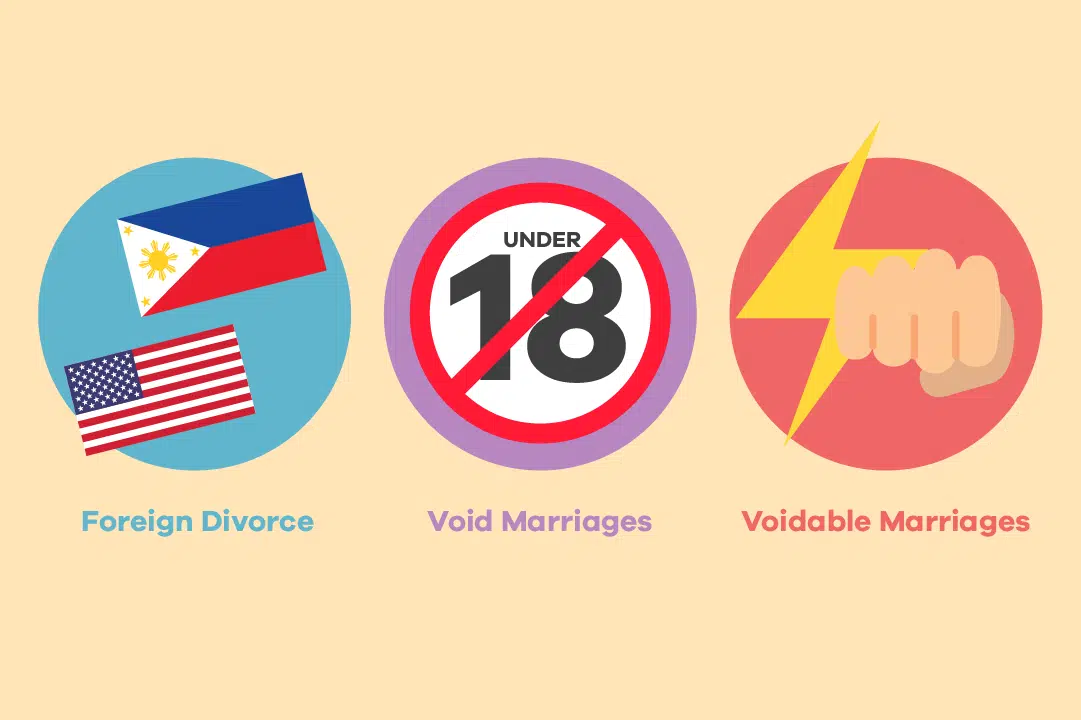
In Philippine law, annulment strictly refers to cases involving voidable marriages under Article 45 of the Family Code—marriages that were valid at the beginning but had a defect in consent or capacity (for example, lack of parental consent, fraud, force or intimidation, insanity, impotence, or serious sexually transmitted disease).

Void marriages include Art 36’s Void Marriage due to psychological incapacity.
By contrast, a declaration of nullity applies to void marriages—those that the law considers never to have existed at all, such as bigamous marriages, incestuous marriages, marriages with a party below 18, marriages lacking essential requisites, or marriages covered by psychological incapacity under Article 36.
Key points to understand about “annulment”:
• In common speech, “annulment” is used broadly, but legally it is for voidable marriages under Article 45; void marriages are handled through a petition for declaration of nullity.
• A voidable marriage is valid until annulled by a court; a void marriage is void from the beginning, but you still need a court judgment to rely on its nullity, especially for remarriage.

One of the grounds to void the marriage is if one of the spouses was under 18
• Typical annulment grounds include lack of parental consent (ages 18–21), insanity, fraud, force or intimidation, impotence, and serious, incurable STD existing at the time of marriage.

Psychological incapacity is when one spouse cannot fulfill the requirements of marriage.
• Typical nullity grounds include psychological incapacity (Art. 36), bigamy or a prior subsisting marriage, underage marriage below 18, lack of marriage license (with limited exceptions), or lack of authority of the solemnizing officer without good-faith protection.
Action:
Take your PSA marriage certificate and, using Articles 35–45 of the Family Code, try to classify your situation as void, voidable, or simply a troubled but valid marriage. After doing this initial homework, schedule a consultation with a family-law lawyer to confirm whether you are looking at annulment, declaration of nullity, or some other remedy.

Annulment and nullity cases are grounded mainly on the Family Code of the Philippines (Executive Order No. 209, as amended), the Rule on Declaration of Absolute Nullity of Void Marriages and Annulment of Voidable Marriages (A.M. No. 02-11-10-SC), and important Supreme Court decisions, especially those on psychological incapacity under Article 36.
These laws and rules determine whether your facts fit a legally recognized ground, what evidence is needed, and how the courts and the Office of the Solicitor General (OSG) will review your case.
Main legal pillars you should know:
• Family Code, Arts. 35–38, 40–45, 52–54 – define void and voidable marriages, set the grounds for annulment and nullity, and regulate the effects on property and children and the requirements before remarriage.
• A.M. No. 02-11-10-SC – special procedural rule that governs petitions for declaration of absolute nullity and annulment, including venue, contents of the petition, and the role of the public prosecutor and OSG in guarding against collusion and fabricated evidence.
• 2023 Amendments to A.M. No. 02-11-10-SC and related OCA guidelines – updated rules on residency and venue, including how Filipinos temporarily residing abroad can meet jurisdictional requirements.
• Tan-Andal v. Andal (G.R. No. 196359, 11 May 2021) – a landmark case declaring that psychological incapacity is a legal concept, not strictly a medical diagnosis, and may be shown through enduring patterns of behavior that make a spouse truly unable to perform essential marital obligations.
Action:
Read through the basic provisions of the Family Code on marriage and the grounds for annulment and nullity (especially Articles 35–38, 40–45, and 52–54), and, if your situation involves psychological incapacity or a foreign divorce, look up brief summaries of Tan-Andal and Article 26 cases from official sources. After that, bring your notes and questions to a lawyer so you can understand how these rules apply to your specific facts.
Some couples separate quietly and simply “move on” without ever filing a case.
This may feel simpler in the short term, but in law the marriage remains on record and continues to produce legal consequences until a court issues a final judgment and that judgment is properly recorded with the civil registry and the relevant registries of property.
Risks of leaving a problematic marriage legally untouched:
• Bigamy risk and void new marriages – A second marriage contracted without a prior judicial declaration of nullity of the first marriage can be void and expose a spouse to criminal charges for bigamy, depending on the facts.
• Inheritance and property disputes – Years later, disputes can arise over who the legal spouse is, whether property is common or exclusive, and how to divide assets on death or separation.
• Immigration and foreign residency problems – Foreign embassies and immigration authorities usually rely on PSA records; inconsistent status (single vs married vs separated) can complicate or derail visa and residency applications.
• Emotional and relational uncertainty – New partners and children can be left in a fragile position when the first marriage remains legally intact, even after long years of separation.
Action:
Make a simple list of any major steps you plan to take in the next three to five years—such as remarriage, migration, buying property with a new partner, or estate planning—and place your current PSA civil status beside each item. If you see that your existing marriage record could interfere with one or more of these plans, that is your signal to consult a family-law lawyer about whether an annulment or nullity case is necessary.
While details vary between courts, most annulment and nullity cases follow a similar path under the Family Code and A.M. No. 02-11-10-SC. It is not just filling in a form; the court must be convinced that a legal ground exists, that there is no collusion, and that evidence is sufficient.
The Office of the Solicitor General and the public prosecutor are involved because the State has a strong interest in the stability of marriage.
Typical steps in an annulment/nullity case:

• Legal consultation and case assessment – A lawyer reviews your PSA documents, your story, and possible grounds under Articles 35–45 and 36, and advises whether a case is feasible and what type.
• Evidence gathering – You collect documents (civil registry records, medical and psychological reports, communications, police or barangay records) and list witnesses who can testify about the marriage and the alleged ground.

You’ll need to write a petition before filing at court.
• Filing the petition – The lawyer prepares and files a verified petition in the correct venue under A.M. No. 02-11-10-SC and the amended guidelines on residency and venue, then the case is raffled to a Family Court.

You’ll need to wait a bit as the court assigns your petition and arranges other legal requirements with your lawyer.
• Prosecutor/OSG participation and hearings – A public prosecutor checks for collusion and may cross-examine witnesses; the OSG reviews the case and may recommend approval or denial.

Finally done!
• Decision and post-judgment recording – If the court grants the petition, the decision and final judgment must be recorded with the local civil registrar, PSA, and relevant property registries under Articles 52–53 before you can legally remarry and rely on the effects of the judgment.
Action:
Map out the basic steps of the process—consultation, evidence gathering, filing, hearings, and post-judgment recording—and jot down what documents and witnesses you already have for each stage. Once you see where your gaps are, you can discuss with a lawyer how to fill them and whether it is realistic to proceed in your chosen court.

Courts do not grant annulments or nullity petitions based only on general statements that the spouses “no longer love each other” or that the marriage has “long been dead.”
The court needs specific, credible, and consistent evidence that fits one of the legal grounds—for example, proof that consent was defective at the time of marriage, or that a spouse has deep-seated psychological incapacity that existed at the time of marriage and continues to the present.
Types of evidence courts often look for:
• Documentary evidence – PSA certificates, medical and psychological reports, counseling records, school or work records, communications showing abandonment, serial infidelity, violence, or refusal to support.
• Testimonial evidence – Your testimony plus that of relatives, friends, co-workers, or spiritual advisers who observed the spouse’s behavior before and after the marriage and can describe concrete patterns, not just isolated quarrels.
• Expert evidence (especially for Article 36) – After Tan-Andal, a psychiatric or psychological label is not always required, but a well-prepared expert opinion can help explain how a spouse’s personality structure makes them truly unable—not just unwilling—to perform essential marital duties.
• Consistency and credibility – Inconsistent stories, obviously coached witnesses, or documents that do not match the timeline can weaken a case even if there are real problems in the marriage.
Action:
Start organizing your evidence into a dated timeline: key events in the marriage, who witnessed them, and what documents support them (messages, records, reports). This simple table will make it much easier for any lawyer or expert you later consult to see whether your story fits a recognized legal ground and what further proof may be needed.
Over time, the Supreme Court has issued several landmark decisions that shape how trial courts decide annulment and nullity cases, especially those based on psychological incapacity.
These cases do not change the text of the Family Code, but they interpret what terms like “psychological incapacity” or “essential marital obligations” mean in real life, and they often make the difference between a granted and a denied petition.
Key cases and their lessons:
• Santos v. CA (G.R. No. 112019, 1995) – First case to recognize psychological incapacity but gave only broad guidance; introduced the idea that incapacity must be grave, antecedent, and incurable.
• Republic v. Molina (G.R. No. 108763, 1997) – Imposed strict guidelines for Article 36 cases, often requiring expert diagnosis and extensive proof; made psychological incapacity difficult to prove for many years.
• Tan-Andal v. Andal (G.R. No. 196359, 11 May 2021) – Re-framed psychological incapacity as a legal concept, not a purely medical one; held that it may be proven through evidence of a spouse’s enduring personality structure and behavior that makes them truly unable to perform essential marital obligations, even without a formal psychiatric label.
• Later cases applying Tan-Andal – Subsequent decisions have applied this more flexible approach, focusing on concrete patterns like chronic abandonment, financial irresponsibility, and persistent infidelity, while still requiring serious and credible evidence rather than ordinary marital difficulties.
Action:
Read at least brief summaries—or the full texts where possible—of Santos, Molina, and Tan-Andal from official Supreme Court sources, and note how the Court described the spouses’ behavior and evidence in each case. Then, honestly compare your own situation to those patterns so that when you do consult a lawyer, you already have a concrete sense of how strong or weak your facts may be.

There is no fixed, government-mandated total cost or timeframe for annulment in the Philippines.
The Family Code and the Supreme Court rules describe procedure but do not set a standard professional fee or a guaranteed timeline; instead, duration and expense depend on your court’s caseload, how contested the case is, the ground you invoke, and whether expert witnesses and foreign documents are involved.
Factors that often influence timelines and expenses:
• Court location and docket – Some Family Courts are heavily congested and may schedule hearings months apart; others move cases more quickly.
• Contested vs uncontested – If your spouse cooperates or does not oppose, proceedings are often smoother; if they contest or file counterclaims, hearings can multiply and lengthen the case.
• Ground and complexity – Psychological incapacity and fraud generally require more extensive evidence and possibly expert testimony, while simpler grounds like lack of parental consent have more straightforward proof.
• Professional and incidental costs – Lawyer’s fees (subject to the Code of Professional Responsibility and Accountability), court fees, publication costs (where required), and expenses for expert witnesses, translations, and document authentication all add up.
Action:
Before you decide to proceed, ask for a realistic breakdown of stages, possible timelines, and cost ranges from a lawyer, or request an initial estimate from a family-law practitioner based on your ground and court venue.
One of the biggest fears about annulment is its impact on children and property.
The Family Code is clear: children conceived or born before the final judgment of annulment or absolute nullity (under Article 36) are considered legitimate, and children born of a properly recorded subsequent marriage are also legitimate.
Property consequences and the right to remarry, however, require strict compliance with Articles 52–53.
Children’s status and support:
• Children conceived or born during the marriage and before the final judgment of annulment or nullity based on psychological incapacity remain legitimate, with corresponding rights to support and inheritance from their parents.
• New children born from a properly recorded subsequent marriage under Article 53 are also legitimate, provided the legal requirements were followed.
Property relations and remarriage:
• In voidable marriages, liquidation of the absolute community or conjugal partnership is typically ordered in the same or related proceedings, with shares fixed under the Family Code rules.
• In void marriages, property acquired during the “marriage” may be treated under rules on co-ownership or separation of property, depending on contributions and good faith.
• Either former spouse may remarry only after the judgment of annulment or nullity and the partition and distribution of property and custody/support arrangements have been recorded in the civil registry and relevant property registries; if these Article 52–53 requirements are not recorded, a subsequent marriage can itself be void.
Action:
If your main concern is protecting your children and property while clearing your civil status, list down all major assets, who holds title, and which children are involved, and keep certified copies of their birth certificates. Once this information is organized, a lawyer can more easily explain how Articles 52–54 will apply in your case and what steps must be taken before you safely remarry or transfer assets.
1. Do I really need annulment if we have been separated for many years?
Long separation by itself does not cancel a marriage under Philippine law, and there is no automatic “expiration date” for being married. As long as there is no court judgment of annulment or nullity, the marriage remains valid in the civil registry, even if you have not seen your spouse in years. This can create serious problems if you later remarry, apply for a visa, or deal with property and inheritance, because government agencies and foreign embassies will rely on your PSA records. If you are long separated and planning a major life change, you should have a lawyer review whether annulment, nullity, legal separation, or another remedy fits your goals.
Action:
Obtain your current PSA marriage certificate and, if applicable, any new relationship or property documents you already have (for example, a new partner’s birth certificate or titles acquired while separated). Review these side by side to see where conflicts might arise, and then decide whether to ask a family-law lawyer to evaluate if an annulment, nullity, or some other remedy is needed before you take further steps.
2. What is the difference between annulment, declaration of nullity, and legal separation?
Annulment deals with voidable marriages that were initially valid but had defects in consent or capacity, such as fraud, lack of parental consent, or force, and it can erase the marriage retroactively once granted. A declaration of nullity concerns void marriages—those the law considers never to have existed at all—such as bigamous marriages, marriages with a party below 18, or marriages covered by psychological incapacity, but a court decision is still needed before you can rely on that status. Legal separation keeps the marriage bond intact but allows the spouses to live separately and to divide property and regulate custody and support without granting them the right to remarry.
Action:
Create a simple comparison chart for yourself with four columns—annulment, declaration of nullity, legal separation, and recognition of foreign divorce—and under each, list the purpose, grounds, and main effects on remarriage and property. Use this chart to frame more precise questions when you speak with a lawyer so your consultation is focused and efficient.
3. Will my children become illegitimate if I get an annulment or declaration of nullity?
The Family Code specifically protects children in most annulment and nullity situations, especially on psychological incapacity grounds. Children conceived or born before the final judgment of annulment or absolute nullity (under Article 36) are considered legitimate, and they retain their rights to support and inheritance from their parents. Later children from a properly recorded subsequent marriage under Articles 52–53 are also legitimate, provided the legal requirements were followed. The key is proper timing and recording of the judgment so that civil records reflect the correct status.
Action:
Keep certified copies of your children’s birth certificates and any written agreements on custody or support in a safe and organized folder, and make sure both parents understand that the case is about the legal status of the marriage, not withdrawing support or responsibility for the children. When you later consult a lawyer, bring this folder along so your children’s rights can be properly factored into your legal strategy.
4. Can I file for annulment if I am living or working abroad?
Yes, many petitioners now live abroad while their annulment or nullity cases proceed in the Philippines, especially after updated Supreme Court guidelines clarified how residency and venue rules apply to Filipinos temporarily residing overseas. Courts may require an affidavit of residency duly authenticated by a Philippine consulate and other supporting documents to show that venue is proper, but your physical presence abroad does not automatically bar you from filing. You will still need to appear for certain hearings, either in person or via authorized remote platforms, depending on current court practice and orders.
Action:
Gather proof of your current residence abroad—such as your visa, work contract, utility bills, and IDs—and check the latest Supreme Court guidelines on residency and venue for annulment cases from official sources. Once you have those documents in order, you will be in a stronger position to ask a lawyer how to file without unnecessary trips or procedural problems.
5. Is bigamy itself a ground for annulment?
Bigamy is not listed as a ground for annulment under Article 45, but a bigamous marriage—where a prior marriage still exists and has not been legally ended or recognized as void—can make a second marriage void from the beginning under the Family Code. In such situations, the usual remedy is a petition for declaration of nullity of the bigamous marriage, and bigamy may also give rise to criminal liability under the Revised Penal Code, which is separate from the civil action. Determining whether a marriage is truly bigamous can be complex, especially if the first marriage had its own defects or a foreign divorce is involved.
Action:
If you suspect there was a prior marriage, request PSA CENOMARs and marriage certificates for both you and your spouse so you are working from actual records, not assumptions. After you have those documents, you can consult a lawyer to determine whether you are facing a void bigamous marriage, possible criminal exposure, or both.
6. How long do annulment cases normally take, and can they be “rushed”?
Many annulment and nullity cases take between one and three years, sometimes longer, depending on the court, the ground, and whether the case is contested, and there is no legal way to “shortcut” the process without risking later problems. The court must ensure that there is no collusion, that the evidence is sufficient, and that the State’s interest in marriage is respected, which naturally takes time and multiple hearings. While some steps can be streamlined with good preparation—such as complete evidence, synchronized witnesses, and proper service of summons—the key is a well-managed case rather than any promise of speed.
Action:
Be wary of anyone promising a guaranteed, very fast annulment or one that requires no court involvement; instead, ask for a step-by-step explanation of the process, including the role of the judge, prosecutor, and OSG. Use this explanation to compare different lawyers and confirm that the strategy being proposed to you is realistic and in line with actual court procedure.