Estate Tax Amnesty

by | Updated: Jul 8, 2024 | Blog, Estate Law, Estate Taxes

If you haven’t been able to transfer the title to inherited property because of late estate tax penalties, then RA 11213 is the answer to your prayers.

RA 11213 makes previously difficult transfers possible:

  • It removes late estate tax penalties
  • It uses a low estate tax of 6%

These are large concessions and heirs can now easily transfer properties to their name.

Which estates are covered by the estate tax amnesty?

RA 11213 covers estates whose decedents died on or before December 31, 2017.

Estates whose decedents died after December 31, 2017 follow the TRAIN Law.

Which estates are excluded from the estate tax amnesty?

Yes, estates that have involved unlawfully gained wealth or the illegal concealment of money are excluded from the estate tax amnesty.

Specifically, these estates are:

  • Estate tax cases that have become final and executory.
  • Properties falling under the jurisdiction of the Presidential Commission on Good Governance.
  • Properties considered as unexplained or unlawfully gained wealth.
  • Properties acquired through illegal concealment of money or banking or commercial transactions.
  • Crimes involving properties committed by public officers under the Revised Penal Code.
  • Tax evasion cases and other criminal acts involving payment of taxes under the Tax Code.

When is the estate tax amnesty law in effect?

Act fast!

You can avail of the Estate Tax Amnesty from June 15, 2019 to June 15, 2021.

After June 15, 2021, previously suspended late estate tax penalties will be applicable and the costs to transfer will be very high.

UPDATE: 

This period is to be extended until June 14, 2023.
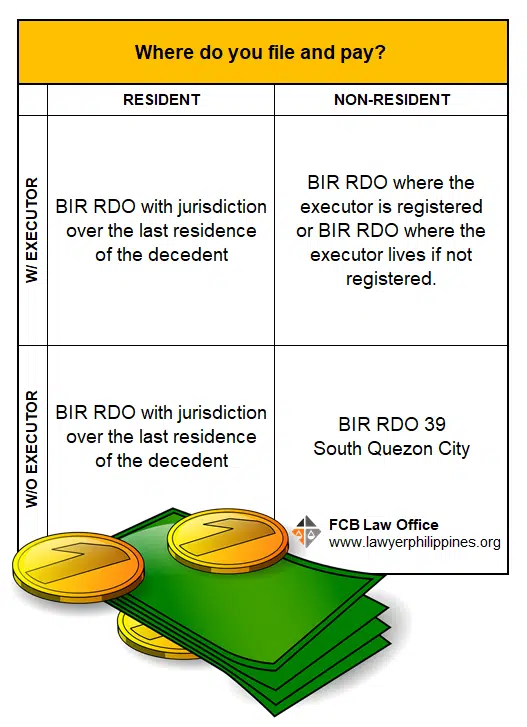
Where do you file for the Estate Tax Amnesty?

How do you file of the Estate Tax Amnesty?

The table below gives a good general idea of how to file for the Estate Tax Amnesty.

The steps include gathering the documents, filing the BIR 2118 and APF, paying the estate tax, and then transferring the property.
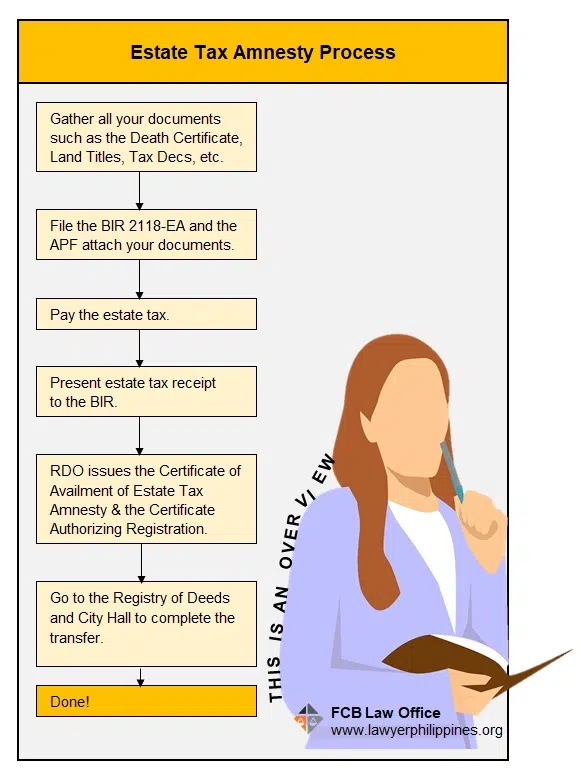
This is just meant to give you a general idea.

If you need clarification or your case is complicated, remember that there is no harm in asking.

You can always call the BIR.

The BIR officers will attend to your questions as much as they can.

What documents will you need?

You’ll mainly need documents that are proof of the property of the decedent’s property and BIR forms 2118-EA and the APF.

This is the first step in availing of the estate tax amnesty.

Now, that sounds simple.

It’s actually a long, long list.

You need to complete the documents applicable to the estate of the decedent but this can be tough.

Often, no-one knows where the documents were kept. Other times, they are well and truly lost.

Replacing them can be difficult, especially in the case of lost owner’s land titles.

But still, try your best to get them – they are important so that your case can be successfully processed.

I’ve listed several documents you are generally required to have in applying for estate tax amnesty.

I suggest that you make your own list of the things that are applicable to your circumstances to guide you better.

Mandatory Requirements:

  • Certified true copy of the Death Certificate (DC)
  • Taxpayer Identification Number (TIN) of decedent and heirs
  • Estate Tax Amnesty Return (ETAR)
  • Estate Tax Acceptance Payment Form (APF) and Revenue Official Receipt (ROR), if paid to Revenue Collection Officer (RCO).
  • Affidavit of Self Adjudication, Deed of Extra-Judicial Settlement (EJS) or Court decision when settled judicially or if there was a last will and testament.
  • Certification of the Barangay Captain for the last residence of the decedent and claimed Family Home, if any.
  • Notarized Promissory Note, for “Claims Against the Estate” arising from Contract of Loan, if applicable.
  • Proof of the claimed “Property Previously Taxed”, if any.
  • Proof of the claimed “Transfer for Public Use”, if any.
  • At least one valid government ID of the executor, heirs or authorized representatives.

Requirements for Real Estate Property, if any:

  • Certified true copy of the Owner’s Property Title;
  • Certified true copy of the Tax Declaration of real property and improvements issued nearest to the time of death of the decedent, if none is available at the time of death.
  • Certificate of No Improvement issued by the Assessor’s Office at the time of death of the decedent, if there are no improvements.

Requirements for Personal Property, if any:

  • Certificate of Deposit/Investment/Indebtedness owned by the decedent alone or jointly with others.
  • Certificate of Registration of vehicles and other proofs showing the correct value of the same.
  • Certificate of stocks and proof of valuation of shares of stock at the time of death
  • Proof of valuation of other types of personal property

Other Requirements, as applicable:

  • A duly Notarized Original Special Power of Attorney (SPA), if the person processing the transfer is the authorized representative
  • A Sworn Statement, if one of the heirs is designated as executor or administrator
  • Certification from the Philippine Consulate if a document is executed abroad
  • Location Plan/Vicinity map if zonal value cannot be readily determined from the documents submitted.

You’ll need  1 is the original and 2 photocopies which should be submitted with the Revenue District Office (RDO) of the Bureau of Internal Revenue (BIR).

How much is estate tax under the estate tax amnesty?

Estate tax is 6% on the net estate.

The estate tax amnesty only removes the tax penalties but you are still required to pay taxes, albeit at a much lower rate.

I get asked how much estate tax is all the time.

In general, it’s really simple.

To go into specifics of how much it is in your situation, you’ll need to answer several questions.

You’ll also need to show the estate’s documents.

If you wish to try to do it yourself, you’ll first need to figure out what the decedent’s gross estate is.

The gross estate is just all the property that the decedent owned.

That could be real estate, stocks, bonds or vehicles.

Note: A Filipino would be required to report all the properties he owns.

A non- resident alien would only need to report all Philippine properties.

Then, you will need the value of the property at the time of death.

This is usually zonal value or the city assessor’s fair market value.

Apply the standard deductions, the spouse’s share and any debts and obligations to get to the net estate.

Multiply this by 6% to get the estate tax.

Now, what happens if the estate is small enough that there is no estate tax?

In that case, you pay Php 5,000 which is the minimum allowed to transfer an estate.

What are the Immunities and Privileges under the Estate Tax Amnesty?

Aside from tax amnesty the law also gives some other benefits for the taxpayers who will apply the law in their favor. They are as follows:

  1. Immunities from all penalties for taxable year 2017 and prior years for estate taxes that are not yet paid and the penalties for non-payment thereof.
  2. Immunity from criminal, civil and administrative cases and penalties under the Tax Code.
  3. Final and irrevocable. Once the RDO-BIR will issue the CAETA the estate tax amnesty already paid will be final and not subject not changes.

39 Comments

  1. Floras12

    The process often begins with securing a PSA Appointment for Death Certificate since it serves as the foundational record required when handling estate matters and legal claims after a person’s passing. This document then becomes a key reference point in discussions around estate tax amnesty and compliance, where proper documentation is needed before any settlement can move forward. In practice, having the correct civil registry records in place helps smooth out the legal and tax procedures involved in transferring assets to rightful heirs.

    Reply
    • Atty. Francesco C. Britanico

      I agree with what was mentioned. In addition, it is important to note that a Death Certificate issued by the Local Civil Registry may also be used, provided it is a certified true copy. Since PSA records often take time to obtain, the BIR will acknowledge the certified Local Civil Registry copy in the meantime. This is crucial because estate tax has a prescriptive period that begins at the time of the decedent’s death. After the lapse of one year, penalties will be imposed for late filing.

      Reply
  2. Alexander Estoesta

    The direct heirs of grandparents who died are their grandchildren, since their children and their respective spouses (parents of the grandchildren), were also deceased. Under this estate tax amnesty, are the grandchildren who agreed for an extra judicial settlement (EJS) still required to file/submit affidavit of total landholdings of their deceased parents still in their names?

    Reply
    • Atty. Francesco C. Britanico

      The BIR generally requires documentation of all properties registered under the names of the deceased, since estate tax attaches to the estate of each decedent. If the parents of the grandchildren also passed away and still have properties in their names, those estates are separate taxable estates. This means the heirs may need to file estate tax returns for both the grandparents’ estate and the parents’ estate. The Affidavit of Total Landholdings is a supporting document to establish the extent of properties left by each decedent. If the parents’ estates remain unsettled, the BIR may still require this affidavit to properly account for those properties. However, if the parents left no properties or their estates were already settled, then the affidavit may not be necessary.

      Reply
  3. Editha Testa

    Can we pay our state tax if one of the heirs will not sign the extra judicial particial

    Reply
    • Atty. Francesco C. Britanico

      Generally, BIR require documentation of all properties registered under the names of the deceased, since estate tax attaches to the estate of each decedent. If the parents of the grandchildren also passed away and still have properties in their names, those estates are separate taxable estates. This means the heirs may need to file estate tax returns for both the grandparents’ estate and the parents’ estate. The Affidavit of Total Landholdings is a supporting document to establish the extent of properties left by each decedent. If the parents’ estates remain unsettled, the BIR may still require this affidavit to properly account for those properties.

      Reply
    • Atty. Francesco C. Britanico

      Technically, Estate tax can be paid even without EJS, since tax attaches to the estate itself. However, without a complete EJS signed by all heirs, the BIR may not issue the necessary Certificate Authorizing Registration (CAR), which is required to transfer titles and properties. Some families proceed by paying the estate tax first to stop penalties and interest from accruing, then later resolve the settlement issue. But the transfer of property cannot be finalized until the settlement is complete.

      Reply
  4. Zena

    If wife or husband survived, Is the land still subject to Tax Amnesty if one had passed away? It is a conjugal property with both husband and wife in the title of land. There are children of the marriage.

    Your advice will be most helpful in this case. Thank you.

    Reply
    • Atty. Francesco C. Britanico

      By law, half of the property belongs to the surviving spouse, and the other half forms part of the estate of the deceased spouse. The estate tax applies to the deceased spouse’s share. The surviving spouse’s half is not subject to estate tax, since it remains with them. The children inherit from the deceased spouse’s estate (the half share). The surviving spouse and children are considered heirs together.

      Reply
  5. Juliana

    If the market value of the real estate property (owned by decedent who passed in 1995) is below the threshold (30,000 pesos), do we still have to complete he entire steps/processes to avail of Tax Amnesty & consequently, register the transfer of ownership from decedent to heirs?

    Reply
    • Atty. Francesco C. Britanico

      If the market value of the property is only ?30,000, that is far below the threshold. The estate tax due would be zero. However, even if no tax is due, the process of filing is still required if you want to transfer the title. The BIR issues the Certificate Authorizing Registration (CAR) only after the estate tax return is filed — even if the computation shows no tax payable.

      Reply
  6. Shire

    How small is the estate that doesn’t require estate tax.

    Reply
    • Atty. Francesco C. Britanico

      In the Philippines, estate tax applies only when the net estate exceeds the allowable deductions. If the estate is very small, it may be exempt.

      Reply
  7. Maria Elena Blanco

    Is the tax amnesty applicable to CLOA title?

    Reply
    • Atty. Francesco C. Britanico

      Estate tax attaches to the estate itself, regardless of the type of property title. So even if the land is under CLOA, the estate tax amnesty applies to the decedent’s share.

      Reply
  8. Beth

    Should Estate taxes be paid on Real Estate Property that is not officially in the name of the decedent? For instance, if my mother (who is one of 3 siblings) is assumed to have inherited 1/3 of a land that is in the name of her father (also deceased), are we supposed to include her potential 1/3 share even if there hasn?t been any official transfer of the title to her name? Or are we supposed to pay estate taxes only on properties in her name?

    Reply
    • Atty. Francesco C. Britanico

      If the land is still in the name of your mother’s father, then the estate tax liability attaches to his estate, not directly to your mother. Until then, the property is still considered part of your grandfather’s estate. Therefore, you do not pay estate tax on properties that are not yet in your mother’s name.

      Reply
  9. Ester Espinosa

    Good day po, ang lolo at lola ko ang may ari ng lupa .May 8 syang anak. Lahat po sila ay patay na,3 anak nya na babae ay single 5 ang may asawa may mga anak po sila at kami po iyon. Ang problema po yung panganay na anak ng lolo at lola ko ay walang death cert. ,kasi po bata pa ang mga pinsan kong mamatay .Ano po angdapat naming gawin .

    Reply
    • Atty. Francesco C. Britanico

      If no death certificate exists. You must request a Late Registration of Death from the Local Civil Registry where your relative died. Even if decades have passed, the registry can process a late registration, provided you submit supporting documents. Without the death certificate, the estate cannot be fully settled, because the BIR and Registry of Deeds will not process transfer without proof of death. What you initially do is to file for late registration of death.

      Reply
  10. Savana

    Is this applicable in Extrajudicial settlement with deed of absolute sale?

    Reply
    • FCB Law

      Yes, it can be.

      Reply
      • Noemii

        What happens if there are 2 real properties left by decedent at different location and there is only one consularize copy of SPA? Can the tax amnesty be settled in only one RDO?

      • Atty. Francesco C. Britanico

        I have answered your inquiry in the comment section.

    • Noemii

      What happens if there are 2 real properties left by decedent at different location and there is only one consularize copy of SPA? Can the tax amnesty be settled in only one RDO?

      Reply
      • Atty. Francesco C. Britanico

        When a decedent leaves multiple real properties in different locations, the estate tax amnesty is still filed and settled with the Revenue District Office (RDO) that has jurisdiction over the decedent’s place of residence at the time of death. f there is only one consularized copy of the SPA, it can be used for the estate tax filing, provided it authorizes the representative to act for the heirs in the settlement. The BIR usually requires the original consularized SPA, but certified copies may be accepted depending on the RDO’s discretion.

  11. Juan P

    Hi! I have 3 questions.
    1. In “Certification of the Barangay Captain for the last residence of the decedent and claimed Family Home, if any.” What does “last residence of the descent” and “claimed family home” mean?

    2. In “Proof of the claimed “Property Previously Taxed”, if any.” What does “claimed property” mean?

    3. When is “Certification from the Philippine Consulate if a document is executed abroad” applicable?

    Reply
    • Atty. Francesco C. Britanico

      1. This refers to the final address where the deceased person lived before passing away. The barangay captain issues a certification to confirm this, since the RDO jurisdiction for estate tax filing is based on the decedent’s last residence.
      If the heirs are declaring a property as the family home, the clarification helps establish that fact. The family home may be entitled to certain deductions under estate tax.
      2. Claimed property previously taxed means that the property was already subjected to estate tax in a prior succession. The heirs can claim a deduction for property previously taxed.
      3. It is only applicable when any estate related like SPA or Affidavit is signed by heirs who are abroad

      Reply
  12. Jim Borja

    Dear Attorney,

    Can you please give us an idea of how much you charge to work on the estate tax amnesty so the heirs can discuss about it. The heirs could not yet agree on the division of property but we want to avail ourselves of the estate tax amnesty and settle the estate later. We know that under the extension, extrajudicial settlement requirement was removed as one of the requirements. There are 3 properties of the decedent, two are in Tanauan, Batangas and the other is in Palanan, Makati (230 sq. meters).

    Thank you for your help.

    Reply
    • Atty. Francesco C. Britanico

      Our professional fees usually depend on the scope of work you what our service involved. Whether we will assist with the BIR filing, or also handling documentation, coordination with the Registry if Deeds, and drafting of agreements among heirs. It also depends on the number and complexity of properties. Since there is an issue among heirs, our lawyer may need to advise on settlement strategies, which can affect fees.

      Reply
  13. Antonio M. Argodino Jr.

    If there are many heirs gor instance there are 11 children of the Decedent plus the wife and most of their children are dead. The children of each direct heirs inherits, how can we arrange that the inherited properties titles would only appear to at least one representative of each family heir in the new title.

    Reply
    • FCB Law

      The others will have to sign a waiver or authorize the representative to sign on their behalf.

      Reply
      • juliet abalos

        what if parents have several land holdings but only 3 have clean documents can I only apply the 3 for estate tax while Im trying to recover the others

      • Atty. Francesco C. Britanico

        You can proceed with the estate tax amnesty filing even if only three properties have complete and clean documents. The BIR allows you to declare and pay for the properties that are properly documented first, so you don’t miss the amnesty deadline. For the other landholdings with incomplete or problematic documents, you may file later once you recover or regularize the papers. These can be settled separately, but they won’t be covered by the amnesty if missed.

      • Jean Medel

        Question:
        My parents (now both deceased) were only issued “Rights” not Land Title on the piece of land where our familial home is built. Is the property in question included in the Tax Amnesty? Can we apply for the Tax Amnesty?

        Thanks,

        Jean

      • FCB Law

        Yes, it may be included in the estate and subject to the tax amnesty even if not titled.

  14. Rhoda Garupa

    Sir, may ginawa kaming Extrajudicial settlement decades ago nang namatay aming parents. We sibblings all have agreed our sharing but umfortunately hindi natapos kasi namatay young isang kapatid namin and the wife refuses to sign the settlement kasi 1/2 lang ang share niya.Walang anak kapatid ko. For more than a decade she kept us hostage kasi hindi daw ma register kon not signed by all. We wanted to pay the estate tax amnesty but the EJ settlement is a mandatory requirement which is unfinished yet. What shall we do?Thanks Atty.

    Reply
    • Atty. Francesco C. Britanico

      If the widow of your sibling refuses to sign, the remedy is to file a petition in court for judicial settlement of the estate. The court can then determine the rightful shares and issue an order that substitute for her signature. On estate payment, you may still pay the tax. However, expect penalties because it lapses the one-year period. Since your sibling died without children, his surviving spouse is entitled to inherit from him. The law gives her rights to his share, but not necessarily the full half she is demanding. Her exact entitlement depends on the Civil Code rules on succession.

      Reply
  15. Christopher Fortich

    Greetings,
    We have finished all the needed requirements and ready to pay the taxes due. Since we are beating the deadline some SPA’s are to be secured abroad and the issue here is the consulate offices are still not available this time ( slots for SPA’s not available in the meantime) Are there other ways to how can we authorize one of the siblings only for the payment thereof? Please help!

    Reply
    • Atty. Francesco C. Britanico

      The BIR’s acceptance of alternatives depends on the Revenue District Office (RDO) handling the estate. Since you are racing against the deadline, the safest course is to file and pay the estate tax first (to stop penalties and interest), while coordinating with the RDO on acceptable interim authorizations. You can later submit the consularized SPA once available.

      Reply

Submit a Comment

Your email address will not be published. Required fields are marked *

Share This